For decades, student success in college was almost exclusively measured by a good GPA. But that's a narrow, outdated view. Real success is a much richer, more holistic journey of growth that truly prepares a student for a rewarding career and, just as importantly, a fulfilling life.
It's about finding the right balance between hitting the books and developing as a person, creating a solid foundation that supports you long after you’ve tossed your graduation cap in the air.
What Does Student Success In College Really Mean Today?
When we think about success in college, it's easy to jump to the classic image of a straight-A student. While grades certainly matter, they're just one piece of a much bigger, more complex puzzle.
True success is about building lasting capabilities, not just collecting credits. It’s about learning how to think critically, solve complex problems, manage your time effectively, and build a network of mentors and peers who will have your back for years to come.
Think of it this way: what good is a 4.0 GPA if a student graduates with no practical skills, crippling anxiety, and zero professional connections? The institution may have checked a box, but it has failed the student.
To better understand this, I've found it helpful to think of modern student success as a structure built on four essential pillars. If any one of them is weak, the entire structure is at risk of collapsing.
The Four Pillars of Modern Student Success
This table breaks down the multifaceted nature of student success in college, moving beyond traditional metrics to include holistic development.
| Pillar of Success | Description | Key Indicators |
|---|---|---|
| Academic Achievement | The traditional foundation: grasping course material, earning strong grades, and progressing toward timely degree completion. | GPA, credit accumulation rate, successful course completion, on-time graduation. |
| Personal Development | Growing as an individual by building resilience, emotional intelligence, self-awareness, and overall well-being. | Use of campus wellness resources, self-reported growth, stress management skills. |
| Career Preparation | Gaining the tangible skills, hands-on experience, and professional network needed to transition from college to career. | Internship participation, resume-building, networking event attendance, job placement rates. |
| Community and Belonging | Feeling seen, connected, and supported within the campus environment, from peer groups to faculty relationships. | Participation in clubs/organizations, sense of belonging surveys, mentor relationships. |
These four pillars work together. A student who feels a strong sense of belonging is more likely to seek academic help, and one who lands a great internship is often more motivated in their coursework. It’s all connected.
A Shifting Educational Context
This new definition of student success in college isn't happening in a vacuum; it’s a direct response to a higher education landscape that is changing dramatically. The numbers tell a compelling story.
As of Fall 2024, U.S. colleges enrolled 19.1 million undergraduates, which is a significant drop from the peak in 2010 of 21 million undergraduates. We're also seeing fewer high school graduates head straight to college, with the immediate enrollment rate falling to 63% in 2024 from 70.1% in 2009.
Interestingly, of those who do enroll, a massive 82.7% of first-time students attend full-time. This suggests that while fewer students are enrolling overall, those who do are more committed than ever.
This trend, combined with 32% of Americans having little or no confidence in higher education in public confidence in the ROI of higher education since 2015, puts enormous pressure on institutions to prove their value. You can explore more about these enrollment trends and what they mean for higher education.
This new reality means that success is no longer just about getting students in the door; it's about guiding them through a meaningful experience that delivers tangible outcomes.
The diagram below perfectly illustrates the foundational skills that are the bedrock of this modern definition of success.
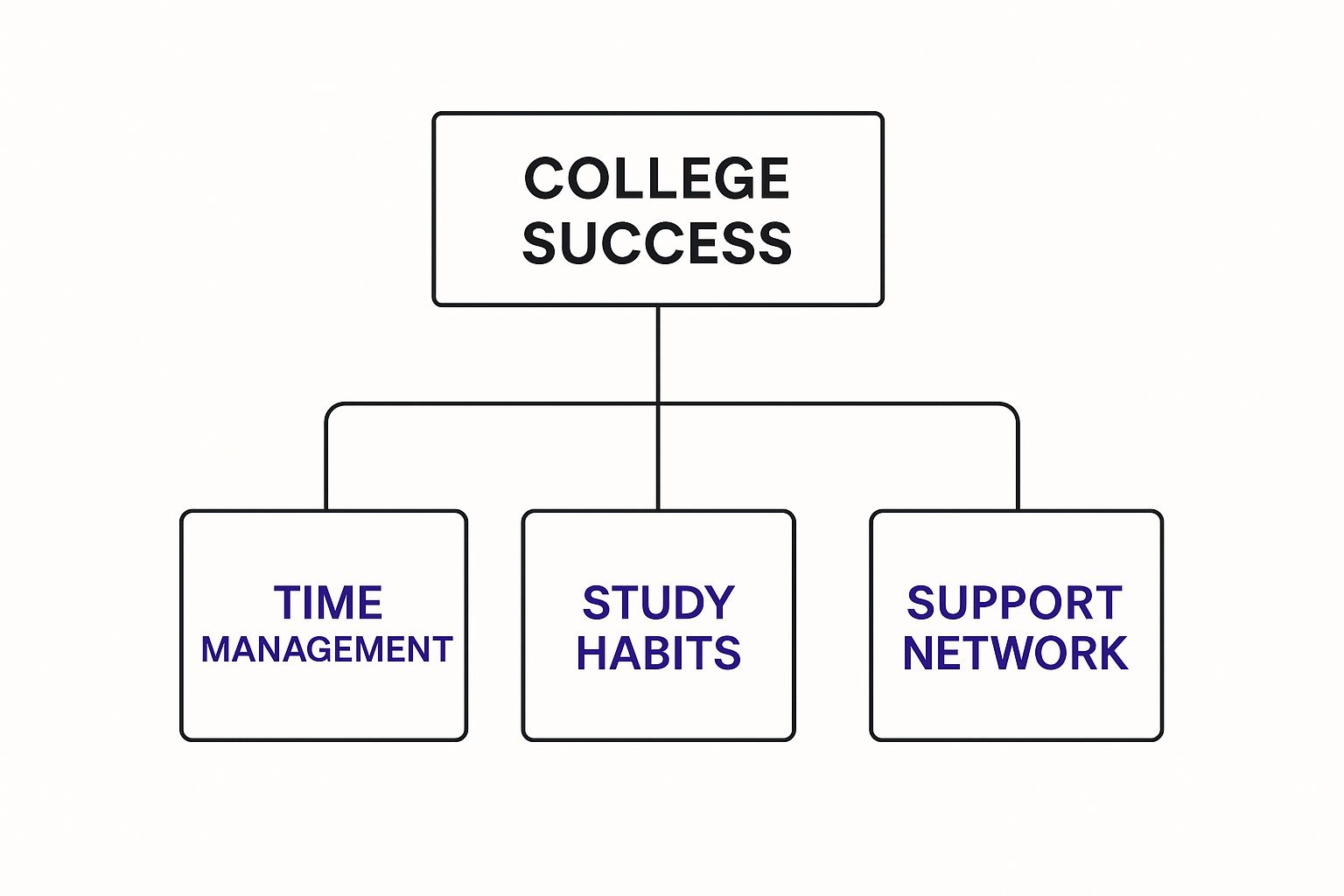
As you can see, fundamental skills like time management, effective study habits, and a strong support network aren't just "nice-to-haves." They are the essential tools that allow students to thrive across all four pillars of success. Mastering these areas is what truly separates students who just survive college from those who flourish in it.
Laying Your Personal Foundation for Success

True student success in college goes far beyond just raw academic talent. It's really about building a solid personal foundation from two critical sources: your own internal drive and the external support you have around you.
Think of it like building a house. Your internal qualities—like your mindset, habits, and self-belief—are the steel frame that gives it structure. The external support system—your network of friends, mentors, and advisors—is the concrete and siding, providing stability and protecting you from the elements.
You can't have one without the other. A student with incredible self-discipline who feels isolated has no one to turn to for advice when things get tough. On the flip side, someone with a fantastic support system but zero time management skills will constantly struggle to keep up. Success happens when these two sides work together, creating a balanced and resilient college experience.
Cultivating Your Internal Drivers
The most important internal drivers are the personal skills and mindsets you bring to your studies every day. These are the tools in your toolbox that help you tackle challenges, manage a heavy workload, and keep pushing forward when the coursework gets demanding. They are the engine of your academic journey.
One of the most powerful of these is self-efficacy, which is just a fancy way of saying you believe in your own ability to get things done. It's that quiet confidence that tells you, "I can figure this out." Students with high self-efficacy don't give up as easily because they see tough assignments as hurdles to clear, not permanent walls.
Another game-changer is time management. College pulls you in a million different directions at once. Between classes, studying, clubs, a social life, and maybe even a job, it's incredibly easy to fall behind without a solid plan.
- Effective Time Management Habits:
- Use a Planner: Whether it's an app or a paper notebook, a planner lets you see all your deadlines and block out dedicated time for studying. It’s the best way to avoid all-nighters.
- Break Down Big Projects: A 20-page paper sounds impossible. But "find five sources," "write an outline," and "draft the first two pages" are totally doable. Breaking it down makes it manageable.
- Set Realistic Goals: Don't schedule an eight-hour marathon study session; you'll burn out. Shorter, focused bursts of work with breaks in between are far more productive.
The internal foundation is all about personal accountability. It’s the promise you make to yourself to show up, stay organized, and trust that you have what it takes to handle the ups and downs of college life.
The Power of an External Support System
While your internal drive is essential, nobody succeeds entirely on their own. A strong external support system is both a safety net and a launchpad, offering emotional encouragement and practical advice when you need it most. This network is a cornerstone of student success.
Professors and academic advisors are a huge part of this. Popping into office hours can do more than just clear up a confusing topic from a lecture. Those conversations often lead to incredible mentorships, strong letters of recommendation, and career advice that can shape your entire future.
Just as important is finding your tribe of supportive friends and classmates. Connecting with people who share your academic goals creates a powerful sense of community. These are the friends you form study groups with, who cheer you up after a brutal exam, and who celebrate your wins alongside you. Research shows again and again that students who feel like they belong are far more likely to make it to graduation.
Many colleges understand how crucial this is and are creating specific student success programs designed to help you build these vital connections from day one.
How Colleges Use Data to Support Students

Today’s colleges aren't just waiting for students to run into trouble. They're getting ahead of the curve by using data to anticipate challenges, building a powerful safety net to ensure student success in college.
Think of it as a smart GPS for a student's entire academic journey. This system doesn't just point to graduation day; it actively monitors for potential traffic jams, detours, or roadblocks. By picking up on certain signals, advisors can spot a student who might be veering off course long before they get hopelessly lost.
This shift allows institutions to offer personalized help exactly when it's needed most, turning potential setbacks into opportunities for growth. It’s a move away from the old one-size-fits-all model toward a support system that truly understands the individual.
Identifying the Key Engagement Signals
So, what kind of information are we talking about? It's not about spying. It’s about understanding the subtle patterns of engagement that paint a picture of a student’s experience. Advisors look at a mix of digital and real-world footprints that show how connected a student is to their education.
These signals act as an early-warning system. A dip in one area might be nothing, but a sudden drop across several? That’s when a supportive intervention can make a world of difference.
Here are some of the most common signals institutions track:
- Learning Management System (LMS) Activity: This is a big one. How often is a student logging into platforms like Canvas or Blackboard? A sudden drop-off in logins can be a major red flag.
- Campus Resource Usage: Is the student hitting the library, visiting the writing center, or showing up for tutoring? If not, they might not know these resources exist or could feel hesitant to ask for help.
- Class Attendance: A classic indicator. While not always tracked digitally, noticeable dips in attendance, especially for core classes, are a clear sign of disengagement.
- Social and Extracurricular Involvement: Looking at participation in student clubs, campus events, or athletics can reveal how integrated a student feels within the wider college community.
Putting these pieces together gives staff a much clearer picture of who might need a little extra encouragement to stay on track.
Turning Data Into Timely Interventions
Of course, collecting data is just the first step. The real impact comes from using that information to take meaningful action. When the system flags a student who might be at risk, it doesn't set off a blaring alarm. Instead, it triggers a gentle, personalized nudge. The whole point is to be supportive, not punitive. It’s about opening a door for a conversation and offering a hand before a student starts to feel completely overwhelmed.
The goal is to make support feel like a natural part of the college experience. A well-timed email from an advisor asking, "How are things going?" can make all the difference for a student who is struggling silently.
This data-informed approach opens the door to a range of timely, tailored interventions. Depending on the situation, these could look like:
- A personalized email from an academic advisor just to check in and offer a time to chat.
- An automated text message with a direct link to sign up for tutoring for a specific class.
- A friendly invitation to a workshop on time management or better study skills.
- A quiet heads-up to a professor that a student in their class might be falling behind.
These actions transform abstract numbers into a real, human-centric support network. They are the backbone of effective student success initiatives that cultivate a campus-wide culture of care. By reaching out proactively, colleges show students they're seen and valued, fostering the resilience they need to succeed.
Why Student Success Matters on a Global Scale
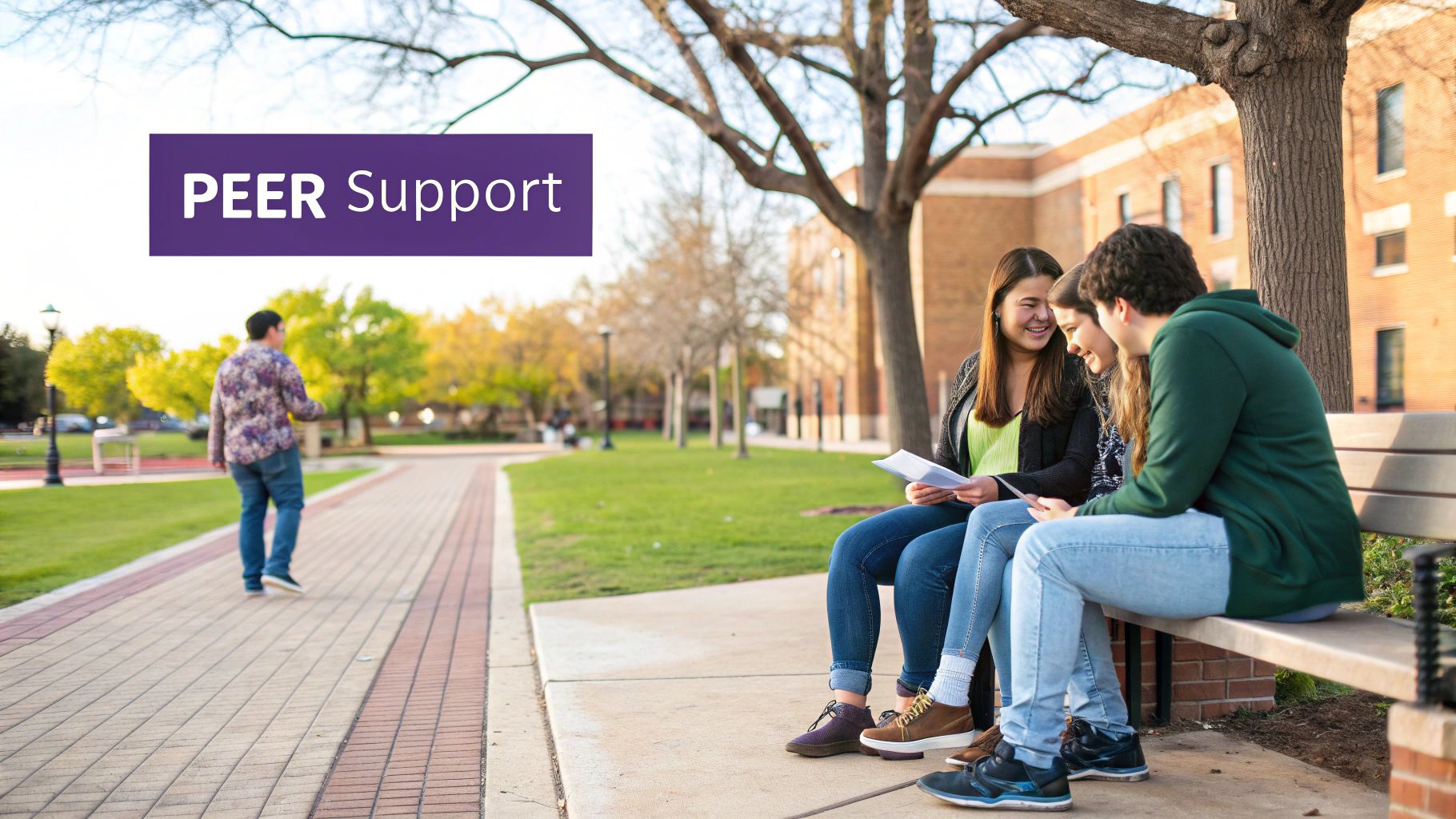
Let's be honest, the idea of student success in college has grown far beyond campus walls. In a world this connected, it has become a powerful currency for a university's reputation on the global stage. An institution’s ability to not only attract top talent from around the world but also see them through to graduation directly shapes its international standing.
Think of global university rankings as a kind of worldwide competition. In this arena, metrics like graduation rates and how well graduates do in the job market aren't just internal numbers to track. They’re public statements about an institution's quality. A university that consistently posts strong numbers in these areas is effectively telling the world, "We are a world-class institution that delivers tangible results."
This creates a powerful, positive cycle. High rankings draw in more high-caliber international students, and their success, in turn, boosts the university's prestige even further. It’s a flywheel of excellence, all powered by a genuine commitment to helping every student thrive.
How Universities Are Adapting to New Challenges
https://www.youtube.com/embed/f5_o1cBXlpA
The ground is shifting beneath the feet of higher education. For decades, universities could rely on a predictable flow of recent high school graduates, but that old playbook just doesn't work anymore. Today, institutions are wrestling with a tangled web of challenges, from a student body that looks completely different than it did a generation ago to a growing public skepticism about the real-world value of a degree.
In this new reality, a “build it and they will come” mentality is a direct path to empty lecture halls. The institutions that are truly getting it right aren't just surviving—they're thriving. How? By becoming more flexible, responsive, and laser-focused on what modern students actually need to succeed. They’re rethinking everything, from the first recruitment email to the final handshake at graduation.
This isn’t about making small adjustments around the edges. It’s a complete overhaul of what it means to be a university. This means building flexible programs for working adults, creating career services that lead to actual jobs, and putting proactive support in place for a diverse student population that includes more first-generation learners than ever before.
Responding to Demographic and Economic Realities
The educational landscape is being reshaped by some powerful forces. In the United States, for instance, a combination of lower birth rates and shifting priorities means the pool of "traditional" college-age applicants is shrinking. Many are choosing to stay closer to home, attend regional schools, or skip college entirely for other opportunities. This has led to enrollment drops in some areas while schools in the South and Midwest have seen growth. You can explore how US institutions are adapting in this detailed report. At the same time, colleges everywhere are fighting a "deficit narrative"—a persistent question about whether a degree is worth the investment compared to other career paths. To counter this, smart universities are taking a much broader view. They're blending their domestic and international recruitment, beefing up student support, and putting a heavy focus on results you can actually measure.
In many key markets, institutions are now judged heavily on their graduation rates and graduate employment outcomes. These metrics now carry significant weight in university rankings and are central to an institution's public reputation.
This intense focus on outcomes is forcing a more strategic approach to the entire student journey. Getting students in the door is just the first step; the real work is making sure they walk out with a diploma and a future.
Embracing Agility and Student-Centric Models
The most successful universities are becoming masters of agility. They get that today’s students aren't a monolith. They might be single parents juggling classes and childcare, professionals looking to gain new skills for a promotion, or the first in their family to ever set foot on a college campus. The one-size-fits-all model is officially broken. This has sparked a wave of creative solutions designed to meet students exactly where they are:
- Flexible Learning Options: This looks like more online and hybrid courses, classes offered on evenings and weekends, and competency-based programs that give students credit for what they already know from work and life experience.
- Stronger Career Integration: Forward-thinking universities are weaving career prep right into the curriculum. They're building solid partnerships with local employers and offering hands-on internship and co-op programs that give students a real advantage.
- Targeted Support Systems: Instead of waiting for a student to ask for help, institutions are reaching out first. They're connecting at-risk students with tailored resources, mentorship programs, and one-on-one financial aid counseling.
By being more responsive and putting the student at the center of every decision, these institutions aren't just weathering the storm. They're building a stronger, more valuable model of higher education—one that is essential for guaranteeing students success in college and securing their own future.
Here is the rewritten section, crafted to sound completely human-written and natural.
Your Action Plan for College Success
We’ve covered a lot of ground, breaking down what student success really looks like today—from the personal drive students need to the data-driven support institutions must provide. But theory is one thing; action is another. So, let's pull all these threads together into a concrete plan you can start using right now. Think of this as a partnership. For students, it's about owning your journey. For colleges, it's about building an environment where that ownership leads to real, tangible success for every single student.
A Student's Checklist for Thriving in College
Your time in college is a unique opportunity, and what you get out of it depends entirely on what you put into it. By building a few key habits and tapping into the resources around you, you’re not just setting yourself up for a better academic experience, but for a stronger career launch. This isn't about perfection; it’s about being proactive. Here’s where to start:
- Build Your Personal Board of Directors: Don't try to navigate college alone. Make it a goal to connect with at least one professor in your major, find an academic advisor you click with, and seek out a mentor—maybe an upperclassman or a professional in your field. These people become your personal brain trust.
- Master Your Calendar: Your time is your most valuable asset. Seriously. Use a planner (digital or paper, whatever works for you) to block out everything—not just classes, but specific times for studying, working on projects, and, just as importantly, unwinding. This simple habit is your best defense against the last-minute cramming that leads to burnout.
- Use Campus Resources Before You Need Them: Pop into the writing center, career services, and the wellness center during your first semester, even if you don't have an urgent need. Just knowing where they are and what they offer makes it a thousand times easier to ask for help when a real challenge pops up.
- Step Outside Your Academic Comfort Zone: Join one club or organization that has nothing to do with your major. This is one of the best ways to build a genuine sense of belonging, which countless studies have shown is directly linked to sticking with it and graduating.
Taking ownership of your college journey means being the architect of your own success. The resources are there, but you have to be the one to pick up the tools and build. It’s a powerful shift from being a passenger to being the pilot of your education.
An Institutional Blueprint for Fostering Success
For university leaders, administrators, and educators, helping students succeed is more than a goal—it's the whole point. This means designing a system where support isn't just an afterthought but is woven into the very fabric of the student experience. It’s a move away from simply reacting to problems and toward building a proactive, supportive ecosystem. A truly effective institutional strategy rests on three pillars:
- Make Decisions with Data: It’s time to look beyond just enrollment and graduation rates. Start actively tracking engagement signals—things like how often students log into the LMS or use campus resources. This data can flag students who are quietly disengaging, allowing you to reach out with personalized support before a small hurdle becomes a major crisis.
- Provide Holistic, Accessible Support: It’s not enough for support services to exist; they need to be visible, promoted, and incredibly easy for a busy student to access. This looks like integrating career prep directly into coursework, offering flexible mental health services, and creating structured mentorship programs that meaningfully connect students with faculty and their peers.
- Focus Relentlessly on Real-World Outcomes: The ultimate measure of students success in college is their ability to build a fulfilling life and career after they leave campus. This demands strong partnerships with employers, a deep well of internship opportunities, and a curriculum that teaches not just theory but the practical, in-demand skills that get people hired.
At the end of the day, creating an environment where students can truly thrive is the single most effective strategy for boosting retention, raising graduation rates, and cementing an institution's reputation for years to come. It’s a shared responsibility that pays dividends for everyone.
Frequently Asked Questions
It's only natural that the path to student success raises a lot of questions—for students, their families, and the educators guiding them. Let's walk through some of the most common ones and get you some clear, practical answers you can actually use. Think of this as a quick, no-nonsense guide to putting these ideas into practice and building a campus environment where every student has the chance to thrive.
How Early Should Students Start Focusing on Success Habits?
Honestly, the sooner the better. But it's also never too late to start.
Ideally, students should start building foundational habits like time management and reaching out to professors during their very first semester. Getting these routines in place early helps prevent that classic, overwhelming feeling of being behind schedule later on.
That said, a student can turn things around at any point in their journey. A sophomore or even a junior who suddenly commits to using a planner, showing up to office hours, and asking for help will notice a real difference almost immediately. The most important thing is simply to begin, wherever you are.
What Is the Single Most Overlooked Factor in Student Success?
If I had to pick just one, it’s the sense of belonging. It's a powerful feeling—the sense that you're seen, valued, and truly part of the campus community. It’s often overlooked, but students who feel like they belong are far more likely to stick it out when things get tough, stay engaged in their classes, and actually use the support services available to them.
Belonging is the glue that holds the entire college experience together. Without it, even the brightest, most academically prepared student can feel isolated and disconnected, which are huge red flags for dropping out.
Institutions can actively cultivate this by creating more inclusive spaces, championing peer mentorship programs, and making sure faculty-student interactions are happening right from day one. It’s a critical piece of the students success in college puzzle.
For Institutions, Where Is the Best Place to Start?
For any college looking to make a real dent in its student outcomes, the best place to begin is with data and communication. It's tempting to jump straight to launching big, flashy new programs, but first, you need to understand where your students are actually struggling. Dig into the engagement data you already have.
Are you seeing a big drop-off after the first year? Are specific student groups hitting more roadblocks? Pinpointing these trends shows you exactly where to focus your energy. From there, a proactive and personalized communication strategy can work wonders. Often, simple, supportive nudges are all it takes to point students toward existing resources and show them that the institution is invested in their journey.
This data-first approach makes sure your resources are aimed where they’ll have the biggest impact on retention and completion, ultimately creating a more supportive campus for everyone.
Ready to reshape your institution's approach to retention and enrollment? Motimatic applies proven behavioral science to send personalized, motivational messages that support students at every step. See how our scalable solutions can help you drive better student success outcomes. Learn more about Motimatic's approach.
See it on your own listOne list, one goal, and a randomized holdout to show the lift. Start a pilot