College re-enrollment campaigns aren't just about marketing. They're targeted, data-backed efforts to bring students who have stepped away—often called 'stop-outs'—back to finish what they started. This goes way beyond a simple email blast. It’s about using empathetic outreach and smoothing out the process to tackle the real-world barriers that forced them to leave. For a growing number of institutions, these campaigns are becoming an absolute lifeline for stabilizing enrollment and, frankly, the bottom line.
Why Re-Enrollment Is Your New Enrollment Lifeline
For years, the chatter in higher ed was all about one thing: recruiting new high school graduates. That conversation has completely changed. We're now facing a new reality shaped by demographic shifts and evolving student needs. Suddenly, proactive college re-enrollment campaigns have shifted from a "nice-to-have" niche strategy to a must-have part of any healthy enrollment plan.
This isn't just about filling seats; it's about fulfilling your mission. Every student who stops out represents untapped potential and, often, a heavy financial and personal burden. These campaigns are an acknowledgment that the path through college isn't always a straight line. It shows that your institution is ready to build a bridge back for those who hit a roadblock.
The Stark Reality of Student Stop-Outs
The numbers here don't lie, and they paint a picture of both a challenge and a huge opportunity. The drop in college attendance isn't some far-off problem; it's here now.
Consider this: overall undergraduate enrollment in the U.S. plummeted by a staggering 15% between 2010 and 2021. That’s about 2.6 million fewer students. What's even more telling is that only 9% of those who left re-enrolled the next year, which proves just how tough it is to come back without a helping hand.
This trend creates a ripple effect with serious consequences:
- For Students: They're often left with "stranded credits" and student loan debt but no degree to show for it, limiting their earning potential.
- For Institutions: It’s a direct hit to tuition revenue and completion rates, which impacts both the budget and your reputation.
- For Communities: A less-educated workforce can slow down local economic growth. College graduates simply have more spending power and contribute more to the tax base.
A smart re-enrollment campaign isn't just damage control—it’s a powerful growth strategy. You're reaching out to a warm audience that's already familiar with your programs and culture. They've already chosen you once.
Moving Beyond the Enrollment Cliff
It's easy to get spooked by headlines about the "enrollment cliff," but panic often overshadows the real, actionable solutions right in front of us. While recruiting new students will always be part of the equation, the most efficient and impactful strategy is often re-engaging the students you've already invested in. We dive deeper into this shift in our article on why quality is the new KPI.
A modern re-enrollment campaign is a sophisticated, data-informed initiative. It’s all about figuring out why a student left and tackling that specific barrier head-on. Was it a $500 financial hold? A struggle in a single prerequisite course? A family emergency?
Generic outreach just won't cut it. To succeed, you need empathy, personalization, and a genuinely simplified path back.
To give you a clearer picture, this table breaks down the core pillars of a modern, effective re-enrollment campaign. Think of it as your strategic cheat sheet.
Pillars of a Modern Re-Enrollment Campaign
| Component | Core Objective | Key Tactic |
|---|---|---|
| Data Analysis | Identify and understand student barriers. | Segment stop-outs by credits earned, GPA, and time away. |
| Empathetic Outreach | Rebuild trust and show you care. | Craft personalized messages that address specific challenges. |
| Barrier Removal | Make the return process frictionless. | Offer dedicated advising and simplified re-application forms. |
| Value Proposition | Remind them of the "why." | Highlight the ROI of their degree and career outcomes. |
By building your strategy on these four components, you move from simply asking students to come back to actively paving the way for their successful return.
Building Your Foundation with Smart Data Segmentation

Here’s a hard truth: the most successful college re-enrollment campaigns are won long before the first email is sent. The secret isn't just a clever tagline. It’s knowing exactly who you're talking to and why they stopped out in the first place.
Blasting a generic message to a giant list of every former student is a recipe for failure. It's loud, it's expensive, and it gets ignored. You have to be smarter than that.
A data-driven approach is your only real foundation. By digging into the information you already have, you can stop guessing and start understanding the different groups you want to bring back. This isn't just about pulling names from a database; it’s about becoming a data detective.
The clues are hiding in plain sight, scattered across the systems your institution uses every day. Your Student Information System (SIS), Learning Management System (LMS), and financial aid records are absolute goldmines. They tell the real story behind why each student’s journey was put on pause.
From Raw Data to Actionable Segments
Your goal is to turn all those raw data points into living, breathing student personas. Instead of one massive "stopped-out" bucket, you can build laser-focused segments that make personalized outreach not just possible, but powerful. A great way to frame this is by using an ideal customer profile template to really hone in on who you're trying to reach.
Start by pulling data from these different systems to create a complete picture for each former student. Look for the patterns. Group students based on what they have in common. This is where the magic happens.
Focus on these critical data points:
- Academic Standing: What was their GPA when they left? Were they on academic probation, or were they a high-performer?
- Credit Accumulation: How close were they to finishing? A student with 90 credits is in a completely different situation than one with only 15.
- Time Since Last Enrollment: Has it been one semester or five years? The urgency and context of your messaging will change dramatically.
- Financial Holds: Is there an outstanding balance? A $200 library fine is a very different barrier than $5,000 in unpaid tuition.
Think about it: a student who left with a 3.8 GPA and 100 credits likely hit a non-academic wall, like a family emergency or a job offer. On the other hand, a student with a 1.9 GPA and just 25 credits might need academic support and a major confidence boost. Your outreach must reflect that difference.
Creating High-Impact Student Segments
Once you have this data, you can build segments that drive your entire strategy. Forget the one-size-fits-all "We Want You Back" email. Now you can craft messages that speak directly to each group's real-world situation.
I recommend organizing your segments around the primary barrier to re-enrollment. This lets you position your institution not as a marketer, but as a problem-solver.
Common High-Impact Segments for Re-Enrollment
| Segment Name | Defining Characteristics | Primary Barrier |
|---|---|---|
| The Finish Liners | 90+ credits earned, good academic standing (GPA > 2.5). | Often personal or financial; they are incredibly close to seeing the ROI on their degree. |
| The Small-Balance Holds | Left with a small outstanding balance (e.g., under $1,000). | A minor financial hurdle is the only thing preventing registration. |
| The Academic Reset | Struggled academically (GPA < 2.0) before stopping out. | Lack of confidence and a need for a clear academic recovery path. |
| The Life Interrupted | Left in good standing with fewer than 60 credits. | Life events (work, family) most likely took priority over their education. |
This level of detail changes everything. For "The Small-Balance Holds," your message can focus on a microgrant or a new payment plan. For "The Finish Liners," you can highlight the immediate salary bump that comes with completing their degree. This targeted approach transforms your campaign from a generic marketing blast into a supportive, solution-oriented conversation. It’s how you get your messages opened, read, and—most importantly—acted upon.
Crafting Outreach That Rebuilds Connections

Once you’ve defined your student segments, it’s time to start the conversation. The most effective college re-enrollment campaigns I’ve seen are built on communication that feels less like marketing and more like a genuine offer to help. Let's move beyond the generic “We Want You Back” plea and start sending empathetic, value-driven messages that actually resonate.
This means looking at the barriers you found in your data and addressing them head-on. Whether a student left because of money, academics, or a personal challenge, your outreach has to present a clear, accessible solution. The goal here is to rebuild trust. You do that with a supportive, non-judgmental tone that reminds them of the real, tangible benefit of finishing their degree.
Moving From Generic to Empathetic Messaging
The secret to powerful outreach is empathy. Plain and simple. Your message needs to acknowledge the student's reality without making assumptions. Instead of leading with what your institution wants (their enrollment), start with what they need (a solution). A student who left with a high GPA faced completely different hurdles than someone on academic probation. Your messaging has to reflect that. To manage this effectively, many institutions use tools and automated sales outreach strategies that allow for personalization at scale, so every student feels seen.
- For High Achievers: Your message can acknowledge their past success. Frame re-enrollment as the final, achievable step toward realizing the potential they’ve already demonstrated.
- For Those Who Struggled: Lead with support. Immediately highlight academic forgiveness programs, tutoring resources, or a new advisor dedicated to helping them succeed this time around.
The best outreach answers the student’s unspoken question: "Do you get why I left, and can you actually help me?" A message that hits this mark can reignite a student’s motivation and their belief that they can do this.
Real-World Messaging Examples
Let’s get practical. The key is to match your message directly to the student segments you created earlier. Scenario 1: The "Finish Liner"
- Segment: Left with a 3.5 GPA and only 15 credits remaining due to a family emergency.
- Ineffective Message: "Hi Alex, enroll for the fall semester today!"
- Effective Message: "Hi Alex, we know you were so close to graduating with honors. If life's circumstances have shifted, we have a streamlined re-entry process and a dedicated advisor ready to map out your final semester. Let's get you across that finish line."
Scenario 2: The "Small-Balance Hold"
- Segment: Left in good academic standing but has a $750 hold on their account.
- Ineffective Message: "You have an outstanding balance. Please pay to register."
- Effective Message: "Hi Jordan, we’re reaching out because you were making such great progress toward your degree. We've launched a new 'Welcome Back Grant' to help students like you clear small balances. Let's talk about how we can remove this barrier."
See the difference? This approach shifts the dynamic from a transactional demand to a supportive partnership. If you want to go deeper into what motivates students to take that next step, exploring the science behind student outcomes offers some fantastic insights for your messaging strategy.
Structuring Your Outreach for Impact
It's not just the words you use—it's how you structure the communication. Always lead with the solution and make the call-to-action simple and direct. Your outreach should always include these four parts:
- A nod to their situation: A brief, empathetic acknowledgment of their segment (e.g., "We know you were close to finishing...").
- A clear solution: The specific program or resource that addresses their main barrier (e.g., a new grant, an academic recovery plan).
- A reminder of the value: A concise benefit of returning (e.g., "to finish your degree and unlock new career opportunities").
- A low-effort next step: A direct link to schedule a call with an advisor or a simplified re-application form.
This thoughtful, structured communication is what separates a moderately successful campaign from one that truly transforms your re-enrollment numbers.
Designing Your Multi-Channel Communication Cadence
Let’s be honest: a single email or a random phone call isn't going to bring a former student back. Real success in college re-enrollment campaigns comes from a thoughtful, persistent, and respectful communication cadence that unfolds across multiple channels.
The whole point is to stay on a student's radar without becoming background noise—or worse, an annoyance. This means orchestrating a smart mix of personalized emails, timely SMS reminders, targeted social media ads, and, when it counts most, personal phone calls from advisors who genuinely want to help.
A great communication plan guides students along the path to re-enrollment, moving them from initial awareness all the way to hitting that "register" button. It's not about blasting the same generic message everywhere. It's about using each channel for what it does best and adapting your outreach based on how a student engages.
This infographic really breaks down the core workflow for measuring and refining your efforts.
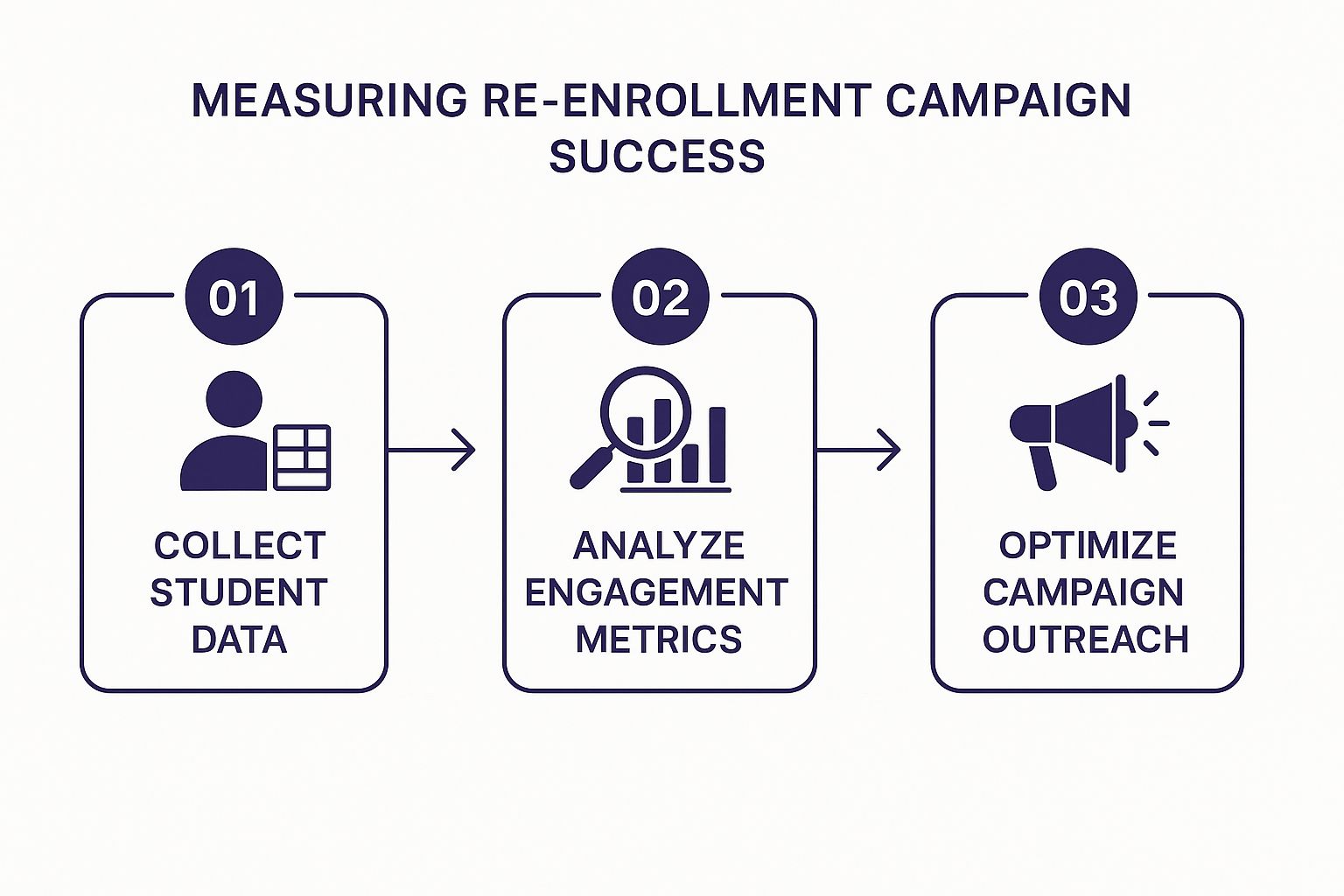
As you can see, it’s a cycle. Collecting student data informs your engagement analysis, which in turn helps you continuously optimize your outreach for much better results.
Building the Communication Workflow
A solid communication cadence is planned out, automated where it makes sense, and always personalized. Before you do anything else, you need to map out an effective communications strategy plan. This document will serve as the blueprint for your entire campaign. Think of it as a journey you're designing for the student, with specific touchpoints designed to keep them moving forward.
- Email: This is your workhorse. Use it for the detailed, value-driven stuff. Share success stories from other returning students, clearly explain new financial aid options, and provide direct links to helpful resources.
- SMS/Text: Perfect for short, urgent nudges. Think application deadlines, registration windows, or a quick heads-up to check their email for an important update you just sent.
- Social Media Ads: Go where your students are. Use retargeting to show ads specifically to former students who have visited your re-enrollment landing page but haven't taken the next step.
- Personal Phone Calls: This is your high-impact, human-touch channel. A friendly, knowledgeable advisor can cut through confusion, solve complex problems, and provide the personal connection that often makes all the difference.
The key is synergy. An email might introduce a new "Welcome Back Grant," a follow-up text reminds them of the application deadline, and a personal call from an advisor helps them navigate the paperwork. Each channel should reinforce the others, creating a supportive ecosystem.
A Sample Cadence for a "Small-Balance Hold" Student
Let's walk through a real-world scenario. Imagine "Maria," a student who left in good academic standing but has a $650 financial hold on her account.
Here’s how a multi-week, multi-channel approach could work:
Week 1: The Initial Outreach
- Day 1 (Email): The first touchpoint is an empathetic email with a subject like: "Maria, Let's Clear Your Path Back to [Your University Name]." It acknowledges her past progress and introduces a new microgrant specifically for students with small balances. Most importantly, it includes a link to a simplified grant application.
- Day 3 (Social Media Ad): A retargeting ad pops up in her social media feeds. It's not generic; it features a testimonial from a student who successfully re-enrolled and highlights the "Welcome Back Grant."
Week 2: Gentle Nudging and Value Reinforcement
- Day 8 (Email): A second email arrives with the subject: "Finishing Your Degree at [Your University Name] is Closer Than You Think." This one focuses on the return on investment of her specific degree program, maybe linking to career outcomes data. It also includes a gentle reminder about the grant opportunity.
Week 3: Creating Urgency and a Human Connection
- Day 15 (SMS): A quick, helpful text: "Hi Maria, a reminder that the deadline for the Welcome Back Grant at [Your University Name] is next week. Let us know if you have questions!"
- Day 17 (Personal Call): A dedicated re-enrollment advisor makes a call. "Hi Maria, I'm calling from [Your University Name]. I see you were looking into our Welcome Back Grant and just wanted to see if I could answer any questions to help you finish the application."
This approach feels supportive, not pushy. It gives Maria multiple opportunities to engage on her own terms, using the channel she prefers. Each step is designed to remove a barrier and build her confidence.
Smooth the Path Back to Campus
Getting a student to say, "I want to come back," is a huge win. But that initial enthusiasm can die on the vine if they immediately run into a tangled mess of administrative red tape.
I’ve seen it happen time and again: a fantastic re-enrollment campaign sends a warm, welcoming email, only for the student to find the actual process of returning is confusing and full of friction. Your most important job here is to dismantle the very barriers that likely pushed them to stop out in the first place.
Think about it from their perspective. A twelve-page re-application? A financial hold that requires trips to three different offices? These administrative nightmares are more than just annoying—they send a clear message that you aren’t really ready for them. Simplifying this journey isn’t just good customer service; it's the core of a successful re-enrollment strategy.
Ditch the Standard Application—It Doesn't Fit
Let's be blunt: asking a returning student to fill out the same application as a high school senior is a deal-breaker. They aren't new prospects; they're members of your community trying to come home. Forcing them through a long, irrelevant form is a surefire way to make them feel like you don't know them at all.
What you need is a dedicated, streamlined re-application portal. It should be smart enough to pre-populate the information you already have—name, student ID, previous major. The only questions left should be the absolute essentials for getting them back in the classroom.
A truly frictionless process looks like this:
- A short online form: Get it down to something that can be finished in under 15 minutes.
- Plain English: Ditch the jargon. Say "re-enrollment," not "matriculation."
- A human connection: Put the name, email, and direct phone number of a re-enrollment advisor right on the form itself.
This simple shift shows you respect their time and are genuinely invested in their return.
Give Them a "Re-Enrollment Concierge"
Imagine having one person—a single, dedicated advisor—whose entire job is to guide a returning student through every single step. This "re-enrollment concierge" model is an absolute game-changer.
Instead of getting bounced between the registrar, the bursar's office, and financial aid, the student has one trusted point of contact. This person becomes their advocate, someone who can coordinate everything behind the scenes.
This concierge can help them:
- Make sense of financial aid paperwork.
- Figure out how to resolve account holds.
- Connect with an academic advisor to build a new schedule.
- Understand policies like academic forgiveness.
Colleges that put this model in place see re-enrollment conversions skyrocket. Why? Because it replaces the anxiety and confusion of the process with confidence and clarity.
The City Colleges of Chicago’s Chancellor’s Retention Grant found something powerful. By creating a clear path for financial help and debt relief, they didn't just boost re-enrollment. They actually generated more tuition revenue than they could have by chasing down old debts.
Tackle the Big Two: Money and Grades
For most students who stopped out, the biggest roadblocks are money and academic standing. You can't sidestep these issues. Your campaign has to meet them head-on with clear, accessible solutions.
Financial Holds: Don't just send a bill. Lead with a solution. I've seen incredible success with programs that offer microgrants or debt forgiveness specifically for returning students. Initiatives like Ohio’s "Comeback" program or Georgia State’s "Panther Retention Grants" offer small grants that wipe out outstanding balances, instantly removing the number one barrier for hundreds of students.
Academic Probation: A student on academic probation needs a plan, not a penalty. Your first point of contact should connect them directly with an academic advisor. This advisor's job is to map out a clear, achievable path back to good standing. Maybe that means a lighter course load for the first semester, required tutoring, or even exploring a new major. The message has to be one of unwavering support and belief in their ability to succeed.
When you proactively clear these administrative and financial hurdles, your re-enrollment campaign becomes more than just marketing. It becomes a genuine system of support, ensuring the interest you generate turns into actual students, back in their seats and ready to finish what they started.
Measuring What Matters to Optimize Your Campaign
Launching a re-enrollment campaign without a measurement plan is like flying blind. You’re putting in the effort, spending the money, but have no real way of knowing if it’s actually bringing students back through the door. The initial outreach is just the starting line; the real work begins when you start tracking, measuring, and refining your approach. To build a campaign that actually works, you have to define what success looks like from the very beginning. This means getting laser-focused on key performance indicators (KPIs) that signal genuine progress. We need to move past the simple vanity metrics. Sure, knowing your email open rate is interesting, but it doesn't pay the bills. The numbers that matter are the ones directly tied to a student crossing the re-enrollment finish line.
Moving Beyond Vanity Metrics
It's incredibly easy to get distracted by metrics that look great on a report but mean nothing for your bottom line. An email campaign with a 40% open rate feels like a huge win, right? But if no one clicks the link to the re-application form, what did you really accomplish? It’s time to shift your focus to KPIs that reflect real action. These are the metrics that paint a much clearer picture of your campaign’s health and true impact:
- Application Submission Rate: What percentage of students who started the re-application actually finished it?
- Financial Consultation Bookings: How many former students took the step to schedule a meeting about financial aid or resolving a hold?
- Successful Re-Registrations: This is the ultimate KPI. How many of the students you targeted are officially signed up for classes next semester?
- Segment-Specific Conversion: Are your "Finish Liners" responding better than your "Academic Reset" group? Knowing this tells you where to double down.
When you track these KPIs, you stop wondering who is listening and start understanding who is acting. This is the core of a smart, data-driven re-enrollment strategy.
Calculating Your True Return on Investment
Proving your campaign's value—and securing budget for the next one—comes down to calculating its return on investment (ROI). The math here is refreshingly simple: you compare the tuition revenue from the students you brought back against what you spent to get them.
Let’s run a quick scenario. Imagine you successfully re-enroll 25 students, and each one pays $5,000 in tuition for the semester. That’s $125,000 in new revenue. If your entire campaign cost $10,000 for ads, software, and staff time, the ROI is massive.
This simple calculation completely changes the conversation. You’re no longer just "spending money on outreach." You're "investing in a program that generates significant revenue for the institution."
The most powerful college re-enrollment campaigns are treated as dynamic, data-centric processes. Each outreach cycle provides new data, which should be used to refine and improve the next cycle. It’s a continuous loop of learning and optimization.
Using A/B Testing to Refine Your Message
Never assume you know which message will land best. A/B testing is a straightforward but incredibly powerful tool that lets your students’ actions guide your communication strategy. You can test anything—subject lines, calls-to-action, even the core offer itself—to see what resonates most with different student segments. For example, you could test two different email subject lines for your "Small-Balance Hold" segment:
- Version A (Direct): "Clear Your Account Hold and Re-Enroll for Fall"
- Version B (Benefit-focused): "A New Grant to Help You Finish Your Degree"
Track which version drives more clicks and, more importantly, more financial aid consultations. The winner becomes your new "control" message, and you can start testing a new variation against it. This iterative process is how you build a messaging playbook that gets more effective over time. Our guide on improving student retention offers more strategies that can be supercharged with this kind of testing.
The data from these campaigns can also shine a light on new opportunities. For instance, we know international student enrollment saw a strong recovery, with 82,000 first-time, full-time students in 2023. Four-year institutions were the main destination, attracting 71,000 of them. This data from the College Board's international enrollment trends signals a valuable audience that could be ripe for re-enrollment efforts.
By measuring what truly matters, you turn your campaign from a one-off project into a responsive, high-impact enrollment engine.
Answering Your Re-Enrollment Campaign Questions
Once you move from planning your college re-enrollment campaign to actually launching it, the real questions start to pop up. This is where strategy meets the pavement—and where you have to tackle the practical challenges of budgeting, avoiding common pitfalls, and addressing specific student situations. Getting the answers right here is often what separates a campaign that sputters out from one that brings students back through the door. I've pulled together some of the most frequent questions we hear from higher ed pros to give you clear, actionable answers for the road ahead.
What Is a Realistic Budget for a Small College's Campaign?
For smaller institutions, the budget question always feels like the biggest hurdle. From what I've seen, a realistic starting point for a focused re-enrollment campaign is somewhere in the $5,000 to $15,000 range per semester. This isn't a rigid rule, but it's a practical baseline. That amount is usually enough to cover the essentials. Think about the costs for your email or CRM platform, credits for a targeted SMS service, and a modest ad spend for highly specific social media ads.
Remember, the single biggest "cost" is often the staff time you invest in analyzing data and making those crucial personal outreach calls. The technology budget is just one piece of the puzzle.
To get the most bang for your buck, start by maxing out the tech you already own. Then, focus your spending only on the channels that give you a direct line to your target student segments. A hyper-targeted digital ad campaign that reaches a few hundred identified former students is always going to be more cost-effective than a generic one blasted to thousands. It's about precision, not just reach.
How Do We Re-Engage Students Who Left Due to Financial Hardship?
When a student leaves for financial reasons, your outreach has to lead with empathy and concrete solutions. A vague promise that "financial aid is available" isn't going to cut it—they've heard that before and it didn't work. You have to be more specific. Your communication should spotlight tangible offers they can act on immediately:
- New scholarship opportunities created just for returning students.
- Flexible payment plans to break down outstanding balances into manageable chunks.
- Debt forgiveness programs designed to clear small but stubborn financial holds.
Instead of sending them to a generic financial aid webpage, give them a direct link to a simplified "Welcome Back Grant" application. Even better, provide the name and direct contact info for a specific advisor who is trained and ready to walk them through their exact situation. Talking up the long-term ROI of finishing their degree can be a powerful motivator, but only after you’ve addressed their immediate financial roadblock. You have to prove you have a solution for their biggest barrier first. That's what rebuilds trust and earns you the right to have a bigger conversation.
What Are the Most Common Mistakes to Avoid?
In my experience, success often comes from sidestepping a few critical, yet surprisingly common, mistakes. Getting around these can dramatically boost the effectiveness of your college re-enrollment campaigns.
The first and biggest mistake is sending a generic, one-size-fits-all message. Every student who stopped out has a unique story. Lumping them all together just signals you haven't done your homework, and your message will land in the digital trash bin.
The second major pitfall is accidentally creating new administrative hurdles. If the re-application form is a nightmare or the financial aid process is still confusing, you’re just rebuilding the very walls that may have pushed them out. The path back has to be seamless.
Finally, avoid launching without a solid data foundation. Acting on assumptions about why students left—instead of hard evidence from your own institutional data—is a recipe for wasted time and disappointing results. Your campaign must be built on insight, not intuition.
Bringing students back requires a deep understanding of their journey and the right tools to guide them forward. Motimatic's platform uses behavioral science and data-driven insights to help institutions like yours re-engage stop-out students effectively. With Pathway Intelligence™ to identify risks and GuidePosts™ to motivate action, we help you remove barriers and rebuild connections at scale. Discover how you can turn stop-outs into graduates by visiting https://motimatic.com/.
See it on your own listOne list, one goal, and a randomized holdout to show the lift. Start a pilot