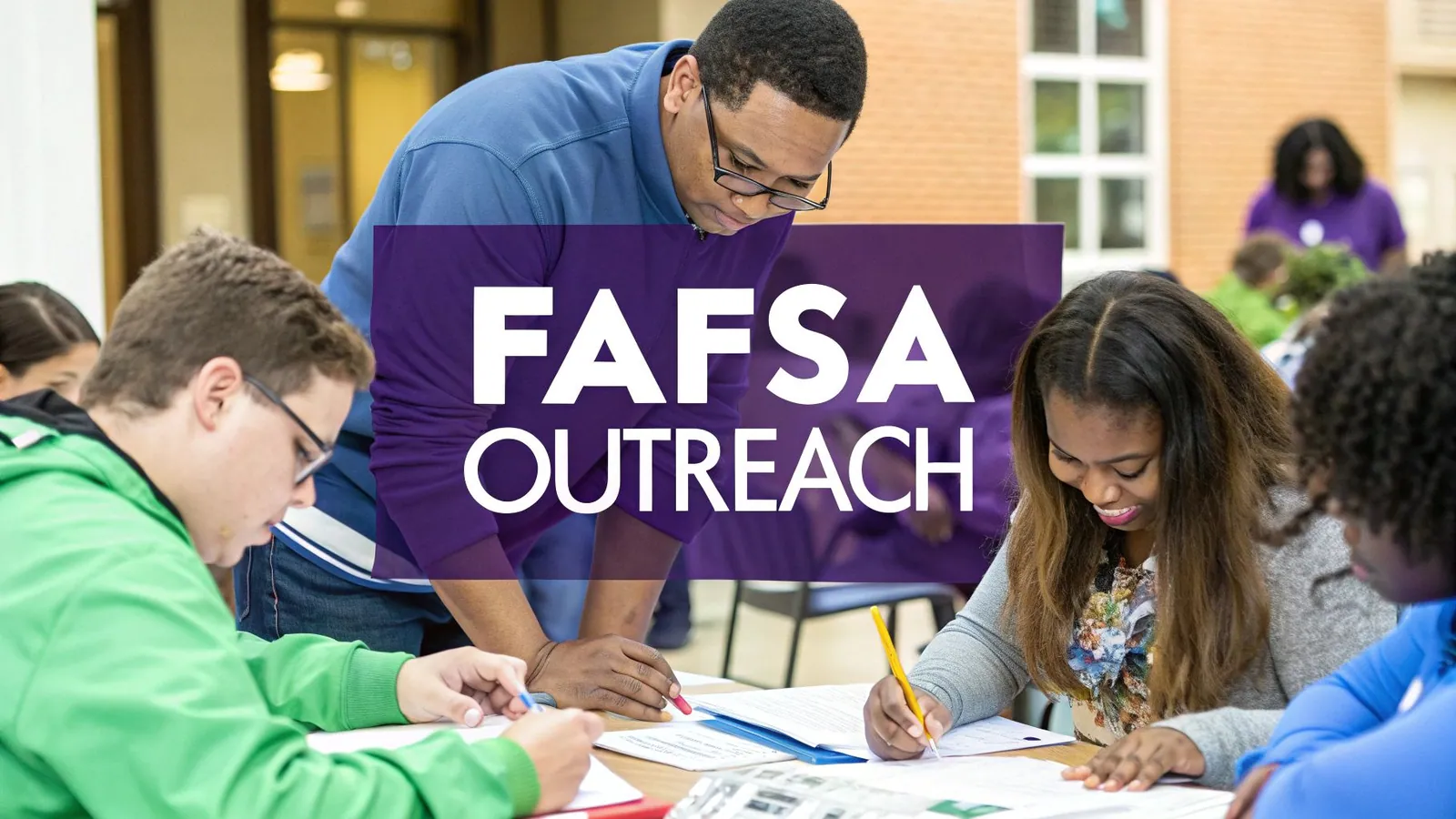
A successful FAFSA outreach campaign isn't just a series of emails. It’s a full-court press designed to get more students and their families across the financial aid finish line. These campaigns weave together smart communication, real hands-on support, and key partnerships to demystify the process, ultimately opening doors to college that might have otherwise stayed shut.
Building Your Campaign Foundation

Before you send a single text message or hang the first poster, you have to lay the groundwork. This is where you move from a vague idea—"let's help more kids with the FAFSA"—to a concrete, actionable plan. It all begins with setting goals you can actually measure. Instead of just saying you want to "increase FAFSA completion," get specific. A much stronger goal is something like, "boost our school district's FAFSA completion rate by 15% before the state's priority deadline." That kind of clarity gives your team a real target to aim for and a clear way to know if you've succeeded.
Define Your Audience and Objectives
Great outreach isn't one-size-fits-all. You have to know exactly who you're talking to. Are you focused on high school seniors? Adult learners trying to come back to school? Families who primarily speak Spanish at home? Each group has completely different challenges and needs a unique game plan.
First-generation students, for example, might need help understanding what financial aid even is. On the other hand, an adult learner probably knows what it is but can't find a spare hour between work and family to actually fill out the form. Digging into these details is what lets you create messaging and support that truly connects.
Once your audience is clear, define what a "win" looks like for them. Your objectives could include things like:
- Boosting FAFSA submissions among low-income students by 20%.
- Hosting five completion workshops that draw at least 50 attendees each.
- Cutting the number of incomplete or rejected FAFSA forms in half.
A strong foundation ensures your efforts aren't just busy work but are actively moving the needle on student success. It transforms good intentions into measurable impact by focusing resources where they matter most.
Assemble Your Team and Timeline
You can't do this alone. A powerful campaign needs the right people and a realistic schedule. Pull together a core team: school counselors, financial aid pros, administrative staff, and even well-trained student volunteers. Make sure everyone knows exactly what their role is to keep things moving smoothly.
At the same time, map out your timeline. The best way to do this is to work backward from the most important dates, like the state and federal FAFSA deadlines. Break your campaign into distinct phases: the initial awareness push, the hands-on support period, and the final "last call" reminders. This timeline is your roadmap from start to finish.
The impact of a coordinated effort is undeniable. For the 2023-24 cycle, a national strategy trained over 7,000 advisors and reached more than one million students. The result? A 24% increase in applications from students in low-income communities. You can explore more about how this large-scale support improved the FAFSA experience and see what’s possible.
Crafting a Multi-Channel Communication Plan
If you want to move the needle on FAFSA completion, you have to meet students and families where they are. A single-channel approach, like relying only on school announcements or a few emails, just doesn't cut it anymore. Real success comes from a coordinated, multi-channel plan that weaves together both digital and traditional outreach into one seamless conversation.
The idea is to create multiple, consistent touchpoints that all reinforce the same core message: "We're here to help you get this done." Think of it less like a series of one-off announcements and more like a single, supportive conversation that unfolds across different platforms.
And the results speak for themselves. A well-designed campaign can have a direct, measurable impact on the metrics that matter most.
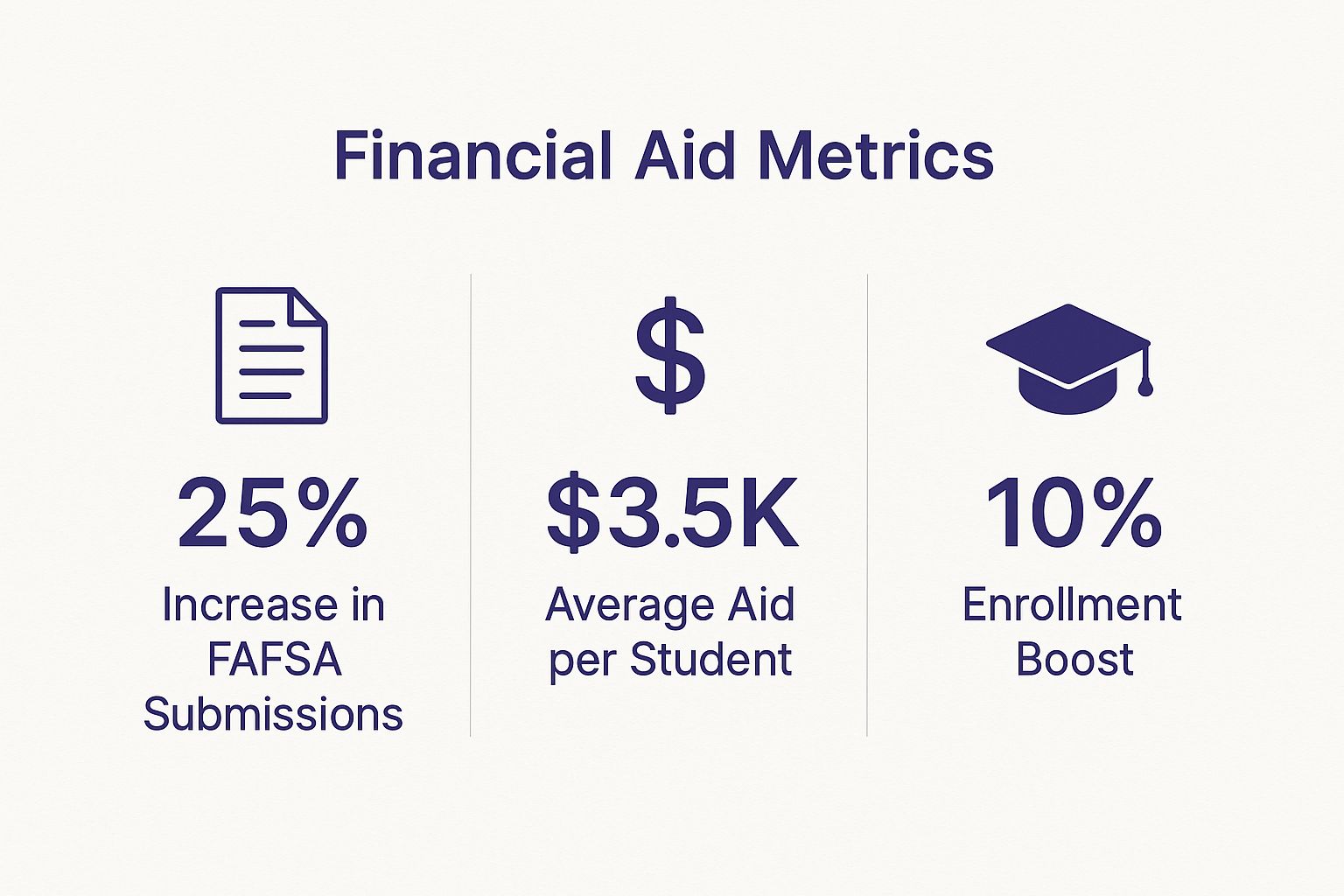
As you can see, a strategic outreach plan isn't just about sending reminders; it's a powerful driver of FAFSA submissions, financial aid awards, and ultimately, student enrollment.
Choosing Your Channels
So, where do you start? The right mix of channels depends entirely on your audience. A high school senior might be all over a TikTok video or an Instagram story, but an adult learner returning to college probably prefers a text message reminder sent after work hours or a clear, concise email. To figure out what works best for your community, it helps to compare the strengths and weaknesses of each option.
Comparing FAFSA Outreach Channels
| Outreach Channel | Best For | Key Advantages | Potential Challenges |
|---|---|---|---|
| Email Sequences | Delivering detailed info, checklists, and step-by-step guidance. | Easy to automate, great for walking students through complex steps like FSA ID creation. | Can get lost in cluttered inboxes; lower open rates than texts. |
| Text Messages | Urgent deadline alerts, event reminders, and quick nudges. | Extremely high open rates (98% on average); immediate and personal. | Limited character count; can feel intrusive if overused. |
| Social Media | Sharing quick tips, myth-busting, and student testimonials. | Highly visual and shareable; great for reaching younger audiences. | Requires consistent content creation; can be hard to cut through the noise. |
| In-Person Workshops | Providing hands-on, personalized support for complex family situations. | Builds trust and community; allows for direct Q&A and troubleshooting. | Resource-intensive; limited by physical space and staff availability. |
| Direct Mail | Reaching families who are less digitally connected. | Tangible and can stand out from digital clutter; feels official. | Higher cost per person; slower delivery and harder to track engagement. |
Ultimately, the most effective FAFSA outreach campaigns don't just blast information; they build relationships. By showing up consistently across the platforms your students actually use, you create a sense of persistent, reliable support that gives them the confidence to take the next step.
Tailoring Your Message
Once you’ve picked your channels, you need to adapt your message for each one. A detailed, multi-paragraph email won't work as a text. A formal flyer design will fall flat on Instagram. You have to speak the language of the platform.
We know this tailored approach works because we've seen it in action. For example, a Michigan study that sent personalized mailings to high-achieving, low-income students successfully boosted both application and enrollment rates.
Keeping students on track through a process as complicated as the FAFSA is all about understanding their mindset. For more on that, check out our guide on how to motivate students.
Running High-Impact FAFSA Events

While emails and texts are great for building awareness, nothing gets students and families over the finish line like hands-on support. High-impact FAFSA completion events—whether in a school library or a virtual meeting room—are where your outreach plans become real, tangible help. These events transform the confusing, abstract process of financial aid into a manageable, step-by-step task. Their success isn't just about booking a room and setting up computers. It’s about creating an environment that feels welcoming, low-stress, and genuinely helpful.
Setting the Stage for Success
The logistics of your event have a massive impact on its effectiveness. Whether you're hosting an in-person workshop or a virtual session, the foundation has to be solid. This means thinking through the entire attendee experience from the moment they arrive. For an in-person event, I've learned to focus on these key elements:
- Venue and Tech: You need a comfortable space with reliable Wi-Fi and enough power outlets for everyone. A school computer lab or public library is often a safe bet.
- Clear Signage: Don't make people guess. Use signs to guide families from the parking lot to the check-in table and all the way to the different help stations.
- Refreshments: Simple snacks and water can make a huge difference. It helps families feel welcome and keeps them focused on the task at hand.
For virtual events, the details change, but they're just as crucial:
- Platform Choice: Stick with something familiar and easy, like Zoom or Google Meet. Make sure features like breakout rooms are enabled ahead of time for one-on-one help.
- Pre-Event Tech Check: Send instructions on how to join the meeting and test audio/video before the event starts. A little prep goes a long way.
- Digital Resources: Have links to key documents, checklists, and help articles ready to drop into the chat.
The goal is to remove every possible barrier. If a family is struggling to find the room or log into the webinar, they’ve already hit a roadblock before even starting the FAFSA. Smooth logistics create a positive first impression.
Building Your Volunteer Support Squad
Let's be real: you can't provide one-on-one help without a well-trained team. Volunteers are the heart of successful FAFSA outreach campaigns, providing the personalized guidance that automated messages just can't deliver. I always recommend recruiting from a wide pool, including school counselors, college financial aid officers, and even community members with financial expertise.
Once you have your team, training is non-negotiable. Every volunteer must understand the most common FAFSA sticking points, like FSA ID creation, parent asset questions, and dependency status. Give them a "quick reference" sheet with common issues and their solutions.
The real value here is the targeted support, which is a principle that applies to other student success challenges, too. It’s a lot like the personalized outreach needed to re-engage students who have paused their education. You can learn more about that specific challenge by reading up on effective college re-enrollment campaigns and see how the same ideas apply.
Driving Engagement and Completion
Getting people to show up is half the battle. Keeping them engaged until they click "submit" is the other half. I've found it's best to structure your event to be both informative and interactive. Kick things off with a brief, encouraging overview, then quickly shift to dedicated work time with volunteers floating around to help. You can also add some creative incentives to boost attendance and morale:
- Small Giveaways: Offer gift cards for coffee or school supplies to a few randomly selected attendees who complete their FAFSA during the event.
- Gamification: Create a "FAFSA BINGO" card with squares for key steps like "Created FSA ID" or "Entered Parent Tax Info." It makes a tedious process feel more like a game.
- Food: Seriously, never underestimate the power of free pizza or donuts to draw a crowd.
By creating a supportive, hands-on environment, you empower families to move past their hesitation and complete this critical step toward higher education.
Forging Partnerships to Broaden Your Reach
Let’s be honest: no one organization can reach every student by itself. If you want to run a truly effective FAFSA outreach campaign, you have to think like a team. It's all about building strong community collaborations.
When you start pooling resources, sharing knowledge, and combining networks, you create a powerful safety net. This catches far more students than any single group could on its own. It transforms your campaign from just another institutional effort into a genuine community-wide movement. You’re not just sending out reminders; you're building a whole ecosystem of support that makes FAFSA completion a shared goal.
The real key is to find allies who already have the trust of the students and families you’re trying to connect with.
Who Are Your Best Allies?
More often than not, the best partners are already part of your students' daily lives. You just have to look beyond the walls of your own campus or organization. Think about who else is invested in helping students succeed. Here are some of the most impactful partners I've seen in action:
- High School Counselors & College Access Networks: These are the experts on the front lines. They work with students every single day and know exactly what barriers they're up against.
- Public Libraries: Libraries are trusted community centers. They can offer workshop space, computers, and internet access, which is a huge help for families facing a digital divide.
- Local Businesses & Chambers of Commerce: These partners can help you reach parents right where they work. Imagine a FAFSA reminder in a company newsletter or a flyer in the breakroom—it works.
- Faith-Based & Community Organizations: These groups have incredibly deep roots and established trust in their neighborhoods. They can help you connect with populations that are often the hardest to reach.
When you work with these allies, your message instantly gains credibility and reach. A nudge from a trusted pastor or a flyer at the local community center can be far more effective than another official-looking email.
Creating a Framework for Collaboration
Once you've identified a few potential partners, the next step is to build a relationship that benefits everyone. This takes more than a quick phone call—it's about setting clear expectations and aligning your goals from the start.
A great partnership is always a two-way street. You need to clearly articulate how working together helps both your organization and your partner achieve their own missions. That’s how you create a true win-win.
For instance, when you approach a public library, don't just ask for a favor. Frame it as a mutual benefit: "Let's co-host a FAFSA completion night. We'll bring the financial aid experts, and you can offer it to your patrons as a valuable community service." This sets clear roles and a shared objective. The end result of this kind of strategic collaboration is a campaign with far more depth. You’ll reach new audiences, share the workload, and build a sustainable model for student support that keeps working long after the FAFSA deadlines have passed.
Measuring Success and Refining Your Strategy

A FAFSA outreach campaign isn't something you can just set and forget. The real work—the smart work—begins after you send the first email or wrap up your first workshop. The magic happens when you start measuring what’s working, what isn’t, and then use that knowledge to make your next move even more effective. This cycle of measuring, learning, and adapting is what separates a good campaign from a truly great one. It’s how you move from guesswork to data-driven decisions that actually boost FAFSA completion and improve student outcomes. In fact, this kind of ongoing refinement is a core principle behind many successful student success strategies.
Key Metrics to Monitor
To get a clear picture of what's happening, you need to look past vanity metrics and focus on data that signals real progress. Here are the core numbers I always keep an eye on:
- FAFSA Submission vs. Completion Rates: It’s one thing for a student to start the FAFSA. It’s another thing entirely for them to finish it. Tracking the gap between submissions and successful completions tells you exactly where students are hitting a wall.
- Event Attendance & Engagement: For your workshops, don't just count heads. Track how many attendees actually left with a completed FAFSA. That’s the true measure of your hands-on support.
- Digital Engagement Metrics: Look at your email open rates, click-throughs on resource links, and social media interactions. This data is your window into which messages are landing and which channels your audience actually uses.
Tracking the right metrics turns your campaign from a series of activities into a focused, goal-oriented strategy. It’s the difference between being busy and being effective, giving you a clear path for improvement.
Gathering Feedback and Pinpointing Bottlenecks
Data tells one part of the story, but direct feedback from students and their families tells you the rest. Simple, targeted surveys are a fantastic way to get qualitative insights you just can't pull from a spreadsheet. For example, after a completion event, send a quick two-question survey. Ask them:
- What was the most helpful part of the event?
- What part of the FAFSA process is still confusing?
The answers are a goldmine. They give you a clear roadmap for what to double down on and what to clarify next time.
You should also be digging into your student information system to spot patterns. Are first-generation students dropping off at a higher rate than their peers? Is one particular high school showing unusually low completion numbers? This is how you find out where to direct your resources for maximum impact.
Even the most well-oiled FAFSA outreach plans hit a few bumps. Knowing what to expect and having clear answers ready can make all the difference, keeping your team confident and your students on track.
Let’s walk through a few of the most common questions we hear from partners doing this work on the ground.
When Should We Actually Start Our FAFSA Campaign?
The short answer? Much earlier than you think. The best FAFSA campaigns don’t just start when the application opens; they build momentum over several months. Think of it as a phased approach:
- The Awareness Phase (Early Fall): Start dropping light, educational messages in August and September. This is all about demystifying the FAFSA—what it is, why it matters, and busting common myths. It's the perfect time to introduce the concept of the FSA ID so families can get a head start.
- The Action Phase (October to January): As soon as the FAFSA is live, your messaging needs to pivot. Now, it’s about driving action. Promote your workshops, push out checklists, and use text nudges to get students and their families to actually sit down and begin the form.
- The Urgency Phase (February to May): This is when state and college priority deadlines start popping up. Your communication should reflect that urgency. Focus on “last chance” reminders and provide targeted, one-on-one support for students who’ve started the form but haven’t hit submit.
A year-round FAFSA mindset, with tailored messaging for each phase, is what separates a good campaign from a great one.
How Can We Get Parents and Guardians On Board?
Engaging parents and guardians is non-negotiable. They're often the ones managing the financial documents and are huge influencers in the process. The key is to meet them where they already are.
Of course, traditional channels like school newsletters and parent-teacher meetings are a solid foundation. But don't stop there. Think outside the box. Could you partner with a large local employer to include FAFSA info in their internal communications? What about a quick info session at a community center they already trust and visit?
Digitally, targeted ads on platforms like Facebook can work wonders. Just be sure all your materials are available in the primary languages spoken in your community and always frame the "ask" around the direct benefit to their child’s future.
The biggest mistake we see is assuming parents will seek out this information themselves. You have to be proactive. A multi-channel strategy that makes their role clear and simple is the only way to turn them into active partners.
What Are the Most Common FAFSA Mistakes Students Make?
If you know where students get tripped up, you can build support into your campaign to prevent those very issues. Most of the time, the errors are surprisingly simple, but they can cause major delays. Here are the big three we see over and over:
- Incorrect Social Security Numbers: A single typo here can bring the whole process to a screeching halt.
- Mixing Up Student and Parent Info: It’s incredibly common for students to enter their own information in the parent fields, or vice versa.
- Forgetting to Sign and Submit: So many students fill out the last question and think they’re done, completely missing the final electronic signature and submission step.
Design your workshops and checklists to specifically catch these errors before they happen. A simple "Final Review Checklist" can be a surprisingly powerful tool to ensure nothing gets missed.
Guiding students through complex financial aid processes takes more than just information—it demands smart, persistent motivation. Motimatic specializes in delivering research-backed, personalized messaging that keeps learners engaged and on track from their first inquiry all the way through graduation.
Learn how Motimatic's platform can help you scale your student success efforts.
See it on your own listOne list, one goal, and a randomized holdout to show the lift. Start a pilot