A specialized creative agency for education does more than just make things look good. They’re the bridge between your institution's unique story and what today's students actually expect to see and hear. They blend deep higher-ed knowledge with top-tier creative to build campaigns that don't just inform—they use proven motivational principles to inspire action.
Why Your Old Marketing No Longer Connects
Let’s be honest. The standard marketing playbook for higher education is collecting dust on a shelf somewhere.
Simply broadcasting program details and pretty campus photos just doesn't cut it anymore. The students you’re trying to reach, especially Gen Z, are navigating a world of endless information. They're not just looking for facts; they're searching for authentic connections and a story they can see themselves in.
Traditional tactics feel flat because they don't tap into that deeper human need for purpose and belonging. A generic viewbook or a static website can feel cold and impersonal, completely failing to capture the vibrant, life-changing experience your institution actually offers. This is exactly why a specialized creative agency for education has become a necessity, not a luxury.
The Shift to Motivational Storytelling
Modern enrollment marketing is less about listing features and more about building a powerful narrative. It’s about digging into the core motivations that drive a student to choose one path over another. It’s about inspiring them to take that next leap—whether it's scheduling a visit, hitting "submit" on their application, or proudly accepting their offer.
An agency that understands motivation doesn't just create ads; it designs experiences that inspire action. They craft messages that connect on an emotional level, helping students truly envision themselves as part of your community and feel confident in their choice.
This isn’t just about fluffy feelings; it's a sophisticated mix of data, psychology, and creative execution. Think about it: instead of just saying your university has a great engineering program, a motivational campaign would tell the story of a recent grad who used her degree to solve a real-world problem in her hometown. This jump from telling to showing is what leaves a lasting mark.
Designing for a New Generation of Learners
To build campaigns that genuinely connect with today's students, standout visuals are non-negotiable. Grasping the role of graphic design in content marketing is the first step to creating assets that stop the scroll and communicate value in a split second.
Even more important is knowing who you're talking to. As our deep dive into the "Toolbelt Generation" reveals, today’s students are practical, purpose-driven, and grew up online. They value authenticity above all else and can spot a phony marketing message from a mile away. https://motimatic.com/gen-z-toolbelt-generation/
A creative partner who gets this will build campaigns that feel real and speak their language. That's how you ensure your message not only reaches them but actually resonates.
Turning Your Mission into Measurable Goals

Before you even start looking for a creative partner, you need to get brutally honest about what success actually looks like. Vague goals like “increase enrollment” or “boost our brand” just don’t fly. They leave way too much open to interpretation and make it impossible to know if your investment is paying off. This is often the first place a specialized creative agency for education proves its worth. One of the key benefits of working with an agency is gaining an outside perspective that challenges your team’s assumptions and forces you to dig deeper than surface-level wishes. It’s a process that turns your mission into a genuine blueprint for creative work.
From Vague Ideas to Specific KPIs
Getting from abstract ambitions to concrete key performance indicators (KPIs) is everything. Instead of just saying you want "more students," the goal needs to be laser-focused. You have to think in terms of measurable outcomes that tie directly back to your institution's core strategy.
Let’s say a community college is launching a new cybersecurity certification. Success isn't just about filling seats; it's about attracting the right kind of student—the ones who will actually finish the program and get a job.
In that scenario, your key KPIs might look more like this:
- A 15% increase in qualified applications from people who’ve already shown interest in tech careers.
- Reducing the cost per enrollment by 10% compared to what you spent on previous program launches.
- Hitting a 25% click-through rate on digital ads you’re running that target local tech industry employees.
See the difference? This level of detail gives an agency something to really sink their teeth into. Now they can build a campaign with purpose, crafting messages that speak directly to the hopes and fears of that specific audience and push them to take the next step.
True collaboration begins when an agency doesn't just execute your vision, but helps you clarify it. They translate your 'why'—your educational mission—into a 'how' that delivers measurable results through rapid creative iteration and testing.
To keep everyone on the same page, it's absolutely essential to formalize these details by creating a clear project scope statement. Think of this document as your shared source of truth, spelling out deliverables, timelines, and the exact metrics that will define a win.
Crafting a Powerful Creative Brief
Once your KPIs are locked in, you can build a creative brief that truly inspires great work. This isn't just a to-do list. It’s a strategic document that gives the agency the context and direction they need to knock it out of the park. A solid brief for a higher-ed campaign should always include:
- Your Core Mission: In a few sentences, what is your institution's purpose? What makes you different?
- The Specific Challenge: Get right to the point. What problem are you trying to solve? (e.g., "We have low out-of-state enrollment for our liberal arts program.")
- Audience Profile: Paint a picture of the prospective student. What drives them? What are they afraid of? Where do they hang out online?
- Defined KPIs: List the specific, measurable goals we just talked about.
This kind of clarity is the bedrock of a productive partnership. It allows an agency to hit the ground running with rapid creative iteration—testing different messages, visuals, and calls to action to find what really moves the needle.
How to Vet Portfolios for Real Impact
A polished portfolio is just the starting point. Let’s be honest—any decent agency can show you beautiful design work. But your goal is to find a partner who understands the art and science of motivation.
You need to look past the glossy surface with a critical educator's eye. Find the evidence of real impact.
This means finding a creative agency for education that doesn’t just win design awards—it drives enrollment. Their work should tell a clear story of how they guided a prospective student from that first spark of curiosity to confident action. Look for campaigns that prove they get the complex, non-linear journey today's learners take. A great partner will be all about rapid creative iteration, constantly testing and refining messages to see what actually inspires a response.
Look for Evidence of Motivational Science
The best agencies use the principles of motivational science, even if they don't call it that. They just get it. They understand that a decision as big as choosing a college is deeply emotional, not just logical. Their campaigns tap into a student's core desires for belonging, purpose, and a better future, rather than just rattling off a list of program features.
A portfolio should demonstrate an agency’s ability to inspire action, not just admiration. Seek out case studies that detail how a specific creative choice led to a measurable increase in applications or a decrease in cost-per-enrollment.
When you're sifting through their work, ask yourself these questions:
- Does this campaign speak to a specific student persona? Generic messaging is a major red flag. The work should feel like it’s having a one-on-one conversation with a real person.
- Can they prove multi-channel success? You want to see integrated campaigns that reached students across social media, email, and maybe even direct mail, all while telling a consistent and compelling story.
- How do they communicate academic value? A great agency translates complex academic concepts into exciting, accessible language that avoids jargon and connects with a student's personal goals.
This graphic really breaks down the flow that an effective creative process should follow for an education partner.
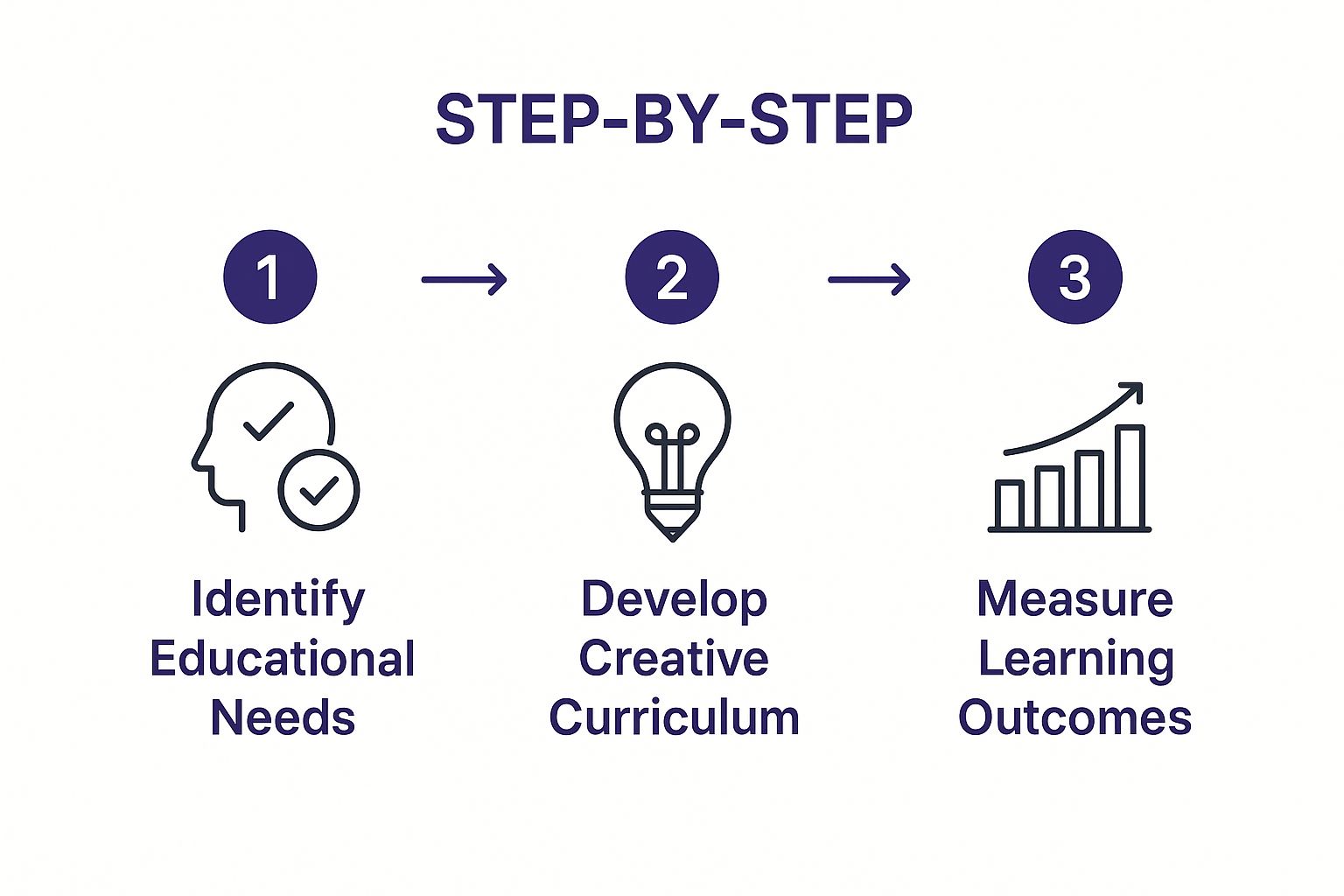
As you can see, success isn't just about launching a pretty campaign. It starts with a deep understanding of your institution's needs and ends with measuring tangible outcomes.
Agency Portfolio Vetting Checklist
To help you stay focused during your review, I’ve put together a quick checklist. Use this to systematically evaluate each portfolio and spot the difference between a flashy designer and a true strategic partner.
| Evaluation Criteria | What to Look For | Red Flags to Watch Out For |
|---|---|---|
| Higher Ed Experience | Clear examples of work with colleges, universities, or other educational institutions. | A portfolio full of CPG brands, tech startups, or other unrelated industries. |
| Measurable Results | Case studies with hard numbers: enrollment increases, application growth, lower CPL. | Vague claims like "boosted engagement" or "increased awareness" without data. |
| Student-Centric Messaging | Language that speaks directly to student goals, fears, and aspirations. | Jargon-filled copy that reads like an academic course catalog. |
| Multi-Channel Campaigns | Integrated work across digital and traditional channels (social, email, search, print). | A collection of one-off projects with no cohesive strategy. |
| Brand Storytelling | Creative that captures the unique mission and spirit of an institution. | Generic, cookie-cutter designs that could apply to any school. |
| Understanding of the Funnel | Campaigns tailored to different stages, from awareness to application to enrollment. | A singular focus on top-of-funnel brand creative with no conversion-focused work. |
Think of this table as your guide. It ensures you’re not just wowed by aesthetics but are actually confirming their ability to deliver what matters most: results.
Vetting for Strategic Partnership
The demand for this kind of deep, strategic work is exploding. The global creative services market was valued at USD 3.17 billion in 2024 and is projected to hit USD 6.45 billion by 2033. Why? Because institutions need more effective digital engagement to survive and thrive. You can discover more about this expanding market and what's driving it.
Ultimately, you're not just hiring a team of designers. You’re looking for strategic partners who can translate your institution's mission into measurable results.
A strong portfolio moves way beyond aesthetics to provide concrete proof of performance. A great way to see what this looks like in the real world is to explore case studies from education-focused creative partners. Finding an agency that showcases this depth of understanding is the absolute key to a partnership that produces real, lasting impact.
Finding a Partner Who Gets Your Culture

Creative talent is only half the battle. A truly successful partnership hinges on a deep alignment of culture, communication, and process. Finding a team that feels like a genuine extension of your own is the secret to moving faster, dreaming up better ideas, and hitting your goals without all the friction. Think about it: the unique approval cycles and stakeholder feedback common in academia can easily frustrate an agency that’s not prepared for them. You need a partner who doesn't just tolerate this environment but actually thrives in it. This calls for a team that is agile, collaborative, and genuinely understands the rhythms of higher education.
Assessing Communication and Workflow
Before you sign on the dotted line, you have to get a clear picture of how an agency actually works day-to-day. Their communication style, feedback process, and project management approach will directly impact your team's experience. Don’t be afraid to ask direct, process-oriented questions during your vetting calls. The right creative agency for education will welcome this kind of scrutiny. They should be able to clearly walk you through their workflow and show you exactly how they keep clients in the loop and projects on track.
A great partnership is built on clear communication and mutual respect for process. You're looking for an agency that values collaboration as much as creativity, ensuring a smooth and productive relationship from the very beginning.
To get the real story, you need to go beyond surface-level questions. Here are a few pointed inquiries to help you assess their operational fit:
- "Walk me through your feedback and revision process." This is huge. It reveals how they handle critique and iteration, which is central to getting the creative right.
- "How do you translate institutional goals into a tangible creative strategy?" Their answer shows if they can think strategically or if they just execute a list of tasks.
- "Describe how you manage projects with multiple stakeholders and complex approval chains." This is crucial for navigating the realities of a university environment.
- "What communication tools and meeting cadences do you typically use to keep clients updated?" This helps ensure their style matches your team’s expectations for transparency and involvement.
Aligning on a Shared Vision
Ultimately, you need a partner who is just as invested in your mission as you are. The creative agency market is booming—valued globally at USD 15.68 billion in 2024—which means you have more options than ever. Educational institutions are a key part of this growth, as more schools discover the key drivers behind the expanding market and turn to specialized agencies to connect with students.
This abundance of choice allows you to be truly selective. You can find a team whose values resonate with your institution's core purpose. When an agency understands and believes in your "why," the work they produce becomes more authentic, powerful, and effective. By exploring an agency's approach, you can learn more about their specific creative services for education and confirm they are the right cultural fit for your team.
This alignment is the foundation for a partnership that doesn’t just meet deadlines, but inspires action and drives meaningful results.
Driving Results with Rapid Creative Iteration
In higher education marketing, the old "set it and forget it" campaign is a thing of the past. The biggest benefit of working with a modern creative agency for education is their commitment to continuous improvement. They turn your strategy from a fixed plan into a live, results-driven engine. The secret sauce is rapid creative iteration—the ability to test, learn, and adapt on the fly. Instead of launching a big campaign and just hoping it works, an agile agency treats every ad, email, and social post as a chance to learn. They constantly dig into live data to figure out which messages and visuals are actually connecting with your audience and leveraging motivational principles to get them to act.
A Real-World Scenario: Open House Registrations
Let's walk through an example. Say you're launching a campaign to boost registrations for your university's fall open house. Your initial creative is a polished video of your beautiful campus quad, with a call-to-action that says, "Discover Your Future." A week goes by, and your agency’s ad data shows a pretty low click-through rate. An agency stuck in the old ways might just tell you to throw more money at it. But a partner focused on rapid iteration has a completely different game plan.
- They analyze the data: Who's seeing the ad but scrolling right past it? Is it a specific demographic? Are they on mobile or desktop?
- They form a hypothesis: Maybe "Discover Your Future" is too vague. Perhaps that gorgeous campus shot, while nice, isn't what truly motivates someone to sign up.
- They iterate—fast: Within a few days, they launch two brand new ad variations. One features a current student talking about their hands-on lab experience, tapping into social proof. The other highlights a specific, impressive career outcome from a popular program, appealing to a desire for security.
By testing different motivational principles—peer validation versus career security—the agency can quickly zero in on the message that inspires action. This isn't just basic A/B testing; it's a strategic deep-dive into what makes your audience tick.
Adapting to Inspire Action
Another week passes, and the data is crystal clear: the career outcome ad is blowing the others out of the water, outperforming them by a whopping 40%. The agency immediately pivots. They reallocate the budget to the winning creative and start developing new variations around that successful theme.
This nimble, data-informed approach can turn a mediocre campaign into a major success story, directly driving up registrations while making sure every dollar you spend is working as hard as it can. This ability to rapidly iterate and optimize is one of the most significant benefits an agency brings to the table.
This kind of adaptive strategy is absolutely critical as the digital education market continues to boom. The market was estimated at USD 32.36 billion in 2025 and is projected to skyrocket to USD 95.70 billion by 2030. This growth is all about effective digital outreach. You can discover more insights about digital education growth on marketsandmarkets.com to get a better sense of the competitive field. Working with an agency that lives and breathes rapid iteration is how your institution stays ahead of the curve.
Mastering the Onboarding for a Strong Start
The first 90 days with your new creative partner are everything. Think of it less as a handover and more as laying the foundation for the entire relationship.
Get this part wrong, and you're in for months of friction and disappointing results. But a thoughtful, strategic onboarding gets your agency past the awkward "getting to know you" phase and into the work that matters—fast.
This isn’t about just sending over a brand guide and a few key logins. A truly effective start means immersing the agency in your institution’s world. Share the data from past campaigns, both the wins and the losses. This is the context they need to understand what has historically connected with your audience—and what has fallen flat.
The Deep-Dive Discovery Workshop
If there's one thing you can't skip, it's a deep-dive discovery workshop. This is so much more than a kickoff call. It's an immersive, collaborative session designed to transfer institutional knowledge and get everyone aligned on what success actually looks like. The goal? To get your agency thinking like they're part of your internal team. A great discovery session should always include these three things:
- A "State of the Union" Presentation: Get real about your current enrollment challenges, marketing performance, and the big strategic goals you're chasing. Transparency is key.
- An Audience Persona Deep Dive: Go way beyond demographics. Share anecdotes, survey results, and student testimonials that bring your target learners to life—their hopes, their fears, and what truly motivates them.
- Stakeholder Mapping: Who are the key decision-makers and influencers on campus? Outlining the approvals process right now will save everyone a massive headache later.
A successful onboarding isn't about giving an agency a to-do list. It's about arming them with the institutional knowledge and insights they need to become true strategic partners—the kind who can start generating smart, creative ideas with confidence from day one.
Setting Up for Success
Once you’ve built that shared understanding, it’s time to build the operational framework. This is where you set up clear communication channels and, crucially, define some tangible milestones for the first few projects.
Stay away from vague objectives. Instead, focus on a few concrete "quick wins" that can build momentum and trust on both sides.
For instance, a great first project could be a small-scale digital campaign for an upcoming webinar. It's a perfect low-stakes way for both teams to test out the workflow, the feedback loops, and the creative process before tackling a massive enrollment campaign.
This is the phase where you teach your agency how your institution really works. In return, they'll show you the value of their process. A strong onboarding doesn't just prevent problems down the road; it actively accelerates your journey toward hitting your goals and inspiring prospective students.
Common Questions We Hear About Choosing an Agency
When you’re vetting a creative partner for your institution, a few key questions always come up. Let’s tackle the big ones—budget, timing, and what a good fit actually looks like—so you can move forward with confidence.
How Much Does It Really Cost?
This is the million-dollar question, isn't it? The truth is, costs can swing wildly depending on the scope of work. A one-off project might start in the low thousands, but a full-funnel, multi-channel recruitment campaign with a long-term retainer can easily reach a six-figure annual investment. What’s most important is finding an agency that’s completely transparent about their fees and what you get for them. A great partner will provide a crystal-clear breakdown of deliverables so there are no surprises down the road.
What Kind of Results Can We Expect, and How Fast?
It's a two-part answer. You should start seeing positive movement in leading indicators—like engagement rates and audience growth—within the first few weeks or even days. But the metric that really matters, enrollment growth, is a long game. Real, sustainable gains in applications and deposits often take a full cycle, usually around 6–12 months, to materialize.
Should We Go with a Big Firm or a Boutique Agency?
There are pros and cons to both. Large, full-service firms often bring a massive team and a broad suite of services, which can be great if you need a one-stop shop. On the other hand, smaller boutique agencies usually offer deep, specialized expertise in higher education and a more hands-on, personalized approach. The right choice really depends on your team's needs, culture, and the specific challenges you're trying to solve.
How Do We Make Sure We've Found the Right Partner?
Beyond the portfolio and the pitch, look for an agency that acts like a true partner. The best collaborations happen when there are open, honest dialogues about feedback, deadlines, and what success looks like for your institution.
Partnering with the right agency isn't just about better design—it's about boosting enrollment by tapping into what truly motivates a student to choose you.
Finding the right creative agency for your college or university doesn't have to be an overwhelming process. With the right questions and a clear sense of what you're looking for, you can find a partner who will help you accelerate results and hit your goals.
Get started with Motimatic at https://motimatic.com/
See it on your own listOne list, one goal, and a randomized holdout to show the lift. Start a pilot