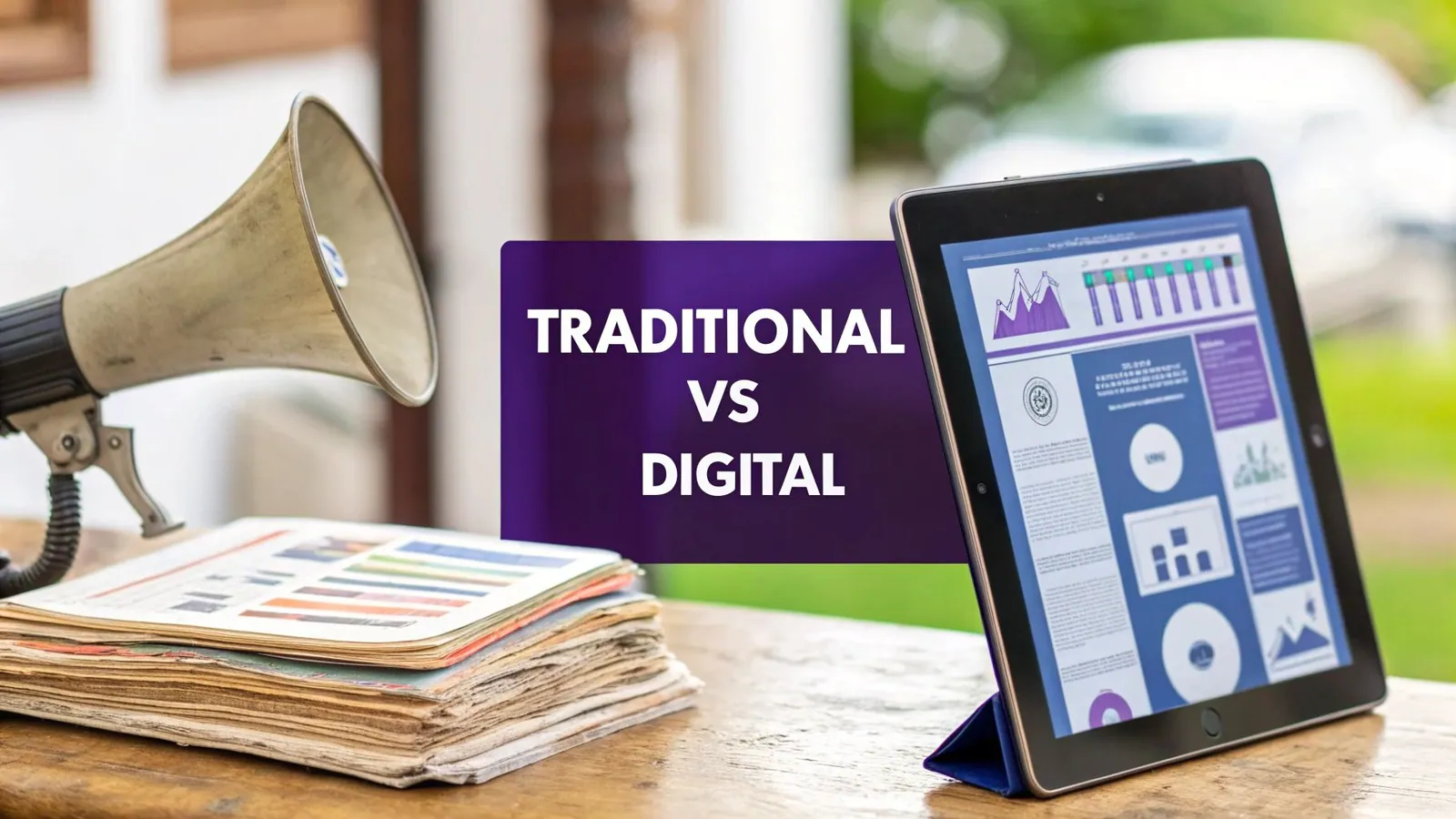
The whole traditional vs. digital marketing debate really boils down to this: digital gives you laser-focused targeting and measurable results, while traditional is a powerhouse for building that foundational brand trust and reaching a wide local audience. For colleges and universities, the goal isn't to pick a winner. It's about blending the two to create a powerhouse recruitment strategy.
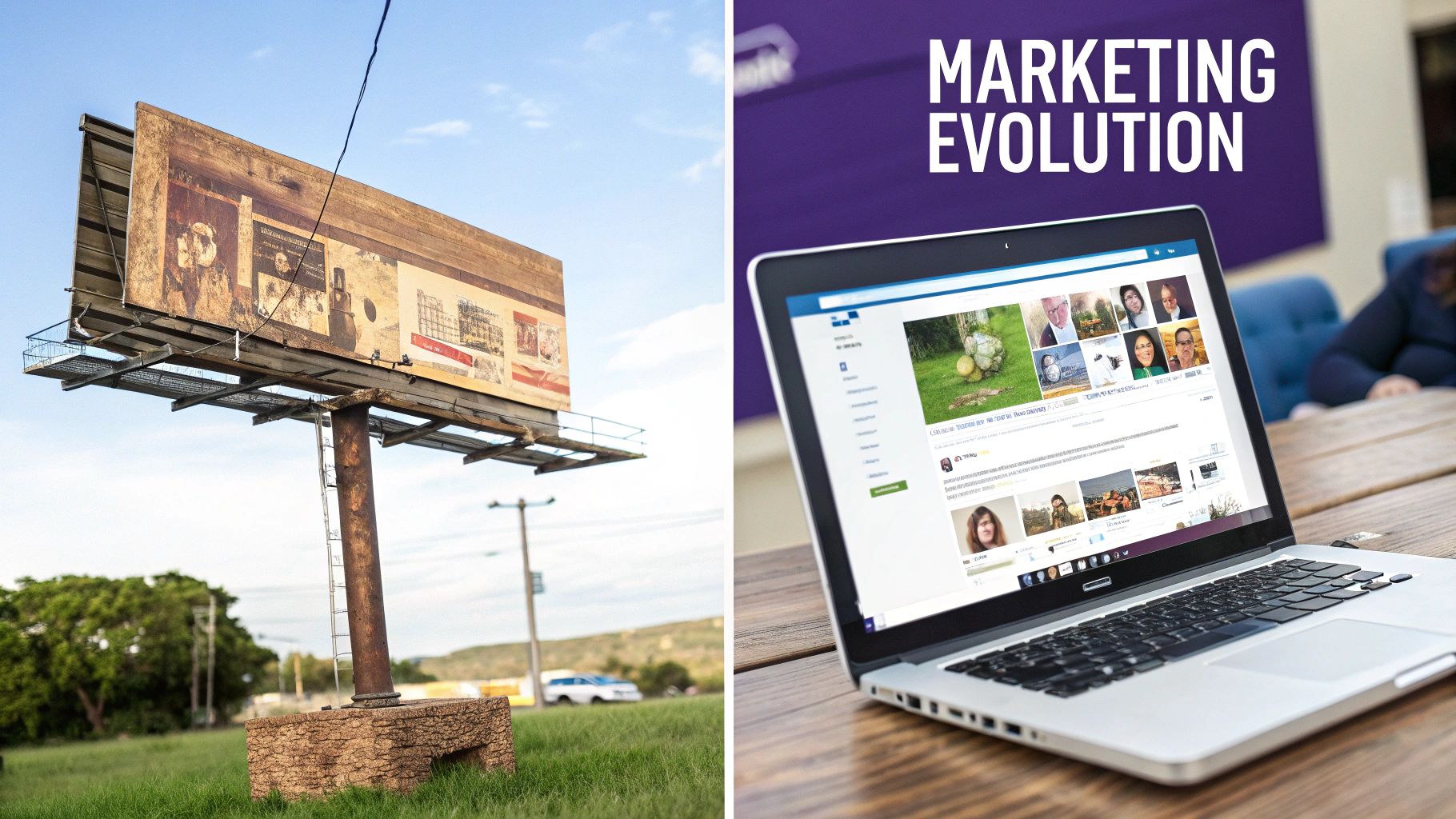
Understanding the Core Differences in Marketing
To build the right marketing mix for your institution, you have to start with the fundamental differences between traditional and digital channels. Each one operates on its own set of rules, brings unique strengths to the table, and helps you hit different goals.
Think about it. Traditional methods, like glossy viewbooks, alumni magazines, and sponsoring local college fairs, create a tangible feeling for your brand. They build credibility and establish a sense of prestige that’s tough to replicate online. It’s about creating a physical presence in the community.
Digital marketing, on the other hand, is all about precision and speed. With social media campaigns, search engine optimization (SEO), and pay-per-click (PPC) ads, you can reach prospective students based on their specific zip code, academic interests, or even the websites they visit. That granular control means you can stretch your budget further and adjust your campaigns on the fly. The data you get back is immediate, giving you clear insights into what’s working, from virtual tour sign-ups to submitted applications.
The real challenge for universities isn't picking a side between traditional and digital. It's about designing a seamless journey where a printed brochure prompts a visit to a specific landing page, and a local radio ad is reinforced by a geo-targeted social media campaign.
Core Differences in Marketing Approaches
To really see how these two worlds differ in the context of student recruitment, it helps to put them side-by-side. The table below breaks down their key attributes, showing how each approach handles things like audience interaction, measurement, and overall flexibility. Think of this as a foundational guide for figuring out where each tactic fits into your master plan.
| Attribute | Traditional Marketing | Digital Marketing |
|---|---|---|
| Primary Medium | Print, broadcast (TV/radio), direct mail, billboards | Websites, social media, email, search engines, mobile apps |
| Audience Interaction | One-way communication (brand to audience) | Two-way, interactive engagement (dialogue and feedback) |
| Targeting Precision | Broad, based on geography or general demographics | Highly specific, based on interests, behaviors, and data |
| Pacing and Speed | Longer lead times for creation and launch | Immediate deployment and real-time adjustments |
| ROI Measurement | Often indirect and more difficult to attribute directly | Highly measurable with clear analytics and conversion tracking |
Ultimately, this comparison isn't about declaring a "better" approach. It's about understanding the specific jobs each channel is built to do, so you can deploy them strategically to meet your enrollment goals.
The Enduring Power of Traditional Marketing
When we talk about traditional versus digital marketing, it's tempting to write off the old-school stuff. But for colleges and universities, these proven channels still pack a serious punch, especially when it comes to building the kind of credibility and trust that digital ads can't quite replicate. A clever social media campaign might get you clicks, but a beautifully designed viewbook in a prospective student's hands creates a tangible, memorable moment. That physical presence matters. It helps solidify a university's prestige and creates a sense of permanence that fleeting digital content struggles to match. It’s a powerful signal of legitimacy, particularly to parents and alumni who hold major sway over enrollment and donations.
Building Foundational Brand Trust
Trust is the bedrock of any university's brand, and traditional marketing is a master at laying that foundation. High-quality print materials, like alumni magazines or brochures mailed to top prospects, signal a level of investment and seriousness that people notice. In fact, studies consistently show that consumers rank print advertising as one of the most trustworthy forms of marketing. Think about it: a sponsorship banner at a local high school football game does more than just show off your logo. It shows you’re a committed part of the community. This kind of consistent, physical presence builds familiarity and goodwill over time, creating a strong awareness long before a student even starts their college search.
A high-quality, personalized mailer from a university sends a clear message: we value you. Unlike a digital ad that vanishes with a scroll, this physical piece can be held, shared with family, and looked at again, reinforcing the institution's impression.
Hitting Key Demographics Where They Are
While digital marketing offers incredible targeting, some of the most important audiences in higher ed are more easily reached through traditional methods. Older alumni, a critical source of endowments and support, are often far more receptive to direct mail and print publications than they are to social media campaigns.
Likewise, reaching parents and guardians—who are huge influencers in the college decision—almost always requires an approach where traditional media plays a leading role.
Consider these scenarios:
- Local Radio Ads: During the peak of application season, radio spots on popular local stations can grab the attention of commuting parents, reinforcing deadlines and open house dates.
- Print Advertisements: Placing ads in local newspapers or regional magazines establishes the university as a pillar of the community, building local pride and recognition.
- Direct Mail Campaigns: A well-targeted direct mail campaign can deliver personalized info about specific programs right into the mailboxes of households in key recruitment areas, cutting through the digital noise.
These tactics create a broad-based awareness that makes all your digital efforts work better. A student who hears a radio ad is more likely to recognize—and click on—your social media ad later. That synergy is where the real magic happens.
Creating Memorable, Physical Experiences
In a world drowning in digital content, a physical brand interaction truly stands out. Traditional marketing is your chance to create tangible experiences that forge a stronger emotional connection with your institution.
A well-staffed booth at a college fair is a perfect example. It allows for face-to-face conversations, personal stories, and the chance to hand out quality materials that students actually take home. Sponsoring a local arts festival or community event ties your university's brand to positive, real-world experiences. For institutions looking to ensure their brand assets are top-notch, exploring specialized creative services for education can guarantee a professional and consistent presentation across every single channel.
Ultimately, the value of traditional marketing isn't about choosing it over digital. It's about using it to build a stable foundation of trust and awareness. These channels establish your institution's credibility in the physical world, which makes every digital touchpoint that follows more meaningful and more effective.
How Digital Marketing Drives Student Recruitment

If traditional marketing builds the foundation of awareness, digital marketing is the precision tool. It gives universities a direct line to the right students, at the exact moment they’re searching for answers. This completely changes the game, shifting recruitment from a mass broadcast to a series of one-on-one conversations.
The real power of digital is its ability to meet prospective students exactly where they are. A high school senior Googling “best undergraduate biology programs” can land on your perfectly optimized program page, all thanks to smart Search Engine Optimization (SEO). This isn't just advertising; it's being the solution to their problem.
And it’s not just about search engines. Platforms like Instagram and TikTok have become crucial recruitment channels. Forget polished campus photos—we’re talking about authentic, student-led content that offers a genuine peek into your institution's culture. Quick video tours, "day in the life" stories, and live Q&As with current students forge a connection that a glossy brochure just can't replicate.
Reaching the Right Audience with Precision
The biggest edge digital has in the traditional marketing vs. digital debate is its incredible targeting. Digital platforms let you zero in on specific student profiles with stunning detail, making every dollar in your marketing budget work harder. Instead of casting a wide net over an entire region, you can build campaigns for very specific groups:
- Academic Interests: Target high school seniors who’ve shown an interest in STEM fields.
- Geographic Location: Aim an open house event ad at students living within a 200-mile radius of your campus.
- Online Behavior: Connect with users who have recently visited competitor university websites or browsed financial aid resources.
This kind of detail allows you to craft messages that speak directly to a student's specific hopes and concerns. It's the end of the one-size-fits-all approach. For a deeper dive into these tactics, you can learn more about building an effective higher education digital marketing plan.
Measuring What Truly Matters
The clearest advantage of digital marketing is its airtight measurability. You can track every click, view, and form submission, giving you a goldmine of data to prove ROI and sharpen your strategy. This data-first approach lets university leaders see exactly how marketing dollars turn into real results.
In traditional marketing, you might know how many people could have seen your billboard. With digital, you know exactly how many people clicked your ad, visited your program page, and started an application.
This shift to hard numbers empowers your institution to make smarter decisions, faster. If a specific ad campaign is underperforming, you can tweak it in real-time—no need to wait weeks for a new print run. Success is now defined by a new set of metrics:
- Cost-Per-Application: How much are you spending to get one completed application?
- Virtual Tour Sign-ups: How much engagement are you driving from students who can't visit in person?
- Conversion Rate: What percentage of website visitors are taking the next step, like requesting information?
The proof is in the numbers. The digital marketing market is on track to hit $786.2 billion by 2026, driven by its sheer effectiveness. Channels like email marketing deliver a jaw-dropping $36 for every $1 spent, and with mobile advertising now making up nearly 58% of all digital ad spend, reaching students on their phones is non-negotiable. This ability to track, measure, and optimize is what makes digital marketing such a powerful engine for modern student recruitment.
Comparing Costs and Measuring Marketing ROI
When it comes to the traditional marketing vs digital debate, the conversation always lands on budget and return on investment (ROI). For higher ed institutions, these aren't just line items; they're the make-or-break factors that shape entire enrollment strategies. The financial realities and measurement tools for each approach couldn't be more different.
Think about traditional marketing. A prime-time TV spot or a glossy full-page ad in a national magazine demands a massive upfront investment. You're paying for production, media buys, and distribution long before a single prospective student even sees your message. It’s a high-stakes, long-term play.
Digital marketing flips that script entirely. A university can spin up a hyper-targeted pay-per-click (PPC) or social media campaign with a surprisingly modest budget. You can test, learn, and then scale up what works. That kind of agility is a massive financial advantage.
The Challenge of Traditional ROI Attribution
Here’s the classic problem with traditional marketing: proving it worked. How do you draw a straight line from a highway billboard to a spike in applications? It's not impossible, but it often leans on a mix of indirect methods and well-educated guesses. Over the years, universities have gotten pretty creative with their tracking workarounds:
- Custom URLs: Printing a clean, memorable URL on a brochure (like
YourU.edu/viewbook) helps you trace web traffic back to that specific print run. - Dedicated Phone Lines: If you assign a unique phone number to a radio ad, your admissions team knows exactly what prompted that call.
- Survey Questions: The good old "How did you hear about us?" on an application form still provides some valuable, if self-reported, clues.
These tactics are useful, but they offer correlation, not causation. They can’t give you the granular, definitive data that digital channels provide. Figuring out the true return on investment is absolutely critical, and for a deeper dive, you can explore more on measuring ROI for marketing efforts.
The Clarity of Digital ROI Measurement
This is where digital marketing pulls away from the pack. Digital platforms are built on data. They offer almost total transparency into how your campaigns are performing, from the first click all the way to a completed enrollment. Every dollar is traceable. Every action, measurable.
Just look at the performance data. It paints a pretty clear picture.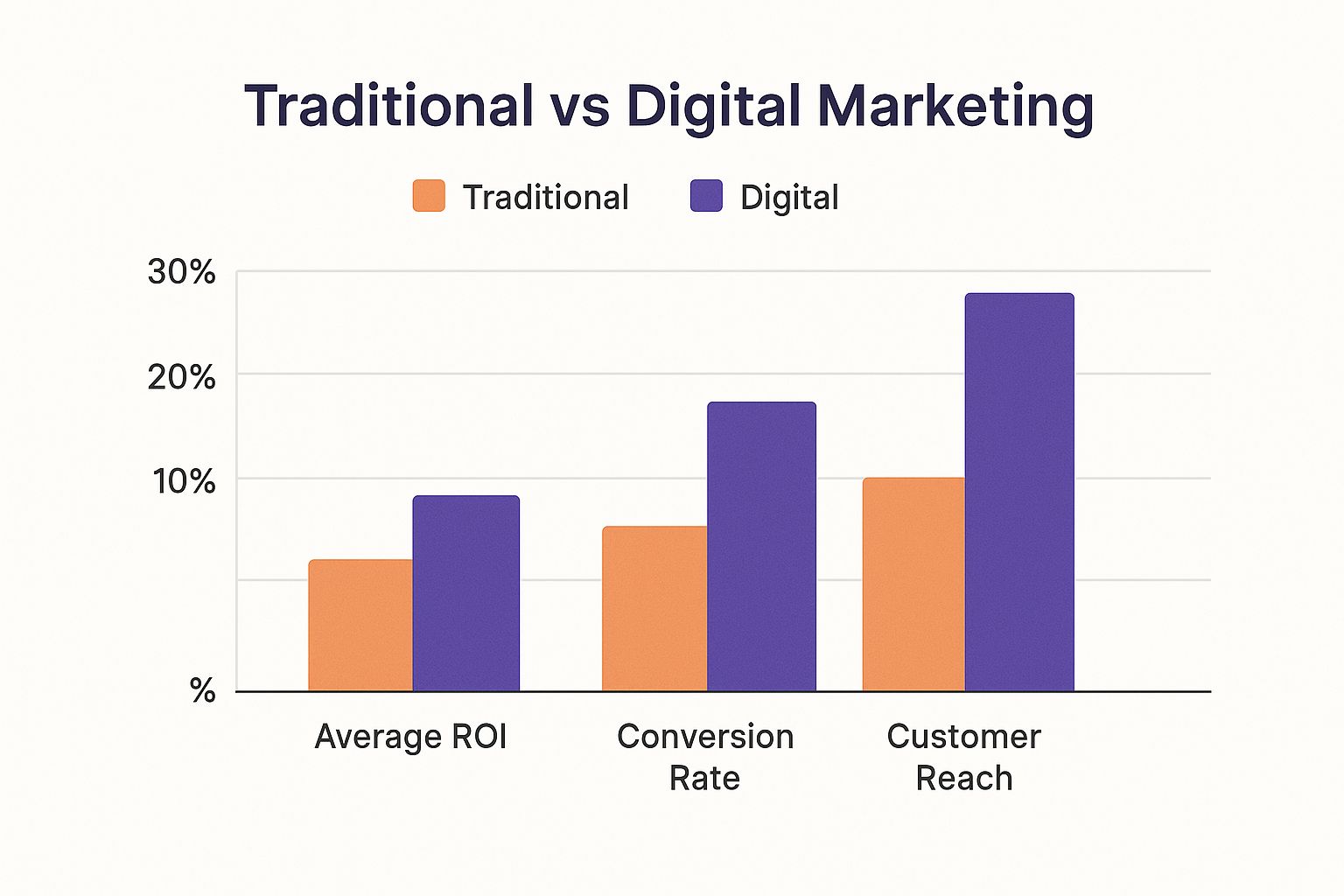
The numbers show that digital marketing not only delivers a better ROI on average but also crushes it when it comes to conversion rates and reaching the right audience.
To put this into perspective, let's break down how the financials and performance timelines compare across different channels.
Comparing Financial and Performance Metrics
| Channel | Typical Upfront Cost | Campaign Lead Time | ROI Measurability |
|---|---|---|---|
| TV/Radio Advertising | Very High ($50k+) | 3-6 Months | Low (Indirect) |
| Print Advertising | High ($10k - $40k) | 1-3 Months | Low (Indirect) |
| Paid Social Media Ads | Low to High (Scalable) | Days to Weeks | High (Direct) |
| Search Engine Marketing (PPC) | Low to High (Scalable) | Days | High (Direct) |
| Content Marketing/SEO | Medium (Ongoing) | 3-9+ Months | Medium (Direct) |
| Email Marketing | Low (Platform cost) | Hours to Days | Very High (Direct) |
This table highlights the fundamental difference: digital's scalability and speed versus traditional's upfront commitment and slower feedback loop. Digital gives you the power to start small, validate your approach with real data, and then invest more heavily with confidence.
With digital analytics, the conversation shifts from, "Did our marketing work?" to, "How can we make it work even better?" Real-time data lets you optimize on the fly—shifting budget from a dud ad to a winner in a matter of hours, not months.
This level of insight gets you past vanity metrics like "impressions" and focuses on what your enrollment team actually cares about: results. You can track your cost-per-inquiry, watch application conversion rates, and even model the lifetime value of a student brought in from a specific campaign. For any university looking to make smarter decisions, knowing your way around higher education data analytics is non-negotiable. Ultimately, the financial side of the traditional vs. digital marketing comparison isn't just about finding the cheapest option. It’s about choosing the approach that gives you the clarity, control, and hard data you need to make intelligent, evidence-based decisions that hit your enrollment goals.
Building an Integrated Marketing Strategy
The whole traditional vs. digital marketing debate? It’s a distraction. The best marketing plans don’t pick a side; they build a single, unified experience for prospective students.
The goal is a seamless journey where every single touchpoint—a billboard, a social media ad, a piece of mail—reinforces your school's message and pulls that student closer to your brand. A truly integrated strategy makes each channel amplify the others, creating a result that’s far more powerful than the sum of its parts.
Think about it: a student’s path to enrollment is never a straight line. They might see a print ad, get a targeted post on Instagram a week later, and finally click a search ad when they’re ready to research specific programs. An integrated campaign makes these transitions feel deliberate and natural, not disjointed.
Global ad spending trends tell the same story. By 2025, digital ad spend is expected to hit $800 billion worldwide. That completely dwarfs the $200 billion slated for traditional channels. While this proves digital’s dominance in terms of flexibility and measurement, it doesn't mean traditional media is obsolete. It still has a strategic role to play in building brand awareness and reaching audiences that aren't glued to their screens 24/7.
Creating a Cohesive Brand Journey
A unified strategy is all about building bridges between your different marketing efforts. Each channel should act like a signpost, clearly guiding potential students to the next step. It creates a consistent, reassuring experience that builds trust. Here are a couple of practical ways this plays out in higher ed:
- From College Fair to Digital Story: A prospect grabs a brochure at a college fair. It has a QR code that, when scanned, takes them straight to a video of a current student sharing their personal experience in that exact program. The physical brochure becomes a direct gateway to a powerful digital story.
- From Billboard to Social Reinforcement: Your university puts up billboards on major local highways. At the same time, you run a geo-targeted social media campaign in that same area, using the exact same visuals and tagline. It creates this powerful, unavoidable sense of local presence.
The big idea here is simple: make it incredibly easy for prospects to move from awareness to action. Every offline touchpoint should offer a clear, compelling path to a digital one—and vice versa.
Fusing Channels for Maximum Impact
Successful integration is about thinking creatively. You need to leverage the unique strengths of each channel to build a multi-layered campaign that grabs attention and nurtures interest over time. For a masterclass in how a major brand blends old and new school tactics, check out Domino's India's traditional and digital marketing strategies. Here’s another powerful sequence you could run for your institution:
- The Direct Mail Kickstart: Send a high-quality, personalized mailer to a hand-picked list of high-achieving high school students, announcing a new scholarship.
- The Email Nurture Follow-Up: A few days later, those same students get the first email in a targeted nurture sequence. It references the mailer they just received and includes a link to sign up for an online info session.
- The Retargeting Reminder: Anyone who clicked the link but didn’t register for the session starts seeing retargeting ads on social media and across the web, reminding them about the event and why they can’t miss it.
This kind of multi-channel flow makes sure your message is seen multiple times in different contexts, which dramatically increases the odds that someone will finally take action.
Building the Right Marketing Mix for Your Institution
The old debate of traditional marketing vs. digital is the wrong way to think about it, especially in higher education. The most successful schools don't pick a side; they build a smart, integrated mix that plays to the strengths of both. There’s no one-size-fits-all template here—the right strategy is always a custom plan built around your institution’s unique goals. A university trying to boost local undergraduate enrollment needs a totally different playbook than one focused on attracting international graduate students. Likewise, reaching first-generation applicants demands different channels and messaging than engaging mid-career professionals looking for a certificate program. Your goals and your audience have to be the starting point for every single decision.

A Strategic Checklist for Your Team
Before you spend a single dollar, your team needs to walk through a clear planning framework. This makes sure your marketing mix is deliberate, goal-oriented, and perfectly tailored to the students you want to attract. Answering these questions will give you the clarity needed to build a powerful and effective strategy.
- What are our primary goals? Are you trying to increase application volume for a specific program? Build brand awareness in a new state? Or re-engage alumni for a fundraising push? Get specific.
- Who is our exact audience? Go beyond demographics. Define your ideal student personas, thinking about their age, location, how they like to communicate, and who influences their decisions (like parents, spouses, or high school counselors).
- What's our realistic budget? Figure out your total marketing spend and how to allocate it. A smaller budget might lean heavily on nimble digital tactics, while a larger one can support broader, more traditional campaigns.
- How will we measure success? Define your key performance indicators (KPIs) from the very beginning. For digital, that might be cost-per-application. For traditional, it could be tracking traffic to a custom URL you put on a print mailer.
The most effective marketing strategies aren't static; they're living plans. The goal is to create a data-informed, hybrid approach that prioritizes continuous testing, measurement, and adaptation for sustainable growth.
Final Recommendation: A Hybrid Approach
The answer is clear: embrace a hybrid model.
Use traditional channels like print, local events, and out-of-home ads to build foundational brand trust and broad awareness. These methods give your institution a credible, tangible presence that your digital efforts can then build on.
At the same time, deploy digital marketing to execute with surgical precision. Use SEO, social media, and paid ads to reach highly specific student segments, nurture leads, and drive measurable actions like virtual tour sign-ups and applications.
When you integrate these two worlds—say, by putting a QR code on a college fair banner that links to a student testimonial video—you create a seamless and persuasive journey for every prospective student. This integrated, data-driven approach is the key to maximizing enrollment and achieving long-term institutional success.
Your Top Questions, Answered
Navigating the traditional vs. digital marketing divide brings up a lot of questions. We've compiled a few of the most common ones we hear from higher ed professionals to give you some clarity as you map out your strategy. Getting these details right helps your institution make smarter decisions about where to put your marketing dollars for the biggest impact on enrollment and student engagement.
Is Traditional Marketing Even Relevant for Reaching Gen Z?
Yes, but it has to be done with a clear purpose. Gen Z students are digital natives, no question. But a smart traditional marketing play can build a sense of trust and legitimacy that a fleeting online ad campaign might not. Think about well-placed out-of-home ads near high schools, a strong presence at college fairs, or beautifully designed print materials. These create a tangible brand impression. The key is to use these traditional channels for broad brand awareness and then link them directly to a digital action. QR codes or custom URLs on a viewbook, for example, should lead straight to a compelling landing page or video tour.
How Can a Small College Get Started with Digital Marketing?
If you're a smaller school with a tight budget, the trick is to focus on low-cost, high-impact channels first. You want to build a solid foundation before you start pouring money into paid ads. First, nail your on-page SEO. Make sure your key academic programs show up when prospective students are searching for them. Next, build an authentic presence on the social media platforms where your target audience actually spends their time—like Instagram or TikTok—to give them a real feel for your campus culture. Finally, start growing an email list from your website inquiries so you can nurture those potential applicants over time.
For a small college, your most powerful digital assets are the ones you own, not the ones you rent. A well-optimized website, engaging social content, and a nurtured email list create a strong digital footprint that pays dividends for years to come.
What’s the Best Way to Measure ROI for an Integrated Campaign?
Measuring the ROI of a campaign that blends online and offline tactics requires a hybrid approach. You'll need to use your digital analytics platform to track metrics like cost-per-application and lead source conversions with precision. That’s the easy part.
For the traditional elements, you have to get creative with attribution. This means creating unique landing page URLs for print materials (think yourcollege.edu/viewbook) or using dedicated phone numbers on radio spots. Ultimately, the best method is to use your CRM to track how applicants first heard about your institution. This gives you a complete picture of which channels—both online and offline—are actually contributing to your enrollment goals.
At Motimatic, we help institutions build and execute marketing strategies that drive real enrollment growth by engaging students at every stage of their journey. Learn how our platform can help you achieve your goals by visiting https://motimatic.com/.
See it on your own listOne list, one goal, and a randomized holdout to show the lift. Start a pilot