If you want to increase student enrollment, you can't rely on the old playbook anymore. It’s time to move beyond traditional outreach and embrace a smarter framework built on data-driven targeting, personalized behavioral messaging, and adaptive automation. This isn't just about new tools; it's a fundamental shift in how you connect with prospective students who expect more than generic brochures and mass emails.
Adapting to the New Admissions Landscape
Let's face it: the world of higher education admissions has changed for good. Not long ago, a strong brand and a picturesque campus were often enough to fill an incoming class. Today's students are a different breed—they're more discerning, deeply conscious of cost, and have grown up entirely online.
This shift presents a tough reality for enrollment teams. The competition is more intense than ever, and the traditional applicant pool is shrinking. In fact, undergraduate enrollment is a perfect example of this pressure. In Fall 2024, around 19.3 million undergraduates were enrolled in the U.S. That number represents an 8.43% decline from the peak in 2010, as more students weigh soaring tuition against other educational and career paths.
To win in this environment, simply working harder isn't the answer. You have to work smarter. This means moving away from broad, one-size-fits-all campaigns and adopting a more precise, surgical approach. The goal is to see and engage with students as unique individuals, not just another name in your CRM.
The objective isn't just to fill seats anymore. It's about attracting, engaging, and enrolling the right students—the ones who are most likely to find their place and succeed at your institution. That’s the real secret to sustainable growth.
The Modern Framework for Enrollment Growth
A successful strategy to increase student enrollment today stands on three core pillars. When they work together, they create a responsive, efficient, and genuinely effective admissions process that meets students right where they are. Honestly, mastering these is one of the most critical enrollment management best practices you can implement. To build a modern enrollment growth engine, you need a solid foundation. The table below outlines the three pillars that are essential for any institution looking to not just survive, but thrive.
Pillars of a Modern Enrollment Growth Strategy
| Pillar | Focus Area | Key Outcome |
|---|---|---|
| Data-Driven Targeting | Building rich prospect profiles based on behavior, interests, and intent—not just demographics. | Higher-quality leads and more efficient allocation of recruitment resources. |
| Behavioral Messaging | Crafting personalized communications that address a student's specific stage, questions, and motivations. | Deeper engagement and stronger relationships that guide students to apply. |
| Adaptive Automation | Using technology to deliver the right message at the right time, nurturing prospects at scale. | Improved conversion rates from inquiry to enrollment without manual overload. |
Each pillar supports the others, creating a system that's far more effective than the sum of its parts. It's about using data to understand who to talk to, behavior to know what to say, and automation to deliver it perfectly.
Here's how this looks in practice, showing how you can align current numbers with future targets.
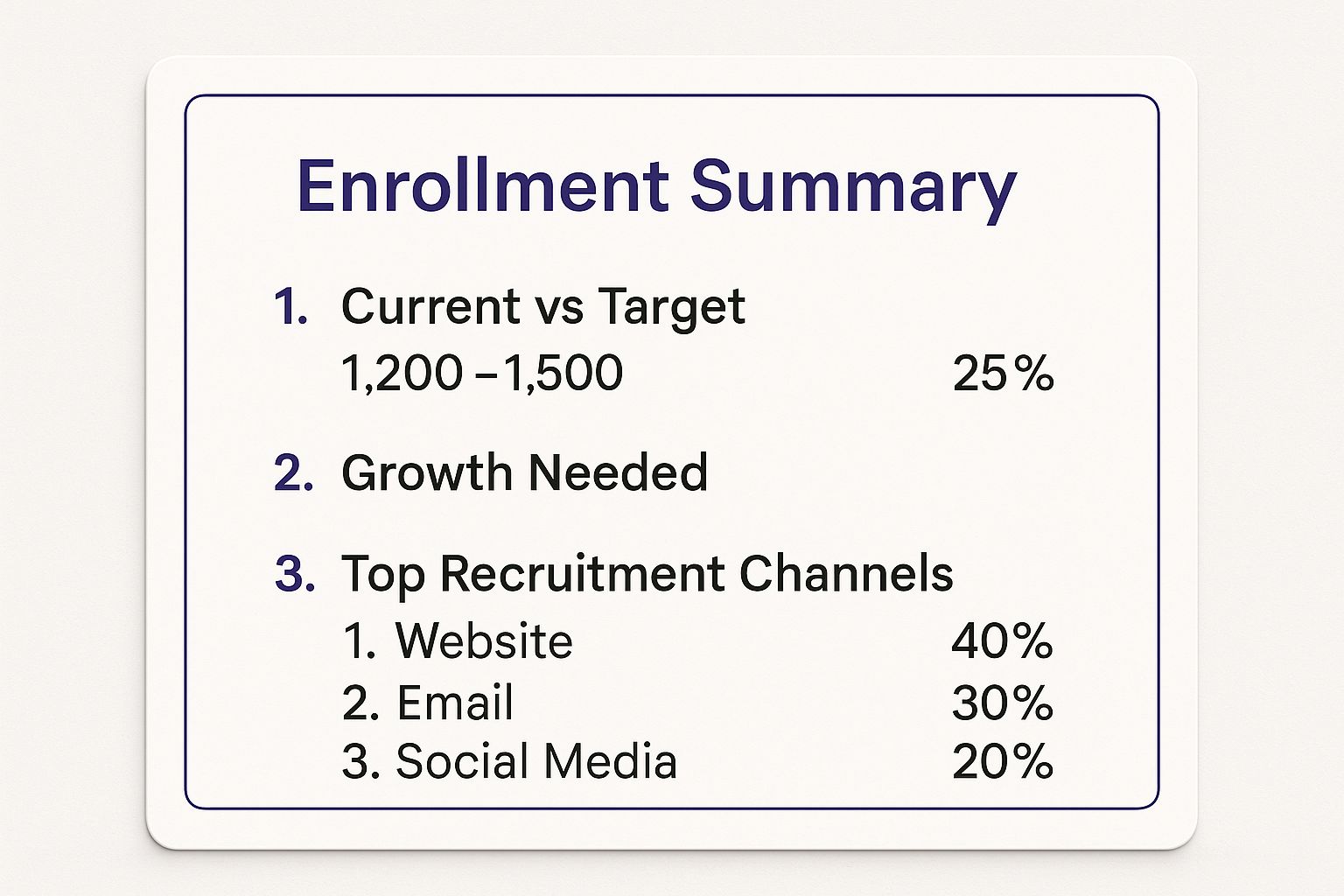
When you visualize your data this way, it does more than just clarify your enrollment goals. It also shines a light on which recruitment channels are actually delivering results. In the next few sections, we’ll dive into exactly how to put each of these pillars into action and build a resilient enrollment strategy.
Building a Smarter Prospective Student Profile
If you want to truly increase student enrollment, the first step is to get a handle on who you’re actually talking to. For far too long, admissions teams have leaned on the basics: age, location, and maybe some test scores. And while that’s a start, those details barely scratch the surface of what makes a student tick.
To really connect with today’s prospects, you have to dig deeper than those generic identifiers. The real goal is to build a rich, three-dimensional profile that tells you not just who a student is, but what they genuinely care about. This means weaving together data from all the places you interact with them to create a single, clear picture.
I once heard an admissions director compare enrollment management to planning a wedding, and it’s a brilliant analogy. You have a fixed number of seats—in dorms, in classrooms, in the dining hall—and you want every single guest to have an incredible experience. To pull that off, you need to know more than just their names on a list. You need to understand their needs to plan a memorable event.
A smarter student profile isn't about hoarding more data; it's about connecting the right data. It’s the difference between knowing a student’s zip code and understanding their career aspirations.
Weaving Together Your Data Sources
The most revealing student profiles don't come from a single source. They emerge when you combine information from three key corners of your digital world. Each one gives you a different piece of the puzzle.
- Website Analytics: Your website is an absolute goldmine of behavioral clues. Analytics tools, like Google Analytics, show you exactly which program pages a student is lingering on, what resources they’re downloading, and how long they stick around. This is a direct signal of their academic interests and how serious they are.
- Social Media Interactions: Social platforms are where a student’s personality shines. Pay attention to the posts they like, share, or comment on. This gives you valuable insight into the kind of campus life and community they’re searching for.
- CRM and Inquiry Data: This is where you keep the information students give you directly. Think of the data from your Slate or Salesforce CRM—their intended major, high school, or the specific questions they’ve asked an admissions counselor. It's the most explicit data you have.
When you integrate these sources, you can build profiles that are both deep and immediately useful. Suddenly, you don't just see a student interested in engineering. You see a student who also engaged with your robotics club's Instagram posts and downloaded a financial aid guide. That’s the kind of insight that lets you stop guessing and start personalizing.
From Data Points to Actionable Segments
Once you start blending this data, you can graduate from basic segmentation (like in-state vs. out-of-state) to creating truly meaningful audience groups based on behavior and intent. This is where you gain the power to tailor your messaging with surgical precision. Let's say you have two prospects who both put "Biology" on their inquiry form.
- Student A: Visited the main biology program page once. Hasn't opened any follow-up emails or engaged on social media.
- Student B: Has been to the biology page multiple times, clicked on faculty profiles, downloaded the pre-med curriculum guide, and even liked a post about your annual research symposium.
These are two entirely different prospects, right? Student A is what I’d call a low-engagement lead; they probably need more general, top-of-funnel content to build awareness. Student B, on the other hand, is a high-intent, deeply engaged prospect. They’re ready for specific details about research opportunities, application deadlines, and scholarships just for biology majors.
Crafting Personalized Messages That Actually Convert
Let's be honest: generic messaging is the fastest way to get your emails deleted and your brochures tossed in the bin. If your communications sound like they could be from any university, they aren't doing the heavy lifting needed to boost student enrollment. It's time to stop shouting into the void and start building real connections with messages that are personal, timely, and driven by actual student behavior.
Think of it this way. Sending a blanket email about your business school to every single prospect is a shot in the dark. But what about sending a personal note about your brand-new fintech lab to a student who has visited that specific program page three times? Now you're starting a real conversation. This is where the magic happens—where genuine engagement leads to conversion.
This goes way beyond just plugging a [First_Name] token into your email template. True personalization shows you understand a student's unique journey, from their very first click on your website to the moment they hit "submit" on their application.
Mapping Your Messaging to the Student Journey
To create messages that truly land, you first have to grasp the distinct stages a prospect moves through. Each phase calls for a different tone, different information, and a different call to action. Nailing this is fundamental to building momentum. Let's walk through the key touchpoints and how to tailor your messaging for each one.
- Awareness: At this point, the student has just discovered you. Maybe they found your blog through a search or saw a social media ad. Your communication needs to be welcoming and informative, not a hard sell. Focus on what makes your university unique—your story, your mission, your vibe.
- Consideration: Now, the student is actively researching and comparing their options. They're digging deeper, visiting specific program pages, downloading curriculum guides, or maybe tinkering with your tuition calculator. Your messaging should get more specific, too. This is the time to highlight program strengths, faculty achievements, and impressive student outcomes.
- Decision: The prospect is on the verge of applying or already has. Your communication should shift again to be reassuring and action-oriented. Think application deadline reminders, helpful financial aid information, and exclusive invitations to virtual "Admitted Student Day" events.
When you align your messages with these stages, you meet students exactly where they are. You're giving them the right information at the precise moment they need it, building trust and making your institution feel like the obvious choice.
The Personalization Makeover: Before and After
The difference between generic outreach and a truly personalized message is night and day. Let's look at a quick scenario to see how a simple shift in approach can deliver dramatically better results. Scenario: A prospect named Maria has been checking out your nursing program.
| Messaging Type | Example Message | Impact |
|---|---|---|
| Generic | Subject: Explore a Future at Our University! |
Dear Student, Discover the world of opportunities waiting for you at our university. We offer a wide range of programs...
Hi Maria, We saw you were exploring our BSN program! Did you know our graduates have a 98% first-time NCLEX pass rate?
This personalized approach doesn't just grab attention. It validates the student's interest and gives them a concrete, compelling reason to take the next step.
A truly personalized message makes a student feel seen and understood. It shows that you're not just trying to hit a quota, but that you're invested in their individual future. This is how you build loyalty long before they ever step foot on campus.
Using SMS and Dynamic Content at the Right Moment
While email is your communications workhorse, you'll get even better results by layering in other channels. Timely SMS reminders and dynamic website content are incredibly powerful tools for prompting action when the moment is right. For instance, if a student started an application but got busy and hasn't finished it after 48 hours, a simple, friendly text can make all the difference.
- SMS Example: "Hi Alex, just a friendly nudge from State University! Your application is waiting for you. Need help with anything? We're here to chat. Finish up here: [link]"
This gentle reminder feels helpful, not pushy, and is often the exact nudge a busy prospect needs. With research showing SMS open rates as high as 98%, it's the perfect channel for high-priority, time-sensitive communications. You can apply the same logic to your website using dynamic content. If a student who has shown repeated interest in your arts program returns to your homepage, why greet them with the same generic welcome message? Instead, you can dynamically display a banner about an upcoming student art show or feature a story on a successful alumni artist. Every interaction with your brand becomes more relevant, more compelling, and uniquely personal.
Tapping into the Global Talent Pool
If your enrollment strategy stops at the border, you're missing out on a huge pool of bright, motivated students. Your next star researcher or future class valedictorian could be an ocean away, actively searching for the exact programs you offer. Reaching into the international market is one of the most effective ways to increase student enrollment while building a richer, more diverse campus.
The market for international students isn’t just recovering—it’s booming. The U.S. saw over 1 million international students enroll in the 2022-23 academic year. That's a staggering 12% increase from the previous year, the fastest growth we’ve seen in over 40 years.
This trend is a massive opportunity, but attracting a global audience demands a more nuanced strategy than your domestic efforts. You have to move beyond a one-size-fits-all website and really think about how your institution looks and feels to someone thousands of miles away.
Going global is more than just translating your viewbook. It’s about showing you genuinely understand the unique journey an international student takes. That’s how you go from being just another option to becoming their top choice.
Your Website: The Digital Front Door
For an international prospect, your website is your campus. It's their first, and often most important, look into your community, culture, and academic life. Making a great first impression here is non-negotiable.
A powerful tactic is to create dedicated, multilingual landing pages for your key recruitment regions. I don't mean a simple Google Translate plugin. I'm talking about fully localized pages that resonate with the specific interests and concerns of students from that area.
For example:
- Your landing page for students in India could spotlight your STEM programs, research facilities, and alumni success stories in the tech sector.
- For prospects in Brazil, you might feature vibrant campus life, student clubs, and testimonials from other South American students.
- An applicant from China may be more interested in detailed information about faculty mentorship and post-graduation research opportunities.
This kind of targeted content shows you've done your homework and are ready to meet their specific needs.
Forging Strategic International Partnerships
You don't have to go it alone. Building relationships with reputable international recruitment agencies can give you an instant, trusted presence in key markets. Think of them as your on-the-ground experts. These partners are invaluable. They can help you:
- Navigate Local Education Systems: They have a deep understanding of local high school curricula and grading systems, saving you the guesswork.
- Pre-Qualify Applicants: They can vet students to ensure they are a strong academic and cultural fit for your institution before they even apply.
- Provide Market Insights: They offer real-time intelligence on what students in their region value most in a U.S. university.
These collaborations extend your reach far more effectively than trying to manage everything from a distance.
Address the Unique Concerns of International Students
Beyond academics, international students face a distinct set of practical hurdles that can make or break their decision. Proactively addressing these concerns shows you’re prepared to support them every step of the way.
| Key Concern | Your Supportive Strategy |
|---|---|
| Visa & Immigration | Host dedicated webinars with your international student office. Walk applicants step-by-step through the I-20 and visa process. |
| Housing & Accommodations | Create a clear, visual guide on your website. Showcase on-campus housing, list application deadlines, and offer resources for finding off-campus arrangements. |
| Cultural & Social Fit | Feature authentic video testimonials and student-run blogs. Let current international students share their stories and advice for adjusting to life in the U.S. |
Taking these steps helps reduce the anxiety that students and their families feel, building critical trust in your institution. These communications can be woven into your broader university marketing strategies to create a consistent, supportive message across every channel.
Using Automation to Nurture Leads at Scale
So, how do you give a personal, guiding touch when you're dealing with thousands of inquiries from prospective students? It's a huge challenge. Your admissions team can't possibly have a one-on-one conversation with every single person who downloads a brochure. This is where smart automation becomes your most valuable player.
Let's be clear: automation isn't about replacing your counselors with robots. It’s about making them more effective. By taking over the repetitive, time-consuming tasks, you free up your team for the high-impact conversations that actually sway a student’s decision. It's all about using technology to deliver the right message at the right time, so no one ever feels ignored.
The real magic happens when you set up systems that react to a prospect's behavior in real-time. This creates a nurturing experience that feels responsive and personal, even when it's happening on a massive scale.
Implementing Action-Triggered Workflows
The backbone of great automation is the action-triggered workflow. This is a sequence of communications—usually emails—that kicks off the instant a prospect does something specific on your website. Think about the common actions a prospective student might take. Every click is a signal of their interest and where they are in their decision-making process.
- Downloading a Program Guide: A student downloads the guide for your Computer Science program. That's a clear sign of interest. This should immediately trigger an automated email workflow all about that program, maybe with a faculty profile or a student success story.
- Registering for a Virtual Tour: Someone who signs up for a virtual tour is clearly moving past the initial research phase. Your follow-up automation should build on that excitement, providing more details about campus life or what to look for during the tour.
- Visiting the Financial Aid Page: This is a big one. A visit here means a student is getting serious about affordability. An automated email offering a simple guide to FAFSA or a list of key scholarship deadlines can be incredibly helpful and timely.
These workflows ensure that every prospect gets relevant information that speaks directly to what they care about, gently nudging them along the path to applying. If you want a more structured way to think about this, a good automated lead nurturing blueprint can offer a solid framework.
Automation ensures your follow-up is immediate and relevant. A student who downloads a program guide at 2 a.m. should get a welcome email within minutes, not have to wait until a counselor logs in the next morning.
Deploying Smart Chatbots for 24/7 Support
Prospective students have questions around the clock, long after your office has closed for the day. An AI-powered chatbot on your website can be a real game-changer here, providing instant answers to common questions and keeping your admissions team from getting bogged down with routine inquiries. A well-programmed chatbot can easily handle queries like:
- "What are the application deadlines for the fall?"
- "Do you have a biology major?"
- "How do I schedule a campus visit?"
By answering these FAQs instantly, the chatbot acts as a helpful first point of contact. This doesn't just improve the experience for your prospects; it allows your counselors to dedicate their valuable time to more complex and personal conversations—like talking through career outcomes or navigating a tricky transfer credit situation.
The Application Abandonment Workflow
One of the most powerful automated sequences you can build is the application abandonment workflow. I've seen it myself—a surprisingly high percentage of students start an application but never finish it. They get distracted, have a question, or just run out of steam.
This workflow is specifically designed to re-engage these high-intent prospects and give them the final nudge they need to hit "submit."
Here’s a simple but incredibly effective three-step workflow I've seen work wonders:
- Email 1 (24 hours after abandonment): A friendly, no-pressure reminder. The tone is purely helpful. Think a subject line like, "Need a hand with your application?" The message can offer a direct link back to their app and links to support resources.
- Email 2 (3 days after abandonment): This email adds a little more urgency and value. A subject like, "Don't miss out on [University Name]!" can work well. Inside, you might highlight an upcoming deadline or feature a short testimonial from a current student in their intended major.
- Email 3 (7 days after abandonment): This is the final nudge. It's a last-chance reminder that their application is still waiting for them, with a clear, direct call-to-action to finish it now.
Just by setting up this single automated sequence, universities can see a significant lift in their application completion rates. It's a perfect example of how automation can recover otherwise lost leads and directly boost your enrollment numbers. For a broader look, exploring various enrollment marketing strategies can show you how these automated tactics fit into the bigger picture.
Getting Ahead of Tomorrow's Enrollment Opportunities
It’s one thing to navigate the admissions challenges you're facing right now, but building a truly resilient enrollment pipeline means looking over the horizon. The strategies that work today are a great start, but tomorrow's students will bring a whole new set of expectations. Getting out in front of these shifts is the only way to not only increase student enrollment in the short term but also secure your institution’s long-term health.
The student landscape is in constant motion, and our recruitment efforts have to keep pace. This isn't about gazing into a crystal ball. It’s about using solid data to make smart calls on everything from program development to marketing messages. This kind of forward-thinking work ensures you're ready to meet students where they will be, not just where they are today.
And the big picture? It’s one of growth. Projections from the National Center for Education Statistics show that total undergraduate enrollment in the U.S. is expected to climb by 9% between 2021 and 2031. That’s a jump from 15.4 million to 16.8 million students. This tells us there's a sustained demand for higher education, and the institutions that are prepared will be the ones to capture it. You can dive into the detailed undergraduate enrollment projections to see how these numbers might shape your own planning.
Understanding the New Face of the Student Body
Future growth won't be a simple, across-the-board numbers game. The makeup of the student body itself is undergoing a major transformation. To keep your momentum, your institution has to become much more agile and responsive to an increasingly diverse group of learners.
This means we have to look beyond the traditional 18-year-old high school grad as the default student. The learners of the next decade will include a much larger portion of people who don't fit that classic profile.
Think about these growing student segments:
- Non-Traditional Students: We're talking about adult learners coming back to finish a degree, parents balancing school with family, and professionals looking to re-skill for their next career move.
- Lifelong Learners: Many people will need to continuously update their skills. This creates a huge market for certificates, micro-credentials, and other flexible, non-degree programs.
- First-Generation Students: As access to education widens, we'll see more students who are the first in their families to attend college. They need unique support systems to thrive.
The real key to future enrollment success is your ability to serve multiple student populations well—at the same time. The old, rigid, one-size-fits-all model just won't cut it anymore. Agility is the new currency.
Aligning Your Programs with Future Market Demands
Once you start anticipating these demographic shifts, you can get proactive about your academic portfolio. Are your programs really aligned with what tomorrow's workforce needs and what these new student groups are looking for?
The rise of the lifelong learner, for example, is a massive opportunity just waiting to be tapped. Instead of putting all your energy into traditional four-year degrees, it’s time to build out a portfolio of more flexible, targeted options.
Here's a real-world example: Imagine a university with a great engineering school. They could create a series of stackable graduate certificates in high-demand areas like AI ethics, sustainable infrastructure, or cybersecurity management. An engineer with a decade of experience might not have time for a full master's program, but they'd jump at the chance to earn a six-month online certificate to stay sharp in their field.
This single strategy does two things: it opens up a brand-new revenue stream and builds a relationship with a professional who might just come back for that full master's degree down the road.
Adapting Your Marketing for Future Audiences
Naturally, your marketing has to evolve, too. The value props that get a high school senior excited are completely different from what motivates a 40-year-old professional exploring a career change. You have to speak their language.
| Audience | Their Core Motivation | Your Marketing Message |
|---|---|---|
| Traditional Student | Campus experience, social life, school prestige. | "Find your community and build your future. Live and learn on our vibrant campus." |
| Adult Learner | Career advancement, flexibility, clear ROI. | "Advance your career on your schedule. Our online business degree is built for working professionals." |
| Lifelong Learner | A specific skill, industry-current knowledge. | "Master the latest data analytics tools in just 12 weeks with our new professional certificate." |
When you segment your messaging to address the distinct goals of each audience, you show that you get it. That builds trust and makes your institution the obvious, most attractive choice. Getting ready for these opportunities today is the ultimate long-term strategy to ensure you can continue to increase student enrollment for years to come.
Answering Your Top Enrollment Questions
Over the years, I've heard the same questions pop up time and time again from admissions and marketing teams. Everyone is wrestling with similar challenges, so let's tackle some of the most common ones head-on.
What's the Silver Bullet for Digital Marketing?
Everyone wants to know the single most effective channel, but the truth is, there isn't one. A genuinely successful strategy is a symphony of channels working together. Think of it this way: platforms like Instagram and TikTok are phenomenal for building your brand and sparking initial interest with younger students. But when a prospective student gets serious, they start searching. That's where targeted search ads (PPC) and a solid SEO game become crucial for catching those high-intent leads. Then, email marketing becomes your workhorse, nurturing those relationships all the way from inquiry to application.
How Do We Figure Out Our Marketing Budget?
This is the million-dollar question, isn't it? While some folks throw around a benchmark of 2-5% of total tuition revenue, I find that approach a bit too broad. It doesn't always connect spending to actual results. A much smarter way to build your budget is to start with your Cost Per Acquisition (CPA).
First, decide what you're willing to spend to enroll one new student. Once you have that number, you can work backward from your total enrollment goals to build a budget that's directly tied to performance.
This method forces a focus on ROI, not just spending.
How Can a Small College Possibly Compete with a Huge University?
It's easy to feel like David against Goliath, but smaller colleges have a secret weapon: their unique identity. Don't try to outspend the big state schools on broad campaigns. Instead, lean into what makes you special.
- Go deep on your niche programs. Are you known for your stellar nursing or graphic design program? Make that the star of the show.
- Sell the experience. Big universities can feel impersonal. Highlight your tight-knit community, accessible professors, and the personalized attention students receive.
- Let your students do the talking. Authentic testimonials and student-run social media takeovers are far more powerful than glossy brochures.
- Own your backyard. Dominate local search results. Many students want to stay close to home, so make sure you’re the first name they see.
These aren't just budget-friendly tactics; they're powerful strategies that connect with students seeking a specific, meaningful college experience that a larger institution simply can't offer.
Ready to guide every student from inquiry to graduation? Motimatic uses behavioral science and adaptive automation to boost enrollment and improve student success at scale. See how we can help you meet your goals.
See it on your own listOne list, one goal, and a randomized holdout to show the lift. Start a pilot