In the highly competitive market of online education, attracting and enrolling the right students demands more than traditional marketing. The digital shift has created a new class of prospective learners who are tech-savvy, discerning, and expect personalized, seamless experiences from their first point of contact. To succeed, institutions must move beyond generic outreach and adopt sophisticated, data-driven online degree enrollment strategies that resonate with today's students. This shift is not just about adopting new tools; it is about fundamentally rethinking the entire recruitment funnel.
This article provides a comprehensive playbook of eight powerful, research-backed strategies that universities are using to not just meet but exceed their enrollment targets. We will move past high-level theory and dive into actionable tactics designed for immediate implementation. You will find a clear roadmap for modernizing your approach, ensuring your institution can effectively engage and convert qualified applicants in a crowded field.
Inside, we will explore:
- Digital Marketing and Social Media Outreach: Targeting and engaging prospects where they spend their time.
- Personalized Student Journey Mapping: Creating unique paths for different student personas.
- Strategic Partnership Development: Expanding reach through corporate and community collaborations.
- Data-Driven Predictive Analytics: Using data to identify and prioritize high-potential leads.
- Flexible Admission and Enrollment Processes: Reducing friction for non-traditional students.
- Content Marketing and Thought Leadership: Building authority and attracting organic interest.
- Retention-Focused Enrollment Strategy: Aligning recruitment with long-term student success.
- Omnichannel Communication Strategy: Delivering a consistent and integrated brand message.
Each section offers specific implementation steps, real-world examples from leading institutions, and key performance insights, equipping your team to thrive.
1. Digital Marketing and Social Media Outreach
A modern, multi-channel approach is fundamental for any institution looking to boost its online degree enrollment. Digital marketing and social media outreach involve a coordinated effort to attract and engage prospective students across the various platforms where they spend their time. This strategy moves beyond traditional advertising, using data-driven insights to connect with the right audience through targeted ads, valuable content, and optimized search presence.

At its core, this is one of the most effective online degree enrollment strategies because it meets potential students where they are. It combines search engine optimization (SEO) to capture active searchers, content marketing to build authority and trust, and social media engagement to foster community and direct communication.
Implementation and Best Practices
To execute this strategy effectively, an integrated approach is key. Success hinges on understanding your target audience and crafting messages that resonate with their specific goals and challenges.
- Develop Detailed Personas: Go beyond basic demographics. Create detailed "student personas" that outline the motivations, pain points, and digital habits of your ideal candidates, such as a working professional seeking career advancement or a recent graduate looking for a flexible master's program. This informs all content and targeting.
- Targeted Advertising: Use platforms like Google Ads, LinkedIn, and Facebook to run highly targeted campaigns. For instance, Penn State World Campus successfully uses LinkedIn ads to reach mid-career professionals with messages focused on career growth and flexibility.
- SEO-Focused Content: Create blog posts, program guides, and resource pages that answer the questions your prospective students are asking. The University of Maryland Global Campus (UMGC) excels at this, developing content that ranks high for terms related to online degrees for military members and adult learners.
- Campaign-Specific Landing Pages: Direct all ad traffic to dedicated landing pages that feature clear calls to action, such as "Request Information" or "Download a Program Brochure." This streamlines the user journey and improves conversion rates.
Key Insight: The goal is not just to generate leads, but to attract qualified leads. By aligning your messaging and targeting with specific student personas, you increase the likelihood of converting prospects into enrolled students who are a good fit for your programs.
2. Personalized Student Journey Mapping
A strategic approach that maps out every touchpoint in a prospective student's decision-making process, from initial awareness to enrollment. This strategy involves creating detailed pathways that guide prospects through personalized experiences based on their interests, background, and engagement level. It ensures relevant communication is delivered at the right time, making each interaction feel supportive and directly relevant to the individual's needs. This visualization outlines a simplified student journey, from initial website interaction to final enrollment.
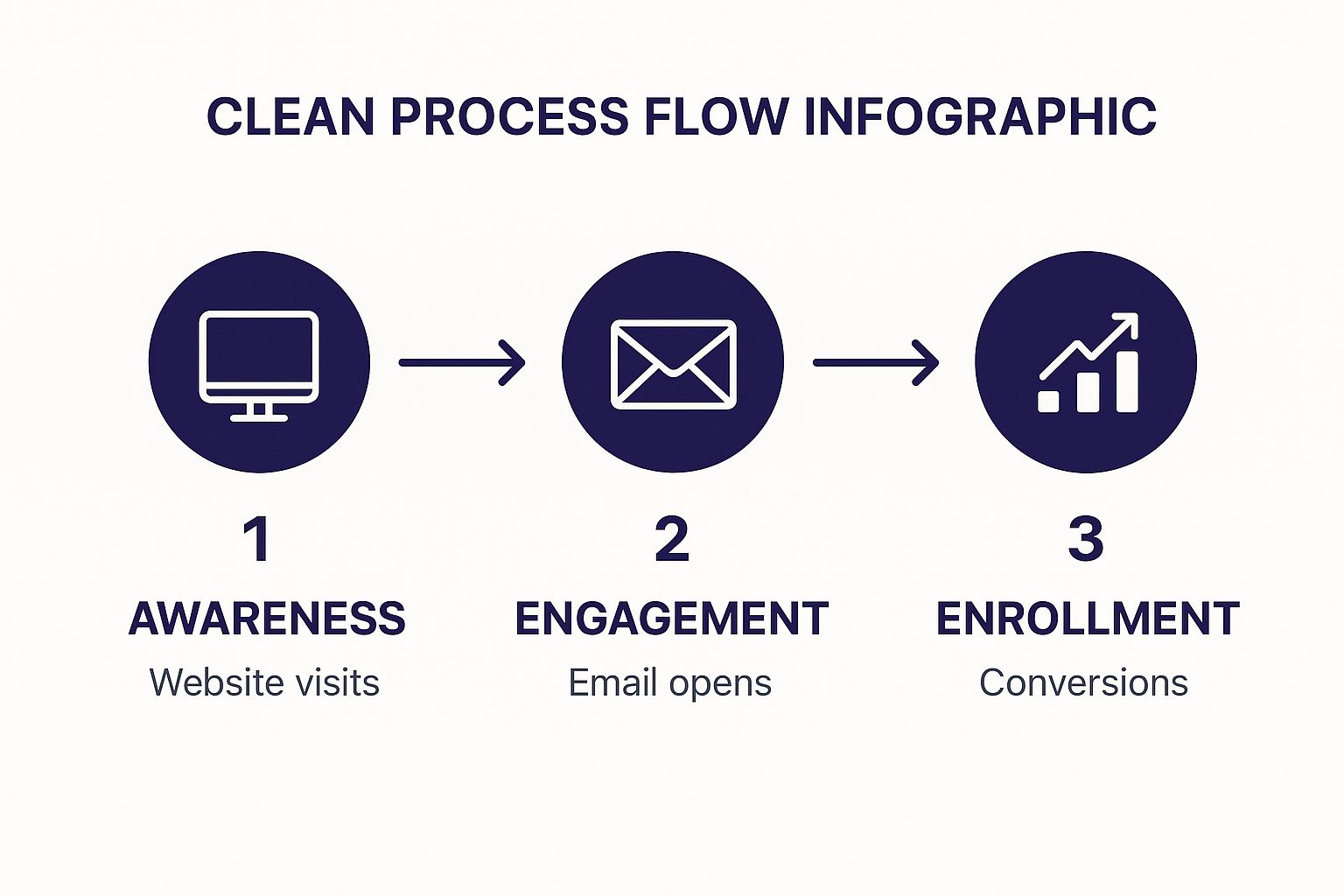
The flow from awareness to conversion highlights how automated engagement can nurture interest into a successful enrollment. At its core, this is one of the most powerful online degree enrollment strategies because it transforms a generic recruitment funnel into a series of tailored, one-on-one conversations at scale, significantly boosting conversion rates by addressing specific pain points and aspirations.
Implementation and Best Practices
Effective journey mapping requires a blend of data analytics, marketing automation, and a deep understanding of student motivations. The goal is to anticipate needs and provide solutions proactively.
- Start with Segmentation: Before full personalization, group your audience into broad segments, such as "undergraduate applicants" or "working professionals." This allows you to create distinct communication tracks that can be refined over time.
- Use Progressive Profiling: Instead of asking for all information upfront in one long form, gather data gradually. Ask for a name and email first, then follow up with questions about academic interests or career goals in subsequent interactions. This reduces friction and builds a richer profile.
- Implement Marketing Automation: Use platforms like Salesforce or Adobe to trigger emails, text messages, or personalized content based on user actions. For instance, if a prospect downloads a brochure for a nursing program, the system can automatically send them a follow-up email with faculty profiles or student testimonials from that specific program.
- Regularly Audit and Update: Student behaviors and program offerings change. Review your journey maps quarterly or biannually to ensure they are still relevant and effective, using analytics to identify drop-off points or areas for improvement.
Key Insight: Personalization is about relevance, not just using a prospect's first name. True personalization delivers the right information at the right moment, demonstrating that you understand the student's unique path and are equipped to help them succeed.
For a deeper look into the mechanics of this approach, you can learn more about student journey mapping on motimatic.com/.
3. Strategic Partnership Development
Building mutually beneficial relationships with employers, professional organizations, and other educational institutions creates powerful pipelines for student enrollment. This strategy leverages trusted, third-party endorsements to expand reach beyond an institution's direct marketing efforts. By establishing formal partnerships, universities can tap into large, motivated audiences and create seamless pathways for students to transition into online degree programs. At its core, this is one of the most effective online degree enrollment strategies because it generates highly qualified leads through established networks. It transforms corporate tuition assistance programs, community college transfer agreements, and professional association benefits into direct recruitment channels, often with lower acquisition costs than traditional advertising.
Implementation and Best Practices
Success in strategic partnerships depends on creating genuine, mutual value. The relationship must benefit the partner organization and its members just as much as it benefits the university's enrollment goals.
- Identify Aligned Partners: Seek out organizations whose values, mission, and member demographics align with your institution's programs. Western Governors University (WGU) excels at this, forming partnerships with major corporations like Amazon and Microsoft whose employees are ideal candidates for its flexible, competency-based online degrees.
- Develop Clear Value Propositions: Tailor your offer to each partner. For corporations, the value is employee upskilling and retention. For community colleges, it is a guaranteed transfer pathway. Arizona State University’s renowned partnership with Starbucks, offering 100% tuition coverage, is a prime example of a powerful, clear value proposition.
- Establish Dedicated Management: Appoint a partnership manager or team responsible for nurturing these relationships. This role involves setting up clear communication channels, co-developing marketing materials, and tracking progress toward shared goals.
- Create Seamless Pathways: Simplify the process for partner members to learn about programs and apply. This can include dedicated landing pages, streamlined application processes, or pre-approved credit transfers, like those in articulation agreements between community colleges and four-year universities.
Key Insight: Partnerships thrive on mutual benefit and shared success. The focus should be on building long-term, sustainable relationships rather than pursuing short-term lead generation. When partners see tangible benefits for their employees or members, they become your most effective advocates.
To see how these corporate-education benefits are structured at scale, platforms like Guild Education demonstrate the framework that connects employees from companies like Walmart and Disney to online degree programs. These models showcase the immense potential of structured, strategic alliances.
4. Data-Driven Predictive Analytics
Leveraging advanced analytics and machine learning, institutions can move from reactive to proactive enrollment management. This strategy involves analyzing vast datasets, including historical enrollment figures, student demographics, and online behaviors, to forecast which prospects are most likely to enroll. By identifying high-potential candidates early, universities can allocate resources more effectively and personalize their outreach for maximum impact. At its core, this is one of the most powerful online degree enrollment strategies because it replaces guesswork with data-backed certainty. Instead of casting a wide net, predictive analytics allows enrollment teams to focus their efforts on individuals with the highest probability of converting, thereby increasing efficiency and ROI.
Implementation and Best Practices
Successful implementation requires a commitment to data quality and a phased approach to model development. The goal is to build a reliable system that generates actionable insights for the admissions team.
- Standardize Data Collection: Ensure that all prospect and applicant data is collected in a clean, standardized format. This foundational step is critical for accurate modeling. Start by consolidating information from your CRM, SIS, and marketing platforms into a single source of truth.
- Start with Simple Models: Begin with simpler predictive models, such as logistic regression, to identify key indicators of enrollment.
- Validate and Refine Models: Continuously test your models against new data to ensure their accuracy. As you gather more information, you can advance to more complex algorithms.
- Invest in Training and Compliance: Equip your staff with the skills to use analytics tools effectively and ensure all data handling practices comply with privacy regulations like FERPA and GDPR.
Key Insight: Predictive analytics is not just about identifying top applicants. It is about understanding the entire student journey. Use insights to optimize every touchpoint, from initial inquiry to final enrollment, creating a more personalized and supportive experience for prospective students.
5. Flexible Admission and Enrollment Processes
For non-traditional students, particularly working adults, a cumbersome and rigid application process can be a significant barrier to enrollment. Flexible admission and enrollment processes are designed to remove this friction by streamlining the entire journey from application to registration. This strategy involves simplifying application forms, offering multiple start dates, and leveraging technology to create a convenient, digital-first experience that accommodates the busy schedules of modern learners. At its core, this is one of the most impactful online degree enrollment strategies because it directly addresses the practical needs of the target audience. By making it easier and faster for a prospective student to apply and enroll, institutions can dramatically reduce application abandonment rates and accelerate the conversion of interested prospects into fully enrolled students.
Implementation and Best Practices
Successfully implementing a flexible process requires a thorough review of existing procedures to identify and eliminate bottlenecks. The goal is to make every step intuitive, supportive, and efficient.
- Map the Current Enrollment Journey: Begin by mapping every touchpoint a student encounters, from initial inquiry to final registration. This helps identify friction points, such as lengthy forms, redundant information requests, or long waiting periods for decisions.
- Implement Multiple Start Dates: Instead of traditional fall and spring semesters, offer rolling admissions with monthly or bi-monthly start dates. Southern New Hampshire University (SNHU) excels at this, providing numerous start dates throughout the year, allowing students to begin their studies when it best suits them.
- Simplify the Application: Reduce the time and effort required to apply. The University of Maryland Global Campus (UMGC) offers a streamlined online application that can be completed in under 30 minutes, significantly lowering the barrier to entry.
- Use Progress Indicators and Automation: Implement clear progress bars within the online application to show applicants how far they have come. Use automation to send instant confirmation emails and regular status updates, keeping applicants engaged and informed.
Key Insight: Flexibility demonstrates that the institution understands and respects the student's time. A process that is simple, fast, and transparent signals that the educational experience will be similarly student-centric, building trust before the first class even begins.
Institutions like Western Governors University (WGU) have built their entire model around this concept, with a competency-based structure that allows for monthly starts. To learn more about modernizing these critical systems, you can explore detailed guides on optimizing the student enrollment process. This approach not only boosts enrollment numbers but also attracts motivated, self-directed learners who thrive in a flexible environment.
6. Content Marketing and Thought Leadership
Establishing your institution as a trusted authority is a powerful, long-term enrollment driver. Content marketing and thought leadership involve creating and distributing valuable, relevant, and consistent content to attract and retain a clearly defined audience. This strategy positions your institution not just as a provider of degrees, but as a credible expert and indispensable resource in a student's career and educational journey.
This approach goes beyond direct advertising by demonstrating the quality and relevance of your academic programs through expertise. By addressing prospective students' career concerns, analyzing industry trends, and offering educational insights, you build trust and attract high-intent applicants who are seeking knowledge, not just a sales pitch.
At its core, this is one of the most sustainable online degree enrollment strategies because it creates assets that generate organic traffic and leads over time. It nurtures prospects from initial awareness to application by consistently proving the value your institution provides.
Implementation and Best Practices
Success in content marketing requires a commitment to quality and a deep understanding of your audience’s informational needs. Your goal is to become the go-to source for insights in the fields you teach.
- Leverage Faculty Expertise: Your faculty members are your greatest thought leadership assets. Feature them in blog posts, webinars, podcasts, and research summaries.
- Focus on Evergreen Content: Create comprehensive guides, in-depth articles, and resource hubs that remain relevant long after publication. This content, which addresses timeless student questions about career paths or skill development, will continuously attract organic search traffic.
- Repurpose Content Across Channels: A single piece of research or a webinar can be repurposed into multiple formats: a blog post series, an infographic, social media snippets, and a podcast episode. This maximizes your reach and caters to different content consumption preferences.
- Collaborate for Wider Reach: Partner with industry publications or respected professionals to co-author articles or host joint webinars.
Key Insight: Thought leadership isn't about promoting your programs directly; it's about showcasing the intellectual capital behind them. When you provide genuine value and expertise, you build an audience that trusts your institution and is therefore more likely to enroll when they are ready to commit.
7. Retention-Focused Enrollment Strategy
A truly sustainable enrollment plan looks beyond just getting students in the door; it focuses on keeping them there until graduation. A retention-focused enrollment strategy integrates student success and persistence from the very first interaction. This approach ensures that admitted students are not only academically qualified but also well-supported and likely to complete their programs, recognizing that long-term growth is built on high retention rates, not just high application numbers. This approach is one of the most critical online degree enrollment strategies because it directly combats the "leaky bucket" problem where new student numbers are offset by high dropout rates. It shifts the institutional mindset from a transactional recruitment model to a relational one, prioritizing student fit, support, and long-term success. The goal is to enroll students who will thrive and become proud alumni.
Implementation and Best Practices
Executing this strategy requires a proactive, data-informed, and institution-wide commitment to student success. It's about building a supportive ecosystem that begins long before the first day of class.
- Integrate Support from Day One: Don't wait for students to struggle. Leverage advisors to serve as a consistent guide, helping with course registration, navigating university systems, and connecting students with resources before problems arise.
- Use Predictive Analytics: Leverage data to identify students who may be at risk of dropping out. This model can be adapted for online learners by tracking engagement with the learning management system (LMS).
- Provide Clear Program Roadmaps: Give students a clear, semester-by-semester path to completion. Outline required courses, potential electives, and key milestones. This transparency helps manage expectations and reduces the uncertainty that can lead to attrition, especially for adult learners balancing school with other commitments.
- Create Multiple Engagement Touchpoints: Develop a structured communication plan that includes welcome calls, check-in emails, virtual town halls, and faculty office hours.
Key Insight: The best enrollment strategy is an effective retention strategy. By focusing on enrolling students who are a good fit and providing them with robust, proactive support, you create a virtuous cycle of student success, positive word-of-mouth, and stable, long-term enrollment growth.
To further develop this approach, institutions can explore various methods for keeping students engaged and on track. You can learn more about how to apply these principles by reading up on five proven strategies to improve student retention. This integrated perspective ensures your recruitment efforts lead to lasting success for both the student and the institution.
8. Omnichannel Communication Strategy
An omnichannel communication strategy creates a seamless, integrated experience for prospective students across every touchpoint. This approach unifies interactions from email, text messages, phone calls, social media, and live chat, ensuring conversation continuity and consistent messaging. Unlike a multi-channel approach where platforms operate in silos, an omnichannel strategy allows a student to start a conversation on a website chatbot and seamlessly continue it with an admissions advisor via email without having to repeat themselves. This method is one of the most powerful online degree enrollment strategies because it places the prospective student at the center of the communication ecosystem. It acknowledges that modern learners use multiple channels and expect a fluid, personalized journey. By providing this consistency, institutions can build stronger relationships and guide prospects more effectively through the complex enrollment funnel.
Implementation and Best Practices
Successful execution requires a unified technology stack and a commitment to a student-centric culture. The focus is on creating a single, persistent conversation thread that follows the prospect across their preferred channels.
- Implement a Unified CRM or Communication Platform: Use a platform like Salesforce or Zendesk to create a single view of each prospective student. This allows any team member to see the full history of interactions, regardless of the channel used.
- Map the Student Communication Journey: Identify all potential touchpoints a prospect might have, from initial inquiry to application submission. Plan how communications will flow between channels at each stage, ensuring a logical and helpful progression.
- Train Staff on Consistent Messaging and Tone: All staff interacting with prospects, from marketing to admissions, must be trained to use a consistent brand voice and messaging. This reinforces institutional identity and builds trust.
- Integrate Automation with Human Touch: Use automation for instant responses and routine queries (e.g., chatbots answering FAQ), but ensure a smooth handoff to a human agent for more complex questions.
Key Insight: The core principle of an omnichannel strategy is conversation continuity. The goal is to make the experience so seamless that the student doesn't notice the channel shifts, only that their needs are being met efficiently and personally. This builds trust and significantly reduces friction in the enrollment process.
Institutions looking to build this capability can learn from platforms popularized by customer service leaders like Zendesk, which offer solutions for creating integrated communication experiences. Penn Foster, known for its extensive online programs, also demonstrates this well by providing cohesive student support across text, email, and phone, ensuring learners receive consistent guidance no matter how they choose to connect.
Online Degree Enrollment Strategies Comparison
| Strategy | Implementation Complexity 🔄 | Resource Requirements ⚡ | Expected Outcomes 📊 | Ideal Use Cases 💡 | Key Advantages ⭐ |
|---|---|---|---|---|---|
| Digital Marketing and Social Media Outreach | Medium to High – requires managing multiple digital channels and frequent optimization | Moderate – skilled staff, advertising budget, analytics tools | Wide reach, targeted lead generation, brand awareness | Attracting diverse online prospects across demographics | Cost-effective, real-time analytics, personalized messaging at scale |
| Personalized Student Journey Mapping | High – complex multi-stage workflows and tech integration | High – CRM, marketing automation platforms, behavioral tracking | Higher conversion rates, improved student experience | Nurturing prospects with tailored communication paths | Relevant messaging, better resource allocation, increased enrollment |
| Strategic Partnership Development | Medium to High – relationship building and contract management | Moderate – dedicated roles, legal and negotiation resources | Steady enrollment pipeline through trusted referrals | Building external referral and co-marketing networks | Access to motivated students, shared marketing costs, enhanced credibility |
| Data-Driven Predictive Analytics | High – advanced analytics, machine learning expertise needed | High – specialized staff, technology platforms, data management | Higher conversion, improved ROI, targeted marketing | Optimizing targeting and early identification of prospects and risks | Data-backed decisions, continuous optimization, early risk detection |
| Flexible Admission and Enrollment Processes | Medium – process redesign and digital platform implementation | Moderate – technology investment, staff training | Reduced enrollment friction, faster application completion | Serving working adults and non-traditional students | Convenience, higher application completion rates, competitive edge |
| Content Marketing and Thought Leadership | Medium to High – requires ongoing quality content creation | Moderate – content creators, subject matter experts | Builds trust and credibility, long-term brand equity | Establishing authority and guiding prospects through education | SEO improvement, shareable content, showcases expertise |
| Retention-Focused Enrollment Strategy | High – cross-departmental coordination and support services | High – support services, analytics, staff training | Higher retention and graduation rates | Focusing on sustainable enrollment growth via student success | Improved reputation, ROI on recruitment, positive word-of-mouth |
| Omnichannel Communication Strategy | High – complex integration across multiple platforms | High – CRM, communication tools, staff training | Improved engagement, consistent messaging, better tracking | Seamless communication across diverse channels | Enhanced student satisfaction, efficient workflows, increased accessibility |
Integrating Your Strategies for Sustainable Growth
Navigating the competitive landscape of higher education requires more than just a list of tactics; it demands a cohesive, integrated approach. Throughout this guide, we've explored a powerful suite of eight distinct yet interconnected online degree enrollment strategies, moving from initial digital outreach to long-term student retention. The true catalyst for enrollment growth isn't found in mastering a single one of these pillars, but in skillfully weaving them together into a seamless, student-centric system. An isolated digital marketing campaign, however brilliant, will fall short if it leads prospective students to a rigid and confusing admissions process. Likewise, sophisticated predictive analytics are only valuable if they inform a personalized, omnichannel communication plan that genuinely supports and motivates applicants. Success lies in recognizing that these strategies are not independent functions but gears in a single, powerful recruitment engine.
From Silos to Synergy: A Holistic Recap
The journey to boosting enrollment is a multi-stage process, and your strategy must reflect that. Let's briefly revisit how these core components work in concert to create a powerful, unified approach.
- Attraction and Engagement: Your efforts begin with Digital Marketing and Content Marketing, which cast a wide but targeted net to attract prospective students. This is reinforced by Strategic Partnerships, which lend third-party credibility and open new channels for lead generation.
- Nurturing and Conversion: Once a prospect shows interest, Personalized Student Journey Mapping and an Omnichannel Communication Strategy take over. These elements ensure that every interaction, from email to text message, is relevant, timely, and supportive, guiding the applicant smoothly toward the next step.
- Data-Informed Decision-Making: Underpinning this entire process are Data-Driven Predictive Analytics. This isn't just about tracking clicks; it's about understanding behavior, identifying at-risk applicants, and allocating resources effectively to have the greatest impact on conversion.
- Access and Retention: Finally, a Flexible Admissions Process removes unnecessary friction, while a Retention-Focused Enrollment Strategy ensures that the promises made during recruitment translate into a supportive student experience from day one. This final piece is critical, as today's successful students become tomorrow's most powerful testimonials.
Your Actionable Blueprint for Integration
Moving from theory to practice requires a deliberate plan. To transform your collection of tactics into a truly integrated ecosystem of online degree enrollment strategies, focus on these critical next steps:
- Conduct a Strategy Audit: Gather your marketing, admissions, and student success teams. Map out your current processes against the eight strategies discussed. Where are the gaps? Where are the points of friction or disconnect between departments?
- Prioritize One Integration Point: Don't try to fix everything at once. Identify the most impactful connection to build first. For example, focus on linking your predictive analytics insights directly to your omnichannel communication triggers to better support wavering applicants.
- Foster Cross-Functional Collaboration: Create a standing "Enrollment Growth" committee with representatives from each key department. Mandate shared goals and KPIs that force teams to break down silos and work together toward the common objective of sustainable enrollment.
- Invest in Centralized Technology: The most effective online degree enrollment strategies are powered by technology that unifies data and automates personalized communication. Platforms that connect marketing outreach with admissions workflows and behavioral insights are no longer a luxury; they are a necessity for scalable success.
By viewing these strategies not as a checklist but as an interconnected framework, you shift your institution’s focus from simple lead generation to building meaningful, supportive relationships with prospective students. This holistic philosophy doesn't just fill seats for the next term; it builds a resilient, adaptive, and scalable foundation for long-term institutional health and, most importantly, student success.
Ready to unify your outreach and activate your applicants with proven, science-backed communication? Motimatic specializes in integrating behavioral science and automated, personalized messaging to turn your enrollment strategies into measurable results. Discover how platforms like Pathway Intelligence™ can transform your data into a powerful, motivating force for your prospective students at Motimatic.
See it on your own listOne list, one goal, and a randomized holdout to show the lift. Start a pilot