

In the dynamic landscape of higher education, attracting, enrolling, and retaining the right students is more challenging than ever. Institutions face a perfect storm of demographic shifts, evolving student expectations, and intense competition. Success is no longer about simply filling seats; it's about building a thriving, sustainable academic community. This requires a shift from traditional tactics to sophisticated, data-driven enrollment management strategies.
This comprehensive guide will explore 10 proven strategies that empower enrollment teams to not only meet their goals but to exceed them. We will move beyond theory to provide actionable insights and practical examples that address every stage of the student lifecycle. Readers will learn how to implement everything from holistic Strategic Enrollment Management (SEM) frameworks and predictive analytics to targeted financial aid optimization and robust student success programs.
The focus is on providing a clear roadmap for modernizing your approach. You will discover how to effectively leverage Customer Relationship Management (CRM) systems, enhance digital marketing, and optimize your enrollment funnel for better conversion. We will also cover specific tactics for engaging transfer students and building early college pipelines. From initial inquiry through graduation, these enrollment management strategies will equip your institution to make smarter decisions, optimize resources, and ultimately, foster lasting student success. Get ready to transform your institution's approach to building its future student body.
1. Strategic Enrollment Management (SEM)
Strategic Enrollment Management, or SEM, is not just a single tactic but a foundational philosophy for institutional success. Popularized by pioneers like Don Hossler and Jim Black, SEM is a comprehensive, campus-wide framework that aligns an institution's academic programs, student services, and financial resources with its long-term enrollment objectives. It moves beyond the traditional, siloed approach of an admissions office working in isolation, creating a cohesive ecosystem dedicated to the entire student lifecycle, from recruitment to graduation and beyond.

This holistic approach integrates functions like admissions, financial aid, registrar, academic advising, and student affairs under a unified strategic plan. The core idea is to use data-driven insights to make informed decisions that attract the right students, support their success, and ensure the institution’s financial stability and academic vitality.
Why It's a Top Strategy
Implementing a full SEM plan is one of the most powerful enrollment management strategies because it addresses the root causes of enrollment challenges, rather than just treating symptoms. It fosters a culture of shared responsibility for enrollment health across the entire campus. For example, Arizona State University leveraged SEM principles to drive unprecedented growth and innovation, while Northeastern University successfully transformed its institutional profile from a regional commuter school to a top-tier national research university by strategically managing its enrollment.
How to Implement a SEM Framework
A successful SEM plan requires a structured, top-down and bottom-up approach. Start by securing buy-in from senior leadership, as their commitment is essential for allocating resources and breaking down departmental barriers.
- Establish a SEM Council: Create a cross-functional committee with representatives from key areas like admissions, marketing, finance, academic affairs, and student life. This group will be responsible for developing and overseeing the SEM plan.
- Invest in Data Infrastructure: You cannot manage what you do not measure. Implement robust CRM and data analytics platforms to track every stage of the student journey, from initial inquiry to alumni engagement.
- Set Shared Goals: Develop clear, quantifiable goals that all departments can work toward. These might include targets for application numbers, yield rates, student diversity, retention rates, and net tuition revenue.
- Iterate and Optimize: SEM is not a "set it and forget it" plan. Schedule regular reviews of your data and strategies to assess what’s working and what isn’t, allowing your team to remain agile and responsive to market changes.
2. Predictive Analytics and Enrollment Modeling
Predictive analytics and enrollment modeling leverage statistical algorithms, machine learning, and data mining to forecast future student behavior. Pioneered by organizations like EAB and Civitas Learning, this approach analyzes vast amounts of historical data to identify patterns and predict outcomes, such as a prospective student’s likelihood to apply, enroll, or persist. It transforms recruitment from a numbers game into a precise, data-informed science.

By creating sophisticated models, institutions can move beyond simple demographic segmentation and understand the nuanced factors that drive individual student decisions. This allows for hyper-personalized communication, strategic resource allocation, and proactive interventions, making every interaction with a student more meaningful and effective.
Why It's a Top Strategy
This data-first approach is one of the most impactful enrollment management strategies because it allows institutions to focus their limited resources on students who are the best fit and most likely to succeed. Instead of casting a wide, expensive net, teams can prioritize engagement with high-propensity prospects. For instance, Georgia State University famously used predictive analytics to identify at-risk students and provide timely support, improving its graduation rates. Similarly, the University of Arizona increased its yield by strategically deploying financial aid based on predictive models.
How to Implement Predictive Analytics
Successfully integrating predictive analytics requires a blend of quality data, the right expertise, and a commitment to action based on the insights generated. The goal is to build models that are both accurate and actionable for your team.
- Start with Clean Data: Your models are only as good as the data they are built on. Begin by consolidating and cleaning your historical data from various sources, including your SIS, CRM, and financial aid systems, to create a comprehensive dataset.
- Secure the Right Expertise: Developing effective models requires specialized skills. Partner with an experienced vendor like Ruffalo Noel Levitz or hire in-house data scientists who can build, test, and manage the analytics infrastructure.
- Build Incrementally: Don't try to predict everything at once. Start with a simple, high-impact model, such as an "enrollment likelihood" score for applicants. As you gain confidence and see results, you can develop more complex models for retention, student success, and alumni giving.
- Validate and Refine Models: The factors influencing student decisions change over time. Regularly validate your models against new data to ensure their accuracy and refine the algorithms to maintain their predictive power. Ensure all practices are compliant with data privacy regulations like FERPA.
3. Yield Management and Revenue Optimization
Yield management is a sophisticated strategy, adapted from the airline and hospitality industries, that focuses on maximizing both enrollment numbers and net tuition revenue. Pioneered in higher education by firms like Ruffalo Noel Levitz and the Art & Science Group, this approach involves strategically adjusting admissions standards and financial aid packages to shape the incoming class. It moves beyond simply awarding aid based on need or merit alone, using data models to predict which offers are most likely to result in an enrolled student who meets the institution’s academic and financial goals. This method treats financial aid as a powerful lever to influence student choice. By analyzing historical data, institutions can determine the optimal "price point" or aid amount for different student segments. The objective is to enroll a diverse, high-achieving class while ensuring the institution remains financially sustainable, a critical balance in today's competitive landscape.
Why It's a Top Strategy
This data-driven pricing is one of the most effective enrollment management strategies for institutions facing intense financial pressure. It allows for the precise allocation of limited financial aid dollars to achieve specific outcomes, such as increasing net revenue, improving academic profile, or enhancing geographic diversity. For example, Carnegie Mellon University famously used sophisticated yield modeling to increase its net revenue by millions, while the University of Rochester has long leveraged strategic aid to improve its financial standing without sacrificing student quality. As colleges face a demographic downturn, focusing on the quality and financial health of an incoming class is paramount. Learn more about why quality is the new KPI in enrollment.
How to Implement Yield Management
Successfully implementing yield management requires a commitment to data, analytics, and a clear understanding of institutional priorities. It is a delicate balance between achieving revenue targets and upholding a commitment to access and equity.
- Develop Clear Institutional Priorities: Before optimizing, define your goals. Are you trying to boost net revenue, raise your academic profile, increase diversity, or a combination? Your strategy must align with these top-level objectives.
- Invest in Financial Aid Optimization Tools: Utilize robust software and predictive modeling platforms. These tools analyze historical data to forecast the yield probability of individual applicants at various aid levels.
- Train Staff on Ethical Considerations: Ensure your admissions and financial aid teams understand the ethical implications of differential packaging. Transparency and a commitment to access for underserved populations must remain central to your mission.
- Monitor Competitor Strategies: Stay informed about how your direct competitors are pricing themselves and awarding aid. This market intelligence is crucial for positioning your institution effectively.
- Assess Impact on Access and Diversity: Regularly audit the results of your yield management strategy to ensure it is not inadvertently creating barriers for low-income or underrepresented students. Make adjustments to protect and enhance student diversity.
4. Customer Relationship Management (CRM) Systems
A Customer Relationship Management (CRM) system is the technological backbone of modern student recruitment and retention. Platforms like Slate and Salesforce Education Cloud are comprehensive databases that manage and analyze all interactions with prospective and current students. They move institutions away from scattered spreadsheets and siloed communications, creating a centralized hub for every touchpoint in the student lifecycle, from the first website visit to alumni donation campaigns. These systems are designed to automate and personalize communication at scale. By tracking every email opened, event attended, and application milestone, enrollment teams can deliver the right message to the right student at the right time, fostering a sense of individual connection that is critical in a competitive market.
Why It's a Top Strategy
Implementing a higher education CRM is one of the most impactful enrollment management strategies because it directly translates data into personalized action and operational efficiency. It provides the infrastructure needed to execute sophisticated, multi-channel marketing campaigns and gives admissions counselors the detailed insights they need for meaningful conversations. These systems turn raw data into measurable enrollment outcomes.
How to Implement a CRM System
Successfully rolling out a CRM requires a strategic plan that prioritizes user adoption and data integrity. It is as much a change management project as it is a technology implementation.
- Choose a Higher-Ed Specific CRM: Select a platform built for the unique needs of the student lifecycle, like Slate or Salesforce Education Cloud. To effectively manage prospective student interactions and streamline the recruitment process, exploring resources like the 10 Best Lead Management Software for Sales Teams can provide valuable insights.
- Prioritize Staff Training: Ensure comprehensive training for all users. An underutilized CRM is a wasted investment. Focus on building staff confidence and demonstrating how the tool makes their jobs easier and more effective.
- Integrate and Consolidate: Connect your CRM with other campus systems, such as the Student Information System (SIS) and financial aid software, to create a single source of truth for all student data.
- Maintain Data Hygiene: Establish clear protocols for data entry and schedule regular data cleaning processes. High-quality data is essential for accurate reporting, effective segmentation, and reliable personalization.
5. Digital Marketing and Social Media Engagement
In an era where prospective students are digital natives, a comprehensive digital marketing strategy is no longer optional, it’s essential. This approach involves leveraging a full suite of online channels, including social media, search engine optimization (SEO), content marketing, and paid digital advertising, to reach, engage, and convert modern learners. It moves beyond traditional recruitment tactics to meet students where they spend their time: online.

This strategy is about creating an authentic, engaging online presence that reflects the institution's brand and values. By understanding the digital behaviors of Gen Z and millennials, universities can build relationships and guide prospects through the enrollment funnel. Methodologies from leaders like HubSpot and Carnegie Dartlet have helped formalize these digital-first approaches for higher education.
Why It's a Top Strategy
A dynamic digital presence is one of the most effective enrollment management strategies because it provides a direct, measurable line of communication with your target audience. It allows institutions to tell their story on a massive scale while still enabling personalized interactions. For instance, Arizona State University's innovative social media campaigns reach millions, while the University of Alabama's viral TikTok content has successfully captured the attention of Gen Z. Similarly, Penn State used a comprehensive digital marketing plan to increase inquiries, demonstrating the direct impact on enrollment goals.
https://www.youtube.com/embed/SIWnPyMin5k
How to Implement Digital and Social Strategies
Success in the digital space requires a plan that is both strategic and adaptable. Developing a robust social media content strategy is a critical first step for connecting authentically with prospective students.
- Develop Authentic, Student-Focused Content: Move beyond generic campus photos. Create content that features real student stories, faculty passion projects, and day-in-the-life takeovers. Authenticity builds trust and relatability.
- Utilize Video Content: Short-form video on platforms like TikTok and Instagram Reels is king. Use it to showcase campus life, explain complex academic programs in a simple way, or answer frequently asked questions.
- Maintain a Consistent Brand Voice: Whether on LinkedIn, Instagram, or your university blog, your tone and messaging should be consistent. This reinforces your institution's identity and values.
- Engage with Your Audience: Social media is a two-way conversation. Respond to comments, answer direct messages, and run interactive polls or Q&A sessions to foster a sense of community.
- Track and Analyze Performance: Use analytics tools to monitor key metrics like engagement rates, reach, and conversion. This data is crucial for understanding what resonates with your audience and optimizing future campaigns for better results.
6. Early College and Dual Enrollment Programs
Early College and Dual Enrollment programs are strategic partnerships between higher education institutions and high schools, allowing students to earn college credit before graduating from high school. These initiatives serve as powerful recruitment pipelines by offering students early, meaningful exposure to a college's academic environment. Championed by organizations like the National Alliance of Concurrent Enrollment Partnerships (NACEP), these programs meet the growing demand for accelerated academic pathways and affordability. This model involves either high school instructors, credentialed by the partner college, teaching college-level courses on-site at the high school, or students attending classes on the college campus. The goal is to create a seamless transition from secondary to postsecondary education, giving students a head start on their degree while building institutional loyalty from an early age.
Why It's a Top Strategy
These partnerships are among the most effective enrollment management strategies because they create a direct, long-term recruitment funnel. Institutions build relationships with promising students, their families, and high school counselors well before the traditional application cycle begins. For instance, the University of Connecticut's Early College Experience (ECE) program serves over 40,000 students annually, while Syracuse University's Project Advance has successfully engaged students in hundreds of high schools, creating a strong brand presence and a reliable pipeline of well-prepared applicants.
How to Implement Dual Enrollment Partnerships
Building a successful dual enrollment program requires a commitment to quality control and strong inter-institutional collaboration. It's more than just a transactional agreement; it's a deep academic partnership.
- Establish Clear Quality Standards: Work with organizations like NACEP to ensure your courses, instructors, and student outcomes meet rigorous collegiate standards. This maintains the academic integrity of your institution's credits.
- Provide Comprehensive Instructor Training: Offer robust professional development and ongoing support for the high school teachers delivering your curriculum. Ensure they feel like extensions of your faculty.
- Streamline Credit Transfer and Advising: Create a clear, frictionless pathway for students to apply their earned credits toward a degree at your institution. Dedicated advising is crucial for this process.
- Develop a Recruitment Pipeline: Don't assume dual enrollment students will automatically matriculate. Implement a targeted communication plan that nurtures these students, highlighting the benefits of continuing their education with you and simplifying their application process.
7. Financial Aid Optimization and Strategic Discounting
Financial Aid Optimization is a sophisticated, data-driven approach to distributing institutional aid. It moves beyond simply awarding aid based on need and instead uses predictive modeling and analytics to craft financial aid packages that maximize enrollment yield while carefully managing net tuition revenue. Popularized by consulting firms like Ruffalo Noel Levitz and Maguire Associates, this strategy involves analyzing a student's price sensitivity and ability to pay to create targeted offers that directly influence their enrollment decision. At its core, strategic discounting is not about giving the most aid to every student. It's about allocating the right amount of aid to the right student at the right time to achieve specific institutional goals, whether that's increasing yield, shaping the academic profile of the incoming class, or boosting diversity. This ensures that aid dollars are used as a strategic investment rather than just an expense.
Why It's a Top Strategy
This method is one of the most impactful enrollment management strategies because it directly links financial aid to enrollment outcomes and institutional financial health. It empowers institutions to be more deliberate and effective with their largest expenditure after salaries. For instance, the University of Rochester successfully used aid optimization to increase its net revenue, while Carleton College has leveraged strategic aid to consistently improve its yield among highly sought-after students. Case Western Reserve University also used a merit aid strategy to dramatically reshape its class composition and elevate its national standing.
How to Implement Financial Aid Optimization
Successfully implementing this strategy requires a blend of advanced data analysis, clear policy, and ethical considerations. It is a powerful tool that must be wielded responsibly.
- Invest in Predictive Modeling: Partner with a specialized firm or build in-house capacity to analyze historical data. This model should predict an individual student's likelihood to enroll at various levels of aid, considering factors far beyond GPA and test scores.
- Segment Your Applicant Pool: Don't treat all applicants the same. Group students by academic profile, geographic location, intended major, and demonstrated interest. Tailor your aid strategies for each distinct segment.
- Balance Competing Goals: Define your primary objectives. Are you focused on maximizing net revenue, improving your academic profile, or increasing access and diversity? Your aid leveraging strategy must be aligned with these goals, which often requires making trade-offs.
- Monitor and Maintain Transparency: Continuously track results to see how your aid packages are affecting yield and revenue. Be prepared to adjust your models annually. Importantly, ensure your aid processes remain transparent and are communicated clearly to students and families to maintain trust.
8. Student Success and Retention Programs
Effective enrollment management extends far beyond the initial recruitment phase; it encompasses the entire student journey. Student Success and Retention Programs are comprehensive, data-informed initiatives designed to support students academically, socially, and personally from orientation to graduation. Popularized by the work of pioneers like John Gardner and Vincent Tinto, these programs shift the focus from merely acquiring students to ensuring they thrive and complete their degrees. They are a core pillar of modern enrollment management strategies. These programs recognize that retaining a student is more cost-effective than recruiting a new one. They integrate various campus services, including academic advising, tutoring, mental health support, and career services, into a cohesive support network. The goal is to proactively identify and address student challenges before they lead to attrition, thereby protecting enrollment numbers and bolstering institutional health.
Why It's a Top Strategy
Investing in student success is one of the most impactful enrollment management strategies because it directly addresses the "leaky bucket" problem that many institutions face. A one-percentage-point increase in retention can have a more significant financial impact than a substantial increase in new student enrollment. For example, Georgia State University used data analytics and proactive advising to raise its graduation rates, reducing achievement gaps based on race and income. Similarly, other institutional frameworks provide students with structured pathways and intensive advising, leading to higher completion rates.
How to Implement Student Success and Retention Programs
Building an effective retention program requires a proactive, student-centered, and data-driven approach. It starts with creating a campus culture where every department feels responsible for student success.
- Implement Early Warning Systems: Use predictive analytics based on academic data (like grades and class attendance) and engagement metrics from your learning management system to identify at-risk students early. This allows for timely and targeted interventions.
- Create a Robust First-Year Experience (FYE): Develop a comprehensive FYE program, including orientation, first-year seminars, and learning communities. These initiatives help students build social connections and acclimate to the academic demands of college life.
- Provide Layered Support: Offer a multi-tiered system of support that includes peer mentoring, professional tutoring centers, supplemental instruction, and accessible mental health services to address a wide range of student needs. For additional ideas, you can explore more strategies to improve student retention on motimatic.com/.
- Assess and Refine: Continuously track retention, persistence, and graduation rates. Use this data, along with student surveys and focus groups, to regularly evaluate the effectiveness of your programs and make necessary adjustments.
9. Transfer Student Recruitment and Articulation
Focusing on transfer students is a powerful and often overlooked enrollment management strategy. This approach involves creating intentional, seamless pathways for students moving from community colleges or other four-year institutions. It's about more than just accepting transfer credits; it's about building dedicated partnerships, clear articulation agreements, and specialized support systems that recognize the unique needs and value of this growing student population. A robust transfer strategy acknowledges that the traditional "first-time, full-time" freshman is no longer the only model for a college student. By proactively recruiting and supporting transfers, institutions can tap into a diverse, motivated, and often more mature pool of applicants, helping to stabilize enrollment and achieve diversity goals. Initiatives like the Jack Kent Cooke Foundation's scholarships and Phi Theta Kappa's honor society partnerships have highlighted the academic potential of this key demographic.
Why It's a Top Strategy
Developing a strong transfer pipeline is one of the most effective enrollment management strategies because it directly addresses declining freshman applicant pools and creates a sustainable, alternative enrollment stream. These students often arrive with a proven academic record and higher completion rates. For instance, George Mason University’s ADVANCE program creates a direct, streamlined pathway for Northern Virginia Community College students, while the University of California system's Transfer Admission Guarantee (TAG) programs offer qualified students guaranteed admission, making the transfer process predictable and attractive.
How to Implement a Transfer-Focused Strategy
Building a successful transfer program requires a commitment to removing barriers and fostering strong inter-institutional relationships. The goal is to make the transition as smooth and transparent as possible.
- Develop Clear Articulation Agreements: Work with top feeder institutions, especially community colleges, to create official agreements that guarantee how credits will transfer. Publish these pathways clearly on your website.
- Create Dedicated Transfer Support: Appoint admissions counselors and academic advisors who specialize in transfer students. They can provide expert guidance on credit evaluation, degree planning, and financial aid. Learn more about building effective transfer pathways on motimatic.com/.
- Offer Transfer-Specific Programs: Design orientation, welcome events, and mentoring programs specifically for transfers to help them integrate socially and academically into your campus community.
- Provide Online Evaluation Tools: Invest in self-service online tools that allow prospective transfers to get an unofficial estimate of how their credits will apply to a specific major, empowering them early in their decision-making process.
10. Enrollment Funnel Management and Conversion Optimization
Enrollment Funnel Management is a systematic, data-driven approach to guiding prospective students through each stage of their journey, from initial awareness to final enrollment. Inspired by inbound marketing and customer journey mapping principles from platforms like HubSpot and Salesforce, this strategy focuses on identifying and eliminating bottlenecks in the admissions process. It treats the path to enrollment as a conversion funnel where success is measured by maximizing the percentage of students who advance from one stage to the next.
This infographic illustrates the key conversion points within a typical enrollment funnel, showing the progression from initial interest to a confirmed seat.
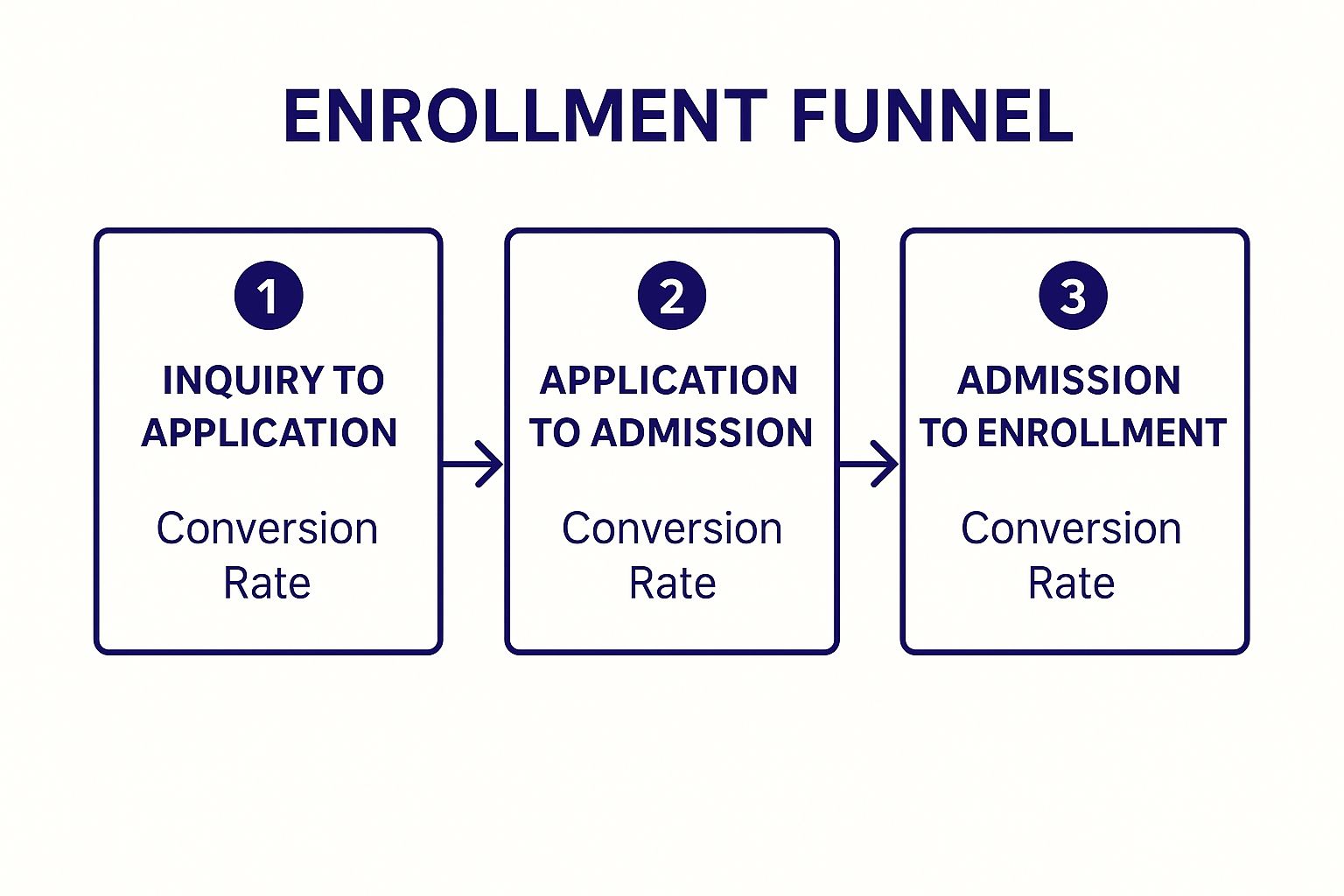
By tracking the conversion rates at each stage, from inquiry to application and admission to enrollment, institutions can pinpoint exactly where they are losing potential students and focus their resources more effectively.
Why It's a Top Strategy
This is one of the most critical enrollment management strategies because it shifts the focus from broad recruitment activities to targeted, high-impact interventions. Instead of just trying to generate more leads at the top of the funnel, it optimizes the entire student pipeline for maximum yield. For example, Boston University used funnel analysis to streamline its application process, leading to a significant increase in completion rates. Similarly, the University of Florida meticulously optimized its post-admission communications, which helped boost its yield rate by a remarkable 18%.
How to Implement Funnel Management
Effective funnel management requires a deep understanding of your specific student journey and a commitment to continuous improvement. To streamline the complex process of handling applications and managing student pipelines, consider leveraging the capabilities of top admissions software solutions that can provide the necessary data infrastructure.
- Map the Student Journey: Document every touchpoint a prospective student has with your institution, from clicking a digital ad to submitting their deposit. Identify the key stages, such as inquiry, application started, application submitted, admitted, and enrolled.
- Identify and Address Drop-off Points: Use your CRM and analytics to pinpoint where you lose the most prospects. Is it a confusing financial aid form? A lack of communication after an offer of admission? Concentrate your efforts on fixing these specific issues.
- Use A/B Testing: Don't guess what works. Test different email subject lines, landing page designs, and call-to-action buttons to see what drives higher conversion.
- Implement Marketing Automation: Use automated email and SMS workflows to deliver timely, personalized, and consistent follow-up messages at each stage of the funnel, ensuring no interested student falls through the cracks.
Enrollment Management Strategies Comparison Table
| Strategy/Item | Implementation Complexity 🔄 | Resource Requirements ⚡ | Expected Outcomes 📊 | Ideal Use Cases 💡 | Key Advantages ⭐ |
|---|---|---|---|---|---|
| Strategic Enrollment Management (SEM) | High – requires cross-departmental collaboration and organizational change | High – investment in leadership, data systems, and ongoing commitment | Improved enrollment efficiency, student success, retention | Institutions seeking holistic, mission-aligned enrollment strategy | Maximizes ROI, unified messaging, optimizes resources |
| Predictive Analytics and Enrollment Modeling | High – complex modeling and technology integration | High – technology, data scientists, ongoing validation | Increased yield accuracy, targeted interventions, early warning | Data-driven institutions aiming to optimize recruitment and retention | Reduces guesswork, improves personalization, early alerts |
| Yield Management and Revenue Optimization | High – sophisticated pricing and aid models | High – financial aid software and expert staff | Maximized net tuition revenue, optimized aid distribution | Institutions balancing enrollment goals with financial sustainability | Boosts revenue, strategic aid use, competitive positioning |
| Customer Relationship Management (CRM) Systems | Moderate to High – platform setup and training | High – CRM software investment and ongoing maintenance | Enhanced communication, personalized student journeys | Schools needing to centralize and automate student engagement | Improves efficiency, enables automation, comprehensive insights |
| Digital Marketing and Social Media Engagement | Moderate – continuous content creation and platform management | Moderate – marketing staff and digital tools | Broad reach, targeted engagement, measurable ROI | Institutions targeting digital-native prospective students | Cost-effective reach, targeting, real-time engagement |
| Early College and Dual Enrollment Programs | Moderate – coordination with schools and quality oversight | Moderate to High – program management and faculty training | Early student pipeline, increased college readiness | Colleges partnering with high schools for early recruitment | Builds early commitment, revenue generation, competitive edge |
| Financial Aid Optimization and Strategic Discounting | High – requires advanced modeling and ethical oversight | High – analytics tools and expert aid staff | Improved enrollment yield, managed tuition revenue | Institutions aiming to strategically balance aid and revenue | Maximizes enrollment yield, strategic aid allocation |
| Student Success and Retention Programs | Moderate to High – ongoing intervention and support services | High – sustained resource investment and staff | Higher graduation rates, improved student satisfaction | Institutions focused on retention and long-term success | Enhances outcomes, reduces recruitment pressure |
| Transfer Student Recruitment and Articulation | Moderate – articulation agreement development and transfer services | Moderate – dedicated staff and partner coordination | Increased diverse enrollment, higher retention rates | Schools tapping into community college and transfer markets | Expands student base, improves transfer pathways |
| Enrollment Funnel Management and Conversion Optimization | High – detailed analytics and continuous optimization | Moderate to High – analytics tools and marketing automation | Increased conversion rates, improved enrollment efficiency | Institutions focused on maximizing prospective student yield | Data-driven funnel optimization, clear ROI measurement |
Building a Resilient Enrollment Future, One Student at a Time
Navigating the complex landscape of higher education enrollment requires more than a simple checklist; it demands a holistic, integrated, and forward-thinking philosophy. The era of passive recruitment and one-size-fits-all communication is definitively over. As we've explored, the most effective enrollment management strategies are not siloed tactics but interconnected components of a comprehensive institutional plan. From the high-level framework of Strategic Enrollment Management (SEM) to the granular details of conversion rate optimization, each strategy builds upon the others to create a powerful, resilient system. The journey from prospect to enrolled student is no longer a linear path. It is a dynamic, multi-channel experience shaped by data, personalization, and authentic engagement. This is where the true power of a modern approach lies. By embracing tools like predictive analytics and robust CRM systems, you transform raw data into actionable intelligence, allowing you to anticipate student needs and proactively address potential barriers.
Key Takeaways for Your Team
To distill these extensive strategies into immediate action, consider these core principles as the foundation of your future efforts:
- Integration is Non-Negotiable: Your recruitment, admissions, financial aid, and student success teams cannot operate in isolation. True enrollment management success is born from cross-departmental collaboration, shared data, and unified goals. Breaking down these internal silos is the first and most critical step.
- Data-Informed, Not Data-Dictated: Leverage predictive modeling and analytics to guide your decisions, but never lose sight of the human element. The most potent enrollment management strategies combine quantitative insights with a qualitative understanding of student motivations, fears, and aspirations.
- The Student Lifecycle is a Continuum: Your focus must extend far beyond census day. Effective retention programs and a seamless transfer student experience are just as vital as initial recruitment. A student retained is a recruitment win, contributing to both your enrollment numbers and your institution's long-term financial health.
- Personalization at Scale is the Goal: Modern students expect communication that feels relevant and personal. Use your CRM and digital marketing tools to segment audiences and tailor messaging, from initial outreach on social media to targeted financial aid offers that demonstrate real value.
Your Actionable Next Steps
Mastering this new paradigm is a journey, not a destination. It requires a commitment to continuous improvement and a willingness to adapt. The most successful institutions will be those that not only implement these strategies but also foster a culture of innovation and student-centricity. Begin by conducting a thorough audit of your current enrollment funnel. Identify the most significant drop-off points and prioritize strategies that directly address those specific challenges.
Whether it's optimizing your financial aid to improve yield or implementing an early-alert system to boost retention, every small, strategic adjustment contributes to the larger goal of sustainable growth. The value of mastering these concepts extends beyond simply meeting enrollment targets. It’s about building a vibrant, diverse, and successful student body that enhances your institution's reputation and fulfills its core mission. By thoughtfully implementing these enrollment management strategies, you are not just filling seats; you are building a stronger, more resilient future for your institution, one successful student at a time.
Ready to enhance your enrollment strategy with proven behavioral science? Motimatic helps institutions increase yield and persistence by delivering personalized, motivational video and text messages that guide students through every step of their journey. Discover how you can turn insights into action and drive meaningful results at Motimatic.
See it on your own listOne list, one goal, and a randomized holdout to show the lift. Start a pilot