

Let's be clear: strategic enrollment management is so much more than just recruitment. It’s a complete shift in thinking. It's an institution-wide philosophy that knits together everything from a student's first click on your website to the day they walk across the graduation stage—and even into their life as an alum.
This approach doesn't just look at admissions. It weaves together financial aid, student success initiatives, and even academic program development to build a student body that is stable, successful, and aligned with the institution's mission.
What Is Strategic Enrollment Management, Really?

Here’s an analogy. Imagine a university as a city and a strategic enrollment manager as its master city planner. The planner doesn’t just focus on building one highway to bring new people in. That would be shortsighted.
Instead, they design a thriving ecosystem—with good housing, strong public services, a vibrant economy, and a real sense of community. This kind of planning doesn't just attract new residents; it makes them want to put down roots, contribute, and build a life there.
That's what strategic enrollment management (SEM) does for a university. It looks far beyond the immediate scramble to fill seats for the fall semester. It’s about orchestrating every facet of the student journey to build a vibrant, sustainable, and successful academic community. This is a massive departure from the siloed, short-term tactics of the past.
From Tactical Recruitment to Holistic Strategy
For decades, many colleges and universities lived and died by their recruitment numbers. This was a tactical game, run almost exclusively by the admissions office, focused on one thing: getting enough applicants to say "yes" for the upcoming academic year.
SEM operates on a completely different plane. It’s a long-term, data-driven strategy designed to navigate the choppy waters of shifting demographics and fierce competition. At its heart is the Strategic Enrollment Management Plan (SEMP), a multi-year blueprint that aligns recruitment, retention, and financial aid with the institution's deepest goals. You can find excellent resources on this topic from thought leaders like the American Association of Collegiate Registrars and Admissions Officers (AACRAO).
The core difference comes down to the question you're asking. Recruitment asks, "How do we fill this year's class?" Strategic enrollment management asks, "How do we build the institution we want to be over the next decade and ensure its long-term health?"
This distinction changes everything. Recruitment is, of course, a critical function. But SEM provides the overarching game plan, ensuring that every marketing campaign, every campus tour, and every financial aid package serves a much larger vision.
To put it simply, one is a sprint, the other is a marathon. Here’s a quick breakdown of how these two approaches stack up.
Recruitment Tactics vs Strategic Enrollment Management
| Aspect | Traditional Recruitment | Strategic Enrollment Management (SEM) |
|---|---|---|
| Focus | Short-term; filling the next class. | Long-term; institutional health and sustainability. |
| Scope | Primarily an admissions function. | Institution-wide; integrates admissions, aid, academics, and student life. |
| Timeline | Annual or cyclical. | Multi-year (typically 3-5 years or more). |
| Approach | Tactical and reactive to immediate needs. | Strategic and proactive, based on data and forecasting. |
| Goal | Meet immediate enrollment targets (yield). | Optimize enrollment, retention, and net tuition revenue. |
As you can see, the shift from a recruitment mindset to an SEM framework isn't just a small adjustment—it's a fundamental change in how an institution operates and plans for its future.
Why SEM Is No Longer Optional For Institutions
Not that long ago, higher education felt pretty stable. Most institutions could count on a steady stream of high school graduates, and the value of a degree was rarely questioned. That predictability created a comfortable environment.
That era is over.
Today, just opening your doors and hoping the right students show up is a recipe for failure. The ground has shifted under our feet, turning strategic enrollment management from a "nice-to-have" administrative function into an essential tool for survival. The institutions that are thriving aren't just reacting to crises—they are proactively shaping their own futures.
This shift from a reactive to a proactive mindset is what modern SEM is all about. It's the difference between frantically plugging leaks in a dam and engineering a water management system built to handle both droughts and floods.
Confronting Unavoidable Market Forces
The most immediate challenge is the one everyone is talking about: the demographic cliff. A steep drop in birth rates after the 2008 recession means there are simply fewer traditional-aged high school graduates in the pipeline. This isn't some far-off problem; it’s happening right now. You can learn more about how to navigate the enrollment cliff and why quality is becoming the new key metric. This demographic squeeze is amplified by a few other powerful trends. Institutions are now competing with everyone—not just their traditional peers, but also online universities, alternative credential providers, and a growing public skepticism about the ROI of a college degree.
A well-executed SEM plan is an institution's primary defense against these forces. It provides the data-driven foresight needed to anticipate market changes, adapt academic offerings, and communicate value in a crowded and noisy marketplace.
The reality is, students and their families are asking tougher questions than ever before. Is this program worth the cost? Will it lead to a good job? Does this school understand what I actually need? Answering these questions requires a coordinated, campus-wide effort—the very definition of strategic enrollment management.
The New Enrollment Landscape
The challenges are all interconnected, creating a complex new reality for enrollment leaders. A recent analysis highlighted just how dramatically a perfect storm of factors is reshaping the student market. Falling birth rates have shrunk the traditional applicant pool. At the same time, student preferences are changing, with many choosing regional institutions closer to home or questioning if a four-year degree is even necessary. These forces are creating a much smaller, more competitive market, forcing colleges to get creative with their recruitment and retention strategies just to stay in the game. You can explore a full analysis of how U.S. institutions are adapting to 2025 enrollment shifts for more detail.
From Financial Strain to Strategic Stability
Without a cohesive SEM strategy, institutions often get stuck in a painful cycle of budget shortfalls and last-minute scrambling. Missing an enrollment target hits tuition revenue directly, which for most schools is their lifeblood. That can lead to some gut-wrenching decisions. Here’s how SEM flips the script:
- Predicts Revenue: By using data to forecast enrollment and retention, SEM helps build more stable and predictable budgets. No more guessing games.
- Optimizes Financial Aid: Instead of just handing out discounts, a strategic aid plan uses funds to attract and keep the students who fit your mission and are most likely to succeed.
- Enhances Reputation: A stable, successful, and diverse student body makes your institution more attractive to future applicants and strengthens your brand.
- Ensures Mission Fulfillment: At the end of the day, financial health is what allows an institution to invest in what truly matters: its academic programs, its faculty, and its ability to serve students.
In this environment, SEM isn't some administrative luxury. It’s the framework that connects your institution’s financial health to its academic mission, securing its future for years to come.
The Core Components Of A Modern SEM Plan

So we’ve covered the "why." Now let's get into the "how." A modern strategic enrollment management plan isn't a dusty binder on a shelf. It's a living blueprint built on a handful of deeply connected pillars. When these parts move in sync, they drive real, sustainable institutional health.
Think about it like building a high-performance car. You need an engine (recruitment), a fuel system (financial aid), a chassis (academics), and a navigation system (student success), all wrapped in a sleek design (marketing). Every part is vital, but it’s how they work together that actually gets you down the road. A breakdown in one area puts the whole vehicle at risk.
Recruitment and Admissions
This is the front door of your institution—the part of SEM everyone sees. But inside a strategic framework, recruitment is so much more than just processing applications and running campus tours. Today's recruitment is driven by data and guided by your mission. It means pinpointing specific student markets that are a natural fit for your culture, building outreach that speaks directly to them, and designing an admissions experience that feels seamless and personal. The goal isn't just more applications. It's about attracting the right applicants—the ones who will thrive on your campus and walk across the stage at graduation.
Financial Aid and Scholarship Leveraging
If there's one lever in the strategic enrollment management toolkit that has an outsized impact, it’s financial aid. For years, we saw it primarily as a tool for access. While that's still true and incredibly important, its role has grown. Now, it's one of the primary ways to shape an incoming class and secure net tuition revenue. Instead of just awarding aid on a first-come, first-served basis, SEM uses data to place every dollar with purpose. This practice, known as financial aid leveraging, helps you hit very specific targets.
- Improve Yield: The right aid offer can be the final nudge that convinces a high-fit, "on-the-fence" student to enroll.
- Boost Your Academic Profile: Merit awards are powerful tools for attracting top students who have offers from your competitors.
- Increase Diversity: Targeted aid is essential for recruiting students from underrepresented geographic, ethnic, or socioeconomic backgrounds.
- Drive Program Enrollment: Scholarships can spark interest in new or under-enrolled academic programs that are key to your institution's future.
This data-informed strategy ensures your institutional aid is working toward clear goals, striking that critical balance between access and financial stability.
Academic Program Alignment
You can have the most sophisticated recruitment and financial aid strategy on the planet, but if your academic programs don't connect with what students want and the market needs, you’ll always be fighting an uphill battle. This is where SEM plugs directly into the academic heart of the university.
A truly strategic plan doesn't just ask, "How do we fill seats in our existing programs?" It asks, "Are we offering the right programs for the students of tomorrow?"
This component demands a continuous, honest look at your academic portfolio. It involves using market research and labor data to spot opportunities for new degrees, certificates, or interdisciplinary studies. It also means having the courage to make tough calls about sunsetting programs that no longer serve students or your institutional mission.
Student Success and Retention Initiatives
Getting students in the door is only half the job. A core belief in strategic enrollment management is that keeping a student you already have is far more efficient and impactful than recruiting a new one. High retention and graduation rates aren't just feel-good stats; they create stable revenue, strengthen your reputation, and fulfill the promise you made to every admitted student. This pillar is all about the student journey after day one. It focuses on building a web of support to help students stick around and succeed. This includes things like:
- First-year experience programs that smooth the often-bumpy transition to college life.
- Proactive academic advising that catches struggling students before they fall through the cracks.
- Career services that draw a clear line between what's learned in the classroom and future professional goals.
- Accessible and robust mental health and wellness resources.
An effective SEM plan weaves these services together, making sure the student experience lives up to the admissions pitch. As most institutions stare down demographic headwinds, simply understanding how to keep enrollment from shrinking is critical. For a deeper dive, check out this whitepaper on navigating the enrollment cliff in higher education.
Marketing and Communications
Finally, all this incredible work has to be communicated through a clear, unified, and compelling brand story. The marketing and communications piece ensures that every touchpoint—from a social media ad to an alumni magazine feature—tells the same story and reinforces your core value proposition. This is much more than just running a few ads. It’s about creating smart, omni-channel campaigns that meet prospective students and their families where they are, whether that's through email, digital ads, social media, or even targeted direct mail. This unified voice is the thread that ties all the other SEM components together, presenting a powerful and authentic picture of your institution to the world.
Exploring Different SEM Models and Structures
Just like there’s no single blueprint for a successful university, there’s no one-size-fits-all way to structure a strategic enrollment management effort. Your institution’s culture, size, history, and resources all have a say in what will work. The real goal is to find a model that finally breaks down those traditional campus silos and gets everyone collaborating. Picking the right organizational model is a foundational step. It sets the tone for everything—reporting lines, who gets to make the final call, and how fast you can actually respond when the market shifts. Let's walk through three of the most common structures you’ll find on campuses today.
The Committee Model
The Committee Model is probably the most common approach, especially for institutions that are just dipping their toes into formal SEM. It’s exactly what it sounds like: a cross-functional committee or council is formed with representatives from all the key areas. You’ll typically see leaders from admissions, financial aid, the registrar, marketing, institutional research, student affairs, and academic departments at the table. This group is usually advisory. Their job is to dig into the data, spot opportunities, and make recommendations to senior leadership—like the provost or president—who still hold the final decision-making power.
The biggest advantage of the Committee Model is its power to build broad institutional buy-in. When you give every key department a voice, you get a much wider range of perspectives and create a genuine sense of shared ownership over enrollment goals.
But that collaborative spirit can also be its greatest weakness. Decisions can get painfully slow, bogged down in departmental politics or an endless quest for consensus. Without a clear leader who has direct authority, great ideas can die on the vine, turning the committee into more of a talking shop than a nimble strategic force.
The Division Model
For institutions that need clear authority and faster execution, the Division Model offers a much more centralized structure. In this setup, key enrollment-focused departments like admissions, financial aid, and the registrar are all brought together under a single administrative roof.
This new division is led by a senior administrator, usually a Vice President or Associate Provost for Enrollment Management, who reports directly to the president or provost. This leader has direct authority over the budgets, staffing, and strategy for every unit in their portfolio. That means they can make quick, decisive moves. The buck stops with them, which drives accountability for hitting the institution's enrollment numbers.
The major risk here? You might just create a powerful new silo. If the enrollment division starts operating too independently, it can lose touch with academic affairs and the student experience. That completely undermines the holistic, campus-wide philosophy that is the heart and soul of strategic enrollment management.
This infographic shows how financial aid—a critical piece of any SEM puzzle—is typically divided into two main types of awards.
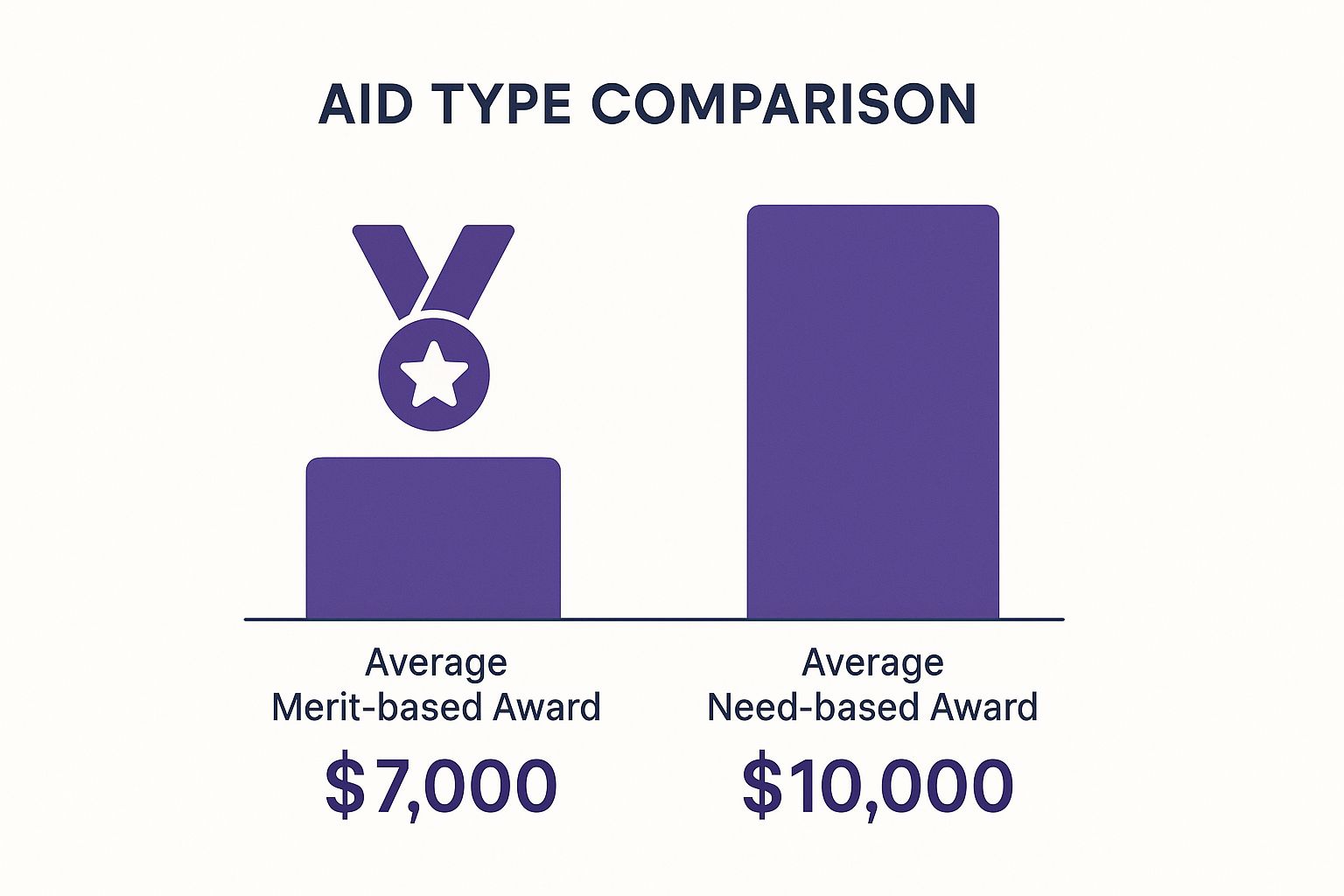
As you can see, both types of aid play a huge role in shaping an incoming class—a responsibility that is handled very differently depending on the SEM model in place.
The Matrix Model
The Matrix Model tries to give you the best of both worlds, blending the strengths of the committee and division approaches. It keeps the traditional departmental structures intact (admissions still reports to the president, the registrar to the provost, etc.), but it creates a formal SEM leader who has strategic authority without direct supervisory power.
Think of this person as the project manager for the entire student lifecycle. They work horizontally across the campus, guiding strategy, coordinating different initiatives, and holding departments accountable to the shared enrollment plan. This structure encourages collaboration without a massive, disruptive reorganization.
However, its success hinges almost entirely on the influence and political savvy of the SEM leader. If they don’t have real backing from the top, they'll struggle to get anything done and won't be able to push for meaningful change.
Comparing Strategic Enrollment Management (SEM) Models
Choosing a model isn't about finding a perfect solution, but about finding the right fit for your campus culture and goals. Each one comes with its own set of trade-offs. This table breaks down how the three common models stack up against each other.
| Model Type | Key Characteristic | Primary Advantage | Potential Challenge |
|---|---|---|---|
| Committee Model | Advisory group with representatives from across campus. | Fosters campus-wide buy-in and collaboration. | Slow decision-making and lack of direct authority. |
| Division Model | Key enrollment units report to one senior leader. | Clear authority, accountability, and agile execution. | Can create a new, powerful "enrollment silo." |
| Matrix Model | SEM leader has strategic oversight but not direct authority. | Balances collaboration with strategic direction. | Success depends heavily on the leader's influence. |
Ultimately, the best structure is the one that fits your institution's unique reality. It should be the model that empowers your team to finally move from putting out fires to building a proactive, integrated, and sustainable strategy for the future.
Leveraging Technology In Strategic Enrollment Management

If a modern strategic enrollment management plan is your institution's blueprint, then technology is the heavy machinery that actually brings it to life. We've moved far beyond the days of tracking student relationships with messy spreadsheets and disconnected department databases. Today, a powerful, integrated tech stack is the real engine behind any effective SEM strategy.
Think of it like this: you could try to build a skyscraper with hand tools. It might even stand for a little while. But to construct a modern building that can withstand market forces and stand the test of time, you need power tools, cranes, and precision instruments. Technology does the same thing for enrollment, shifting your team from painstaking manual labor to automated, data-informed work that can be done at scale.
This isn’t just an upgrade; it’s a total transformation in what’s possible. The investment numbers tell the story. The global market for student enrollment management software was valued at $2.71 billion in 2024 and is on track to hit $3.1 billion by 2025. This shows just how fast institutions are ditching old methods for new, integrated solutions that support targeted recruitment and retention efforts. You can see the market trends for yourself and get a sense of where the industry is heading.
The Rise of the 360-Degree Student View
At the heart of any modern SEM tech strategy, you'll find a CRM, or Customer Relationship Management system. But in higher education, "customer" really means student, and a well-oiled CRM acts as the central nervous system for every single student interaction. It logs every touchpoint—from the first click on your website to an email with an admissions counselor, from a financial aid application to attendance at a virtual open house. All this data creates a rich, 360-degree view of each prospect and current student. This complete picture unlocks something that was once unthinkable: personalization at scale. Instead of blasting generic emails to thousands, you can send targeted, relevant messages based on a student’s specific interests, behaviors, and needs.
A CRM transforms your outreach from a megaphone blasting one message to everyone into a series of meaningful, one-on-one conversations happening simultaneously with thousands of individuals.
From Raw Data to Actionable Intelligence
Of course, just having a mountain of data isn't enough. You have to know what to do with it. This is where analytics platforms and predictive modeling software come in, turning all that raw information into intelligence you can actually act on. These tools are the "brains" of the SEM operation, helping leaders spot patterns and make far smarter decisions.
- Predictive Analytics: By analyzing years of historical data, these models can forecast your enrollment funnel with surprising accuracy. They can pinpoint which applicants are most likely to enroll, helping your admissions team focus their limited time and resources where it counts the most.
- Retention Monitoring: Analytics platforms can also flag at-risk students by tracking behavioral signals, like a drop in grades or less frequent logins to the campus portal. This allows student success teams to step in with support before a student even thinks about leaving.
This data-driven approach is key to understanding the science behind student outcomes and building systems that genuinely help students succeed. As you lean more on technology, funding these tools becomes a crucial next step. It's worth looking into best practices for applying for technology grants for private schools to power up your digital infrastructure. Ultimately, technology gives you the foresight to manage enrollment with intention, not just react to whatever comes your way.
Best Practices For Implementing Your SEM Plan
https://www.youtube.com/embed/anA_TiUfmbM
Moving a strategic enrollment management plan from a well-researched document to a campus-wide reality is where the real work begins. A great strategy is useless without focused execution. The most successful implementations aren't just top-down directives; they’re collaborative efforts built on clear communication, shared data, and widespread buy-in from the ground up.
Think of it like a carefully planned construction project. You have the architect’s blueprint—that’s your SEM plan. But now you need to coordinate the electricians, plumbers, and framers to work together seamlessly. Without a solid project manager and a clear work plan, you’ll end up with chaos instead of a coherent structure. These best practices provide the operational roadmap to get it right.
Secure Visible Leadership Buy-In
Before a single dollar is spent or a new initiative is launched, the most critical first step is to get unwavering and visible support from the top. Your president, provost, and other senior leaders can't just approve the plan. They have to actively champion it. When leadership consistently talks about the importance of SEM in town halls, cabinet meetings, and board presentations, it sends a powerful message. This endorsement provides the political cover needed to break down departmental silos and makes it clear that this is a core institutional priority, not just the "flavor of the month."
Form a Cross-Functional SEM Council
A single department cannot execute a strategic enrollment management plan alone. It's just not possible. True success depends on forming a dedicated, cross-functional council or committee with representatives from every corner of the student experience. This group should absolutely include leaders from:
- Admissions and Recruitment
- Financial Aid
- The Registrar’s Office
- Marketing and Communications
- Institutional Research
- Key Academic Departments
- Student Affairs and Retention Services
This council becomes the engine of your SEM plan. They are responsible for monitoring progress, solving problems that inevitably crop up, and ensuring that all departments are finally moving in the same direction.
An effective SEM council doesn’t just meet to hear reports. It is an active working group that analyzes data, debates strategy, and holds its members accountable for achieving specific, measurable goals tied to the overarching plan.
Conduct a Comprehensive Data Audit
You can't manage what you don't measure. It’s a cliché because it’s true. A foundational best practice is to conduct a thorough audit of your institution's data infrastructure. This means figuring out what data you have, where it lives, and—most importantly—how accessible and reliable it actually is. This process almost always reveals surprising gaps or inconsistencies. Do the admissions and financial aid systems talk to each other? Can you easily track a student's entire journey from prospect to alum? An honest data audit is the first step toward building the integrated information ecosystem that a real SEM strategy demands. This ensures you’re making decisions based on solid evidence, not assumptions. Of course, successful SEM implementation also hinges on efficient internal processes. For instance, adopting robust marketing workflow management best practices can significantly streamline outreach efforts and inter-departmental collaboration.
Establish Clear Goals and KPIs
Finally, you have to translate your broad strategic vision into a concrete set of Key Performance Indicators (KPIs). These metrics are what make your goals tangible and trackable. Instead of a vague goal like "improve retention," you need a specific target. Something like, "increase the first-to-second-year retention rate from 78% to 82% within three years." Your KPIs should cover the entire student lifecycle, from the top of the admissions funnel (e.g., number of qualified inquiries) all the way to the very end (e.g., four-year graduation rate). Think of these metrics as the dashboard for your SEM plan. They tell you at a glance whether your strategies are working and where you need to make adjustments.
Frequently Asked Questions
Even the best-laid plans come with questions. When it comes to something as comprehensive as strategic enrollment management (SEM), a few things are bound to come up. Here are some of the most common questions we hear, with answers to help you get started on the right foot.
Recruitment Versus Strategic Enrollment Management
It's easy to mix these two up, but they're fundamentally different.
Think of recruitment as a sprint. The goal is singular and immediate: get this year's class in the door. It’s a crucial, tactical job, usually driven by the admissions office, focused on hitting the numbers for the next academic term.
Strategic enrollment management, on the other hand, is a marathon. It’s a long-term, campus-wide philosophy. SEM weaves together recruitment, financial aid, student success, and academic programs to achieve bigger, more sustainable goals. It’s not just about filling seats for one year—it’s about intentionally shaping the student body to ensure the institution's health for years to come.
Timeline For Developing And Seeing Results
Let's be clear: an SEM plan isn't built overnight. The planning phase alone often takes a solid 6 to 12 months. This involves digging deep into your data, mapping out market trends, and getting everyone from academics to finance on the same page. Once the plan is in motion, patience is your best friend. You might see some quick wins in the first year, maybe a nice bump in applications from a new territory. But the real, game-changing results—like better retention rates, stable tuition revenue, and a more diverse student body—typically take 3-5 years to fully materialize.
A strategic enrollment management plan isn't a quick fix for a tough enrollment cycle. It's a long-term investment in your institution's future, designed to build momentum and deliver compounding returns over time.
First Steps To Starting An SEM Initiative
Getting an SEM initiative off the ground the right way is critical. You can't just dive in; you need to build a solid foundation first. Here are the first three moves you need to make:
- Get Executive Buy-In: This is non-negotiable. Your president and provost have to be the biggest champions of this effort. Without their visible, vocal support, getting different departments to work together will be an uphill battle.
- Build a Steering Committee: Next, you'll need a cross-functional team. Pull in leaders from admissions, financial aid, the registrar's office, marketing, student affairs, institutional research, and key academic departments. This group will be the engine of your SEM plan.
- Conduct an Environmental Scan: The committee's first job is to figure out where you stand right now. A thorough environmental scan and data audit gives you a clear, honest baseline. It shows you exactly where your challenges and opportunities lie, creating the data-backed foundation for everything that comes next.
At Motimatic, we know the journey from a student's first click to their graduation day is full of potential drop-off points. Our platform uses behavioral science to send the right motivational message at the right time, helping our partner institutions improve enrollment, increase retention, and support student success.
See how our approach can help you meet your strategic enrollment goals. Learn more about how Motimatic works.
See it on your own listOne list, one goal, and a randomized holdout to show the lift. Start a pilot