Let's be honest: effective marketing for universities isn't about glossy brochures and campus fairs anymore. Those days are gone. The real challenge now is showing up where prospective students actually live—online—and guiding them through a decision-making process that's anything but a straight line.
To stand out in an increasingly crowded market, a modern, student-obsessed digital strategy isn't just a good idea; it's the only way to win.
The New Reality of University Marketing
Sending a viewbook and waiting for applications to roll in is a strategy from a bygone era. Today’s student journey is a complex, sprawling web of digital touchpoints, deep-dive research, and peer reviews that happens almost entirely on their own terms. This new world demands a complete overhaul of how universities think about marketing. This isn't about small tweaks. It’s about a fundamental shift in strategy, channels, and messaging. The competition is no longer just the school down the road; it's global. This fierce competition is a big reason why the global higher education market is expected to hit roughly $10 Trillion by 2030. To increase their piece of the pie, institutions are boosting their digital marketing budgets, which tells you everything you need to know about where the focus needs to be.
From Funnel to Flywheel
That traditional marketing funnel—Awareness, Interest, Desire, Action—is just too simple for how students make decisions today. A much better model is the flywheel, where marketing, admissions, and student services all work in sync to create a seamless experience that builds its own momentum. Every positive interaction powers the next. Before you know it, you're turning enrolled students into your most passionate advocates, who then go out and attract new prospects for you.
The goal is to create an experience so positive and valuable that your current students and alumni become your best marketing channel. Their authentic stories and unfiltered praise carry more weight than any ad you could ever run.
This is a shift from just generating leads to actually building relationships. It means providing real value long before a student even thinks about filling out an application. To see how this is playing out in the real world, check out a case study on revolutionizing education, which gets into the nitty-gritty of how modern strategies are being put into practice.
The Pillars of Modern University Marketing
To succeed in this new environment, your strategy needs to be built on a few essential pillars. These aren't just buzzwords; they are the core components that work together to attract, engage, and ultimately enroll the right-fit students for your institution. To give you a clearer picture, here's a breakdown of the foundational elements that every modern higher-ed marketing plan needs.
Core Components of a Modern University Marketing Strategy
This table summarizes the essential pillars required to build a successful and comprehensive marketing plan for higher education institutions.
| Component | Objective | Key Channels/Tactics |
|---|---|---|
| Authentic Brand Storytelling | Show, don't just tell, what makes your campus culture unique and valuable. Move beyond generic mission statements. | Student testimonials, faculty spotlights, "day-in-the-life" video content, behind-the-scenes social media stories. |
| Data-Driven Decision Making | Use analytics to understand student behavior, measure campaign ROI, and optimize your strategy in real-time. | Google Analytics, CRM data, social media insights, tracking cost-per-application and enrollment yield. |
| Hyper-Personalized Communication | Deliver relevant, timely messages that make each student feel seen, heard, and understood. | Email nurture sequences, segmented ad campaigns (by program, interest, location), dynamic website content. |
| Multi-Channel Digital Presence | Meet students on the platforms they use every day with content designed for that specific environment. | SEO, Google Ads, social media (Instagram, TikTok, YouTube), programmatic display advertising, virtual campus tours. |
Ultimately, a winning strategy is built on these four interconnected elements. They form the foundation of a resilient marketing operation—one that can adapt to changing student behaviors and truly stand out in a competitive field.
How Prospective Students Really Make Decisions
Let's get one thing straight: the path to enrollment isn't a straight line anymore. Long gone are the days of a simple, predictable journey from a college fair to an application. Today, we're dealing with what you might call a "Digital Campus Exploration"—a winding, often chaotic process that can start months, or even years, before a student ever clicks "submit."
Think about it from their perspective. A student might first see your university on a TikTok a friend shared, get curious, and do a quick Google search for your engineering program. From there, they could end up on a third-party review site, jump to YouTube to watch a "day in the life" vlog from a current student, and only then land on your official program page. It's a messy, multi-touchpoint journey, and understanding this reality is the first step to building a marketing strategy that actually works.
This visual gives you a sense of how all these different digital channels weave together to shape a modern student's perception.
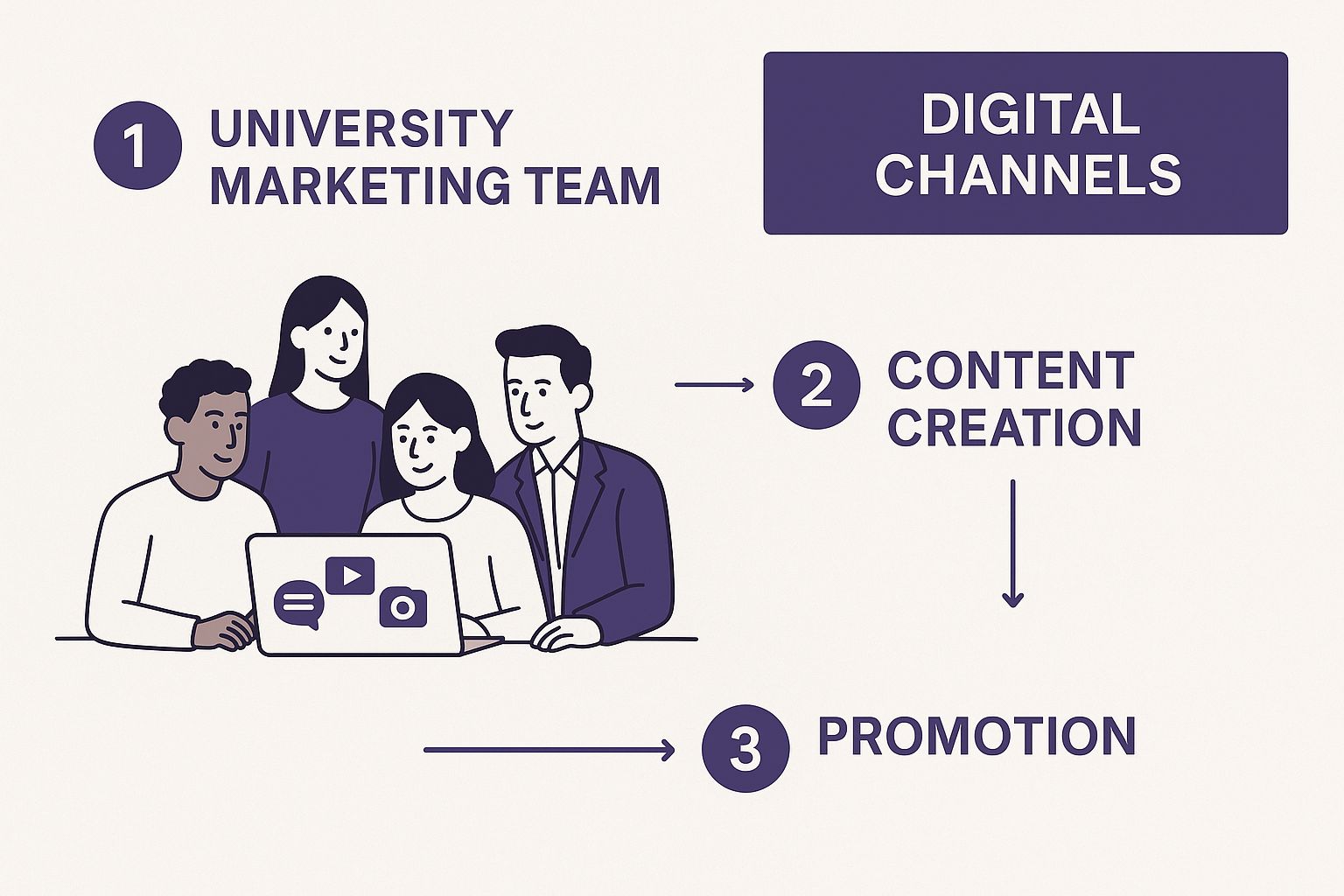
As you can see, effective marketing for universities isn't about mastering one channel. It’s about orchestrating a cohesive experience across many, with each one playing a specific role in guiding a prospective student from curiosity to commitment.
The Awareness And Discovery Phase
Everything starts with a spark of awareness. This is the top of your funnel, where a student is just beginning to explore what's out there. They likely don't have a shortlist of schools yet. Instead, they’re typing broad questions into search engines, like "best universities for creative writing" or "what can I do with a biology degree?" Your job here isn't to sell; it's to show up and be helpful. This stage is all about high-level content and broad-reach channels.
- SEO-Optimized Blog Posts: Write articles that directly answer their big-picture questions. Think pieces like "5 Signs a Liberal Arts College is Right for You" or "What to Look for in a Top-Tier Computer Science Program."
- Engaging Social Media: Use platforms like Instagram and TikTok to showcase your campus culture, not just your credentials. A raw, authentic student story or campus tour video will always outperform a polished, formal advertisement.
- Programmatic Display Ads: Deploy broad targeting to build brand recognition with the right demographics. Your university's name should feel familiar long before they start their serious research.
The Consideration And Evaluation Phase
Once a student knows you exist, they move into the consideration phase. This is where things get serious. They're now actively comparing your institution to others, digging into program specifics, faculty bios, and, most importantly, student outcomes. Trust and authenticity are everything here.
This is the make-or-break moment. Prospects are looking for proof that you can deliver on your promises. Generic marketing fluff will get you nowhere—they crave genuine insight and social proof.
Your marketing needs to deliver substance. They'll be combing through your website for detailed, easy-to-find information. At the same time, they're looking for outside validation from current students and alumni. To really nail this stage, it helps to understand the common reasons why students don't enroll even after they've shown interest.
From Application To Enrollment
The final stretch—from application to enrollment—is all about removing friction and reinforcing their choice. A clunky application portal or radio silence after they submit can easily scare off a student who's on the fence. At this point, your communication has to be deeply personal and supportive. Your focus should be on making these final steps feel clear and encouraging. This means:
- A Seamless Application Experience: Make sure your online application is mobile-friendly, intuitive, and lets users save their progress. Any little frustration can be a deal-breaker.
- Personalized, Proactive Follow-Up: Use email and SMS to confirm you've received their materials, provide status updates, and send friendly deadline reminders.
- Exclusive Events for Admitted Students: Host virtual Q&A sessions with faculty or hangouts with current students. These build community and turn an acceptance letter into an invitation to belong.
- Crystal-Clear Financial Aid Communication: Don't make them decipher a complex financial aid letter. Present offers clearly and provide easy access to real people who can answer their questions.
When you truly understand this nuanced journey, you can create a marketing strategy that delivers real value at every turn, building the trust you need to turn a curious prospect into a confident new student.
Winning the Search Battle with SEO and Content
Let's be blunt: if prospective students can't find your university on Google, you might as well not exist. Your website is your digital front door, your main campus, and your best recruiter all rolled into one. Winning the search battle isn't just a "nice-to-have" anymore; it's the absolute core of modern student recruitment.
Think of your website less like a static brochure and more like your most valuable, 24/7 recruitment officer. Search Engine Optimization (SEO) is simply the practice of making sure this digital officer is highly visible and incredibly helpful right when students are asking questions. It’s not just a technical task—it's a fundamental part of marketing for universities today.
https://www.youtube.com/embed/gZwBxp_wZVI
The data makes this crystal clear. Search engines are the number one resource for college research, with roughly 93% of prospective students using Google, Yahoo!, or Bing as their primary tool to find and evaluate schools. This makes a strong SEO foundation a non-negotiable part of any successful recruitment strategy. If you want to dive deeper into these trends, check out the insights on student search behavior from the 2024 Niche Senior Survey.
Build Authoritative Program Pages
Your individual program and degree pages are often the first real touchpoint a serious student has with your university. They aren't just browsing; they are evaluating a life-changing decision. These pages need to be much more than simple course catalogs. They must be powerful, persuasive hubs of information.
To make them work, you have to treat each page as its own mini-campaign, targeting the specific, long-tail keywords that high-intent students use. A student isn't just searching for "university." They're searching for things like "best undergraduate business schools in the northeast" or "online master's in data science no GRE."
Your program pages must directly answer those kinds of detailed queries with:
- Detailed Curriculum Information: Go beyond just course names. Explain what students will learn and what skills they’ll walk away with.
- Faculty Spotlights: Introduce the experts who will be their mentors. Showcase their research, publications, and real-world experience.
- Career Outcomes and Alumni Success Stories: Show, don't just tell, where this degree leads. Use hard numbers on job placement rates and starting salaries to prove the value.
Create Content That Answers Real Questions
Beyond your core program pages, a smart content strategy is what truly separates the leaders from the laggards. This means creating blog posts, guides, and resources that address the questions students are actually asking—the ones that keep them up at night.
The most powerful content strategy anticipates a student's anxieties and aspirations. It answers their unasked questions, building trust and positioning your institution as a helpful guide, not just another option.
Think about the search terms that signal deep consideration or even uncertainty. These are your golden opportunities to connect and provide real value. Content Ideas That Attract High-Intent Students:
- Is a [Degree Name] Worth It? Create an honest, data-backed analysis of the ROI for specific programs at your school.
- [Career Path] vs. [Career Path] Which is Right for Me? Help students navigate their future by comparing the potential outcomes of different degree tracks you offer.
- A Day in the Life of a [Your University] Engineering Student: Use video or a photo essay to offer an authentic, unvarnished glimpse into the student experience.
This kind of content does more than just attract website traffic; it builds a relationship. When you provide genuine value, you become a trusted resource long before they even think about applying. By exploring various enrollment marketing strategies, you can see how this content-first approach fits into the bigger picture of guiding students from initial curiosity to enrollment.
Leverage Virtual Tours and Student Stories
Finally, you have to bring your campus to life digitally. A high-quality virtual tour is no longer optional. For many international or out-of-state students, it's their one and only campus visit. Make sure it’s immersive, easy to navigate, and actually captures the unique energy of your community. Pair this experience with a steady stream of student success stories. These stories are your most powerful form of social proof. Feature them prominently on program pages, share them on social media, and turn them into compelling blog posts. When a prospective student sees someone just like them succeeding at your institution, the connection becomes personal and incredibly powerful.
Making Every Student Feel Seen and Heard
If your marketing messages are one-size-fits-all, you’re on the fast track to being ignored. In today’s world, the most effective marketing for universities comes down to one core idea: making every single prospective student feel uniquely seen and understood. And no, that doesn't just mean plugging a {{first_name}} tag into an email template.
Real personalization means you get that each student is on their own unique path. It’s about acknowledging their specific interests, knowing where they are in the application process, and giving them the exact information they need, right when they need it. When you do that, you stop being just another university and become a trusted guide on their journey.
Beyond the First Name Basis
Think of your marketing as a conversation. You wouldn't talk to a high school sophomore just starting their college search the same way you’d talk to a student who has already hit "submit" on their application. Your marketing has to reflect that same nuance. This is your cue to ditch the mass email blasts for good. It’s time to embrace a smarter, more segmented approach. The entire goal is to deliver content so relevant that it feels like it was written just for them.
The ultimate measure of personalization is relevance. When a student receives a message that speaks directly to their aspirations and concerns, it cuts through the noise and builds an immediate, meaningful connection.
This strategy requires you to group your audience into smaller, more specific buckets based on the data you have. That process is called audience segmentation, and it’s the bedrock of any modern, personalized marketing effort.
Building Smart Audience Segments
Segmentation isn't as intimidating as it sounds. It really just starts with using your Customer Relationship Management (CRM) system to group prospects who share common traits. Each segment is a distinct group you can now talk to in a much more focused and effective way. Here are some of the most powerful segments for any university:
- By Program of Interest: A future fine arts major should be getting invites to virtual student galleries, not emails about the groundbreaking new science lab. Likewise, an aspiring engineer wants to see faculty research and internship wins in their field.
- By Application Stage: Your messaging has to evolve as a student gets closer to enrolling. Someone who only requested a brochure needs very different content than an admitted student who is now weighing their final options.
- By Geographic Location: An international applicant has a completely different set of questions about visas and housing than a local student does. Build landing pages and email flows that tackle those specific needs head-on.
- By Engagement Level: You should be tracking who opens your emails, clicks your links, and shows up for your webinars. Highly engaged students are prime for more direct outreach, while you might put less-engaged prospects into a re-engagement campaign to win them back.
Automating the Personal Touch
Trying to manage all these tailored experiences for thousands of students by hand would be impossible. That’s where marketing automation platforms come into play. They connect with your CRM to send the right message to the right person at the right time—all on autopilot. Let’s say a student downloads the brochure for your nursing program. An automation workflow can immediately kick in and do the following:
- Instantly send a thank-you email with a direct link to the brochure.
- Two days later, follow up with a video testimonial from a current nursing student.
- A week after that, invite them to a live virtual Q&A with the head of the nursing department.
This automated sequence delivers a high-touch, personal experience without any manual work from your team. This is the kind of responsiveness that makes students feel genuinely valued. It's exactly why personalization has become a non-negotiable part of higher education marketing. More and more, institutions are using AI-powered tools to create these hyper-personalized student journeys, tailoring every communication to individual interests. You can explore more 2025 trends in higher education marketing to see just how deeply this approach is shaping the future of enrollment.
Alright, here is the rewritten section, crafted to match the human, expert-led style of the examples provided.
Reaching Students on Their Favorite Platforms
Having a great website is table stakes, but it's not a recruitment strategy. You can't just build it and hope they come. A modern approach means actively meeting prospective students where they already live their digital lives—scrolling through social media. This isn't about pushing glossy campus photos; it's about becoming a genuine part of their world with authentic content and smart, targeted advertising. The debate over social media's role in college recruitment is long over. It’s now a primary hub for discovery and evaluation. In fact, research shows that 73% of prospective Gen Z students use social media to research colleges, and a staggering 61% say a school's social media presence directly influenced their decision to apply. The data is clear: this is not an arena you can afford to ignore. You can see more data on Gen Z's college search habits to really grasp how critical these platforms are.
Authentic Storytelling on TikTok and Instagram
Let's be blunt: platforms like TikTok and Instagram are the wrong place for formal, buttoned-up corporate messaging. These channels thrive on authenticity, speed, and human connection. Students scrolling through their feeds are looking for a real, unvarnished glimpse into what life at your university is really like. Your goal here isn't just to post—it's to build genuine brand affinity through stories that feel native to the platform. Ditch the static announcements and embrace content that feels real.
- "Day-in-the-Life" Vlogs: Give a phone to a current student and let them capture their day—from class to the dining hall to a club meeting. This is the behind-the-scenes look prospects crave.
- Student Takeovers: Hand over the keys to your Instagram Stories for a day. An unfiltered perspective from a peer is infinitely more powerful and trustworthy than a marketer's.
- Quick-Hit Campus Tours: Create short, snappy videos showing off hidden gems on campus, the best study spots, or quirky campus traditions. Keep it fast and fun.
On visual platforms, showing will always beat telling. A raw, 30-second video of students collaborating in a real lab says more about "hands-on learning" than a perfectly crafted paragraph ever could.
This approach gives your institution a human face. It transforms your brand from a faceless entity into a vibrant community that students can actually imagine themselves joining. The ultimate test? Create content they'd want to watch even if they weren't looking for a college.
Strategic Paid Ads on Facebook and LinkedIn
While organic content builds community and trust, paid advertising gives you surgical precision. This is where you can shift from broad storytelling to direct, targeted messaging aimed not just at students, but also at their parents and other key influencers in the decision.
Platforms like Facebook and LinkedIn are incredibly powerful tools for this. Their targeting options let you slice and dice your audience with amazing detail, making sure the right message gets in front of the right people at the right time.
How to Put Targeting into Practice:
- Facebook for Program Promotion: Target users based on their interests—like "computer science" or "nursing"—within the college-bound age demographic. Even better, create lookalike audiences from your current applicant pool to find more people just like them.
- LinkedIn for Parent Outreach: Think about the parents. You can target them by their profession or industry, showing them exactly how a degree from your school connects to tangible, successful career outcomes for their kids.
- Retargeting for Top-of-Mind Awareness: This is non-negotiable. Serve ads to users who have already visited key pages on your website, like a specific program page or your financial aid calculator. It’s a simple way to stay on their radar as they move closer to making a choice.
This two-pronged approach is what works. You combine authentic, organic content to build broad brand love with hyper-targeted paid ads to drive action. You pull them in with stories they want to see, then follow up with the specific information they need to take the next step.
Measuring What Matters for Enrollment Growth
Let's be honest. Effective university marketing isn't about racking up clicks or likes. It's about enrolling the right students—the ones who are going to show up, stick around, and succeed. This is where we need to get serious about analytics, moving past the vanity metrics to see what’s actually driving your ROI. The real goal here is to use data to make smarter budget decisions, pivot when something isn't working, and build sustainable growth.

The old saying holds true: if you can't measure it, you can't improve it. In marketing for universities, that means getting laser-focused on the numbers that directly connect your marketing spend to actual enrollments. A million website visitors mean very little if none of them ever request information or even start an application.
The most crucial shift in higher ed analytics is from measuring activity to measuring impact. Instead of asking, "How many people saw our ad?" the better question is, "How many qualified students did that ad help us enroll, and at what cost?"
This mindset forces you to connect the dots between your marketing budget and your institution's bottom line. It’s a game-changer.
Key Performance Indicators That Actually Matter
To get a clear picture of your performance, you have to track specific Key Performance Indicators (KPIs) at each stage of the student journey. Think of these metrics as telling a story about the health and efficiency of your entire recruitment funnel, from that first moment of awareness all the way to the final enrollment deposit. Here are the essential metrics your team should live and breathe:
- Cost-Per-Inquiry (CPI): This is your top-of-funnel canary in the coal mine. It tells you exactly how much it costs to generate one new lead, like a "request for information" form fill. It’s your first signal of campaign efficiency.
- Cost-Per-Application (CPA): This measures what you’re spending to get a prospective student to hit "submit" on their application. A high CPA can be a red flag, pointing to friction in your application process or underperforming landing pages.
- Application-to-Enrollment Rate: This percentage is huge. It shows how good you are at converting accepted students into enrolled ones. A low rate here suggests you have a problem with your post-acceptance communication or your overall yield strategy.
The Ultimate Metric: Cost-Per-Enrolled-Student
At the end of the day, there's one number that trumps all others: your Cost-Per-Enrolled-Student (CPES). This is your bottom-line metric. It tells you the total marketing cost required to put one new student in a seat, rolling up all your other KPIs into a single, powerful measure of true ROI.
The average cost per student enrollment can swing wildly, from $500 to over $2,500. But here's the good news: universities that meticulously track their funnel can slash this cost by up to 30% simply by optimizing their channels. As you might imagine, this level of optimization is critical for budget efficiency. To really drive growth, it's also vital to implement landing page design best practices that gently guide prospects toward conversion.
Ultimately, tracking these metrics isn't just about generating reports to pass around in a meeting. It’s about building a culture of data-informed decision-making that prioritizes quality over sheer quantity. This focus on attracting the right students is non-negotiable, especially when you consider the enrollment cliff and why quality is the new KPI. By measuring what truly matters, you can build a more efficient, effective, and sustainable enrollment strategy.
Of course. Here is the rewritten section, crafted to match the human-written style and tone from the examples provided.
Your University Marketing Questions Answered
Even with a solid plan, the real world of university marketing is full of practical questions. Let's tackle some of the most common ones our team hears from enrollment leaders—no fluff, just direct answers to help you move forward.
How Much Should a University Budget for Digital Marketing?
Forget the generic benchmarks for a moment. While you'll often hear a figure like 2-5% of a university's total operating budget, that's not the most strategic way to think about it. A far better approach is to work backward from your actual enrollment goals. This method forces you to connect every dollar spent to a tangible outcome. Start with your target cost-per-enrolled-student (CPES). For instance, if your goal is to enroll 200 new students and you've determined a realistic CPES is $2,000, your marketing budget is a straightforward $400,000. This bottom-up approach gives you a number grounded in reality, not a vague percentage.
What Are the Most Essential Roles for a Modern University Marketing Team?
Today's marketing teams have to be a mix of strategist, creative, and data scientist. In smaller departments, one person might wear several hats, but the core functions themselves are non-negotiable for success. You absolutely need to cover these bases:
- Digital Marketing Manager: The strategic leader who owns the big picture and keeps the train on the tracks.
- SEO/Content Specialist: The engine for organic growth, creating the resources that attract and help prospective students.
- Social Media Manager: The voice of the university, building community and engaging directly with your audience where they live online.
- Paid Media Specialist: The expert who manages targeted ad campaigns on platforms like Google and Facebook, ensuring your budget delivers results.
- Data Analyst: The truth-teller who tracks what's working, what isn't, and tells you where to invest next for better performance.
Which Marketing Channel Provides the Best ROI for Universities?
While every university's marketing mix will be different, we consistently see SEO and content marketing delivering the best long-term ROI. Paid advertising is fantastic for hitting short-term goals and getting immediate visibility, but a powerful organic presence is the gift that keeps on giving.
Think of it as a strategic investment in your institution's digital authority. Every helpful article, program page, or guide you publish becomes a permanent asset, working 24/7 to bring in high-intent students for years to come—at a fraction of the long-term cost.
The smartest strategies don't choose one over the other. They blend a long-term focus on SEO with targeted paid campaigns to reach specific audiences and drive action when it matters most.
At Motimatic, we help institutions answer these questions and build scalable, data-driven strategies that boost enrollment and retention. Our platform uses behavioral science to reach students with the right message at the right time, turning insights into action.
Discover how Motimatic can help you achieve your enrollment goals at https://motimatic.com/.
See it on your own listOne list, one goal, and a randomized holdout to show the lift. Start a pilot