In the competitive landscape of higher education, attracting and enrolling the right students requires more than just traditional outreach. Prospective students today are digital natives, expecting personalized, authentic, and valuable interactions from the institutions they consider. As demographics shift and communication channels evolve, relying on outdated methods is a surefire way to miss enrollment targets and fall behind competitors. A modern, multi-channel approach is no longer optional; it's essential for survival and growth.
This article cuts through the noise to provide a comprehensive roundup of 10 powerful enrollment marketing strategies designed for the modern student journey. We will move beyond generic advice, offering actionable steps and practical examples to help you build a robust and effective plan. You will learn how to connect with prospects meaningfully, from their initial awareness to their final decision.
We'll explore how to leverage everything from sophisticated personalization and social community building to strategic partnerships and retargeting campaigns. Each strategy is designed to help you meet students where they are and guide them effectively toward enrollment, ensuring your institution thrives. For teams looking to scale these efforts, integrating automation can deliver timely, motivating messages across the entire student lifecycle, amplifying results and proving that a data-driven approach is key.
1. Content Marketing & Educational Resources
Content marketing is one of the most foundational enrollment marketing strategies, focusing on creating and distributing valuable, relevant, and consistent content. Instead of direct advertising, this approach positions your institution as a trusted authority and resource, attracting prospective students by addressing their questions and interests organically throughout their decision-making journey.

This strategy moves beyond simple program brochures. It involves building an ecosystem of helpful materials like blog posts, career guides, videos, and webinars that engage students long before they are ready to apply. For instance, Arizona State University’s extensive blog provides a rich resource covering student life and career advice, effectively nurturing potential applicants by demonstrating the university’s supportive environment.
Actionable Implementation Tips
To effectively integrate this into your enrollment marketing strategies, focus on structured execution and measurement.
- Develop Content Pillars: Build your content around key themes that align with student personas and institutional strengths, such as "Career Success in Tech" or "Navigating College Finances."
- Align with Enrollment Cycles: Create a content calendar that maps topics to key dates in the admissions funnel. Publish articles about financial aid deadlines in the months leading up to them and content about campus life right after acceptance letters go out.
- Repurpose Strategically: Turn a comprehensive industry report into a series of blog posts, an infographic, a webinar, and short social media video clips. This maximizes reach and caters to different content consumption preferences.
- Embed Clear CTAs: Every piece of content should guide the user to the next step, whether it's downloading a program guide, signing up for a virtual tour, or contacting an admissions advisor.
2. Social Media Marketing & Community Building
Effective social media marketing has evolved beyond simple broadcasting into a cornerstone of modern enrollment marketing strategies. This approach involves leveraging platforms to build vibrant communities, authentically showcase institutional culture, and engage prospective students where they already spend significant time. It prioritizes genuine interaction and user-generated content over polished advertisements, building trust and organic interest.
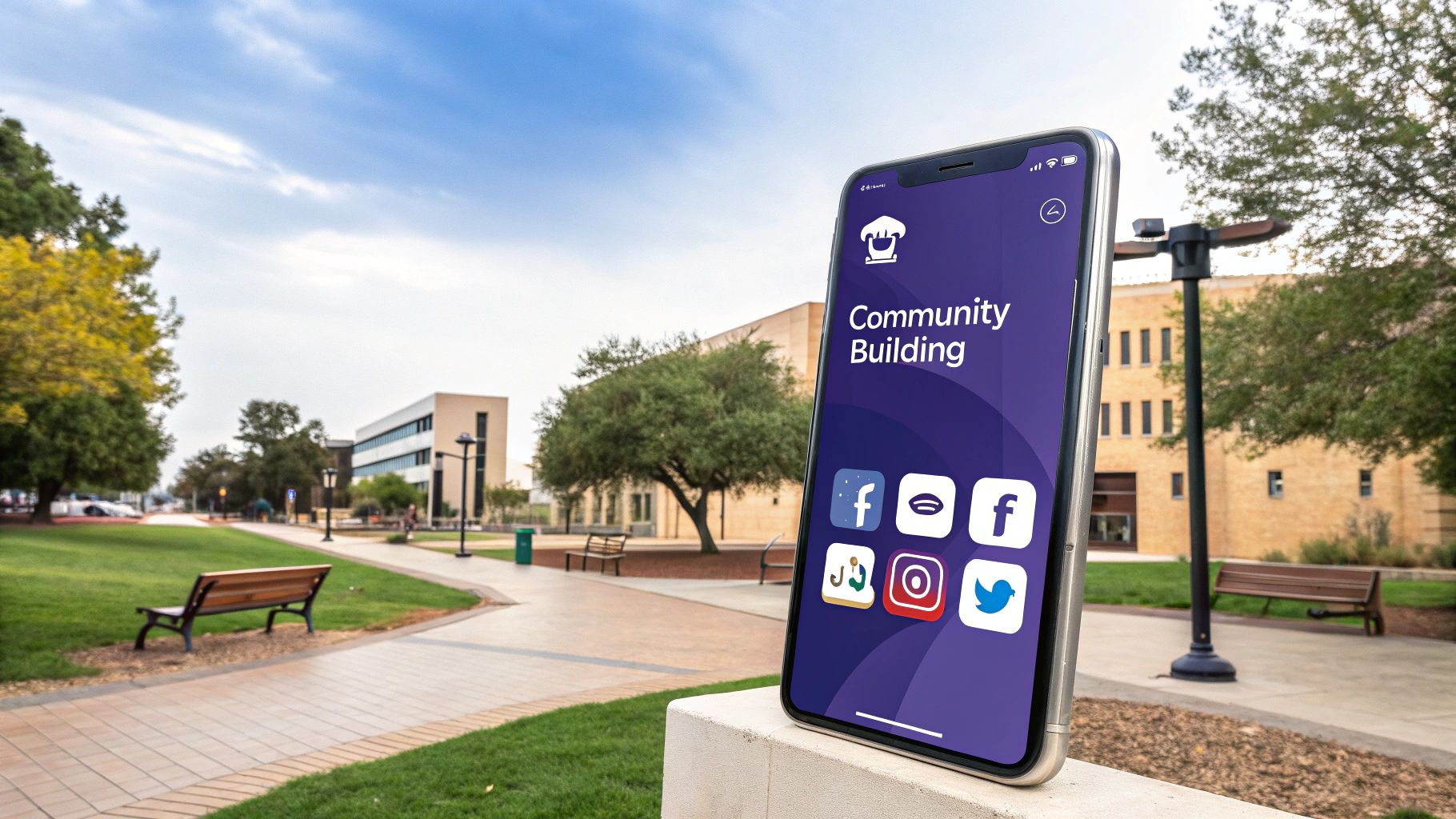
The goal is to create a digital campus experience that feels personal and accessible. Institutions like the University of Vermont excel on TikTok by sharing student-centric content, while MIT’s Instagram highlights groundbreaking research and student achievements. This strategy humanizes the institution, allowing prospective students to envision themselves as part of the community long before they set foot on campus. It's about meeting students in their digital environment with content that resonates with their values and interests.
Actionable Implementation Tips
To transform social media from a bulletin board into a powerful community-building tool, focus on engagement and platform-native content.
- Create Platform-Specific Content: Avoid cross-posting identical messages. Tailor content for each platform’s unique audience and features, such as creating short-form videos for TikTok and Reels, professional insights for LinkedIn, and visually compelling stories for Instagram.
- Encourage User-Generated Content (UGC): Actively promote and share content created by your current students. Launch branded hashtag campaigns or photo contests to encourage submissions, which serve as powerful, authentic testimonials.
- Prioritize Engagement: Respond promptly and personally to comments and direct messages. Use interactive features like polls, Q&As, and quizzes in Instagram Stories or LinkedIn polls to foster two-way conversations and gather valuable feedback.
- Maintain a Consistent Schedule: Use a content calendar to plan and schedule posts, ensuring a steady stream of relevant content. This keeps your audience engaged and signals that your institution is active and responsive.
3. Search Engine Optimization (SEO) & Paid Search
This dual-pronged approach combines organic search engine optimization (SEO) with paid search advertising (PPC) to capture prospective students the moment they actively seek educational opportunities. By appearing in both organic and paid search results, your institution gains maximum visibility, ensuring you connect with high-intent individuals who are using search engines to find programs, compare schools, and make enrollment decisions.

This synergy is a cornerstone of modern enrollment marketing strategies. For example, Purdue University's SEO-optimized program pages consistently rank for competitive engineering terms, while Southern New Hampshire University leverages local SEO to attract regional applicants. This combination ensures a steady stream of relevant traffic. A fundamental goal for any digital enrollment strategy is to understand how to rank on Google, as it directly impacts your ability to reach your target audience organically.
Actionable Implementation Tips
To effectively leverage search for student recruitment, integrate both organic and paid tactics with precision.
- Focus on Intent-Driven Keywords: Target long-tail keywords that signal a user is close to applying, such as "best online MBA for marketing professionals" or "nursing programs near me with no waitlist."
- Create Program-Specific Campaigns: Develop separate paid search campaigns for different degrees, audiences (e.g., adult learners vs. traditional students), and geographic locations to deliver highly relevant ads and landing pages.
- Utilize Ad Extensions: Enhance your paid ads with sitelink, callout, and structured snippet extensions to provide extra information like application deadlines, program costs, or unique features, which improves click-through rates.
- Implement Robust Conversion Tracking: Set up conversion tracking to measure which keywords and ads are driving applications, inquiries, and ultimately, enrollments, allowing you to optimize your budget for what works.
4. Email Marketing & Lead Nurturing
Email marketing and lead nurturing represent a systematic approach to enrollment marketing, moving beyond generic email blasts. This strategy uses targeted email campaigns to guide prospective students through the entire enrollment journey, delivering personalized and timely content that addresses their specific needs and concerns at each decision-making stage.
Rather than sending the same message to everyone, this method personalizes communication at scale. For instance, Georgia Southern University developed a 12-email nurture sequence for graduate programs that delivers relevant information over several months. Similarly, Northeastern University uses a student's browsing history to send personalized program recommendation emails, making the communication feel highly relevant and helpful. These well-crafted campaigns keep your institution top-of-mind and build a relationship with prospects long before an application is submitted. For a deeper dive, explore these enrollment management strategies on motimatic.com/.
Actionable Implementation Tips
To make your email campaigns a core part of your enrollment marketing strategies, focus on segmentation, automation, and continuous optimization.
- Segment Your Lists: Group prospects based on program interest, academic level (undergraduate vs. graduate), and engagement. A student who has attended a virtual tour should receive a different message than one who only downloaded a brochure.
- Use Behavioral Triggers: Automate emails based on user actions. If a prospect visits the financial aid page, trigger an email with a guide to scholarships and FAFSA deadlines. This makes your communication feel timely and responsive.
- A/B Test Key Elements: Constantly test different subject lines, send times, sender names, and content formats to see what resonates most with your audience. Small improvements can lead to significant increases in open and click-through rates.
- Embed Clear Calls-to-Action (CTAs): Every email must have a clear purpose and next step. Whether it’s “Schedule a Call with an Advisor,” “RSVP for Our Webinar,” or “Start Your Application,” guide the reader toward a specific action.
5. Influencer Partnerships & Student Ambassadors
This enrollment marketing strategy leverages the power of peer-to-peer trust by partnering with authentic voices to promote your institution. It moves beyond traditional advertising to build credibility through genuine testimonials from current students (ambassadors) or respected figures in a specific field (influencers). Prospective students, particularly Gen Z, are more likely to trust recommendations from peers than from official brand channels. This approach humanizes your institution and provides social proof. For example, the University of Southern California features student-run social media accounts where ambassadors share unfiltered day-in-the-life content, giving applicants an authentic glimpse into the student experience. Similarly, General Assembly partners with tech professionals who act as advocates for its courses, lending industry credibility to its programs. These partnerships are powerful enrollment marketing strategies because they build a foundation of trust.
Actionable Implementation Tips
To effectively use ambassadors and influencers, focus on authenticity and clear tracking.
- Provide Guidelines, Not Scripts: Equip your ambassadors with key messages and brand guidelines but allow their authentic voice and personality to shine through. The goal is genuine connection, not a scripted advertisement.
- Offer Diverse Incentives: Compensation doesn't have to be purely monetary. Consider offering valuable professional development opportunities, exclusive access to events, university merchandise, or academic credits to motivate student ambassadors.
- Focus on Micro-Influencers: Prioritize partnering with micro-influencers or student ambassadors who have smaller but highly engaged niche audiences. Their recommendations often carry more weight and feel more personal. To further explore this, you can gain insights from strategies used in influencer marketing for startups, which can be adapted to foster student ambassador programs.
- Ensure FTC Compliance: Be transparent about any paid partnerships. Ensure influencers and ambassadors use appropriate disclosures like #ad or #sponsored to maintain trust and comply with FTC regulations.
6. Event Marketing & Virtual Experiences
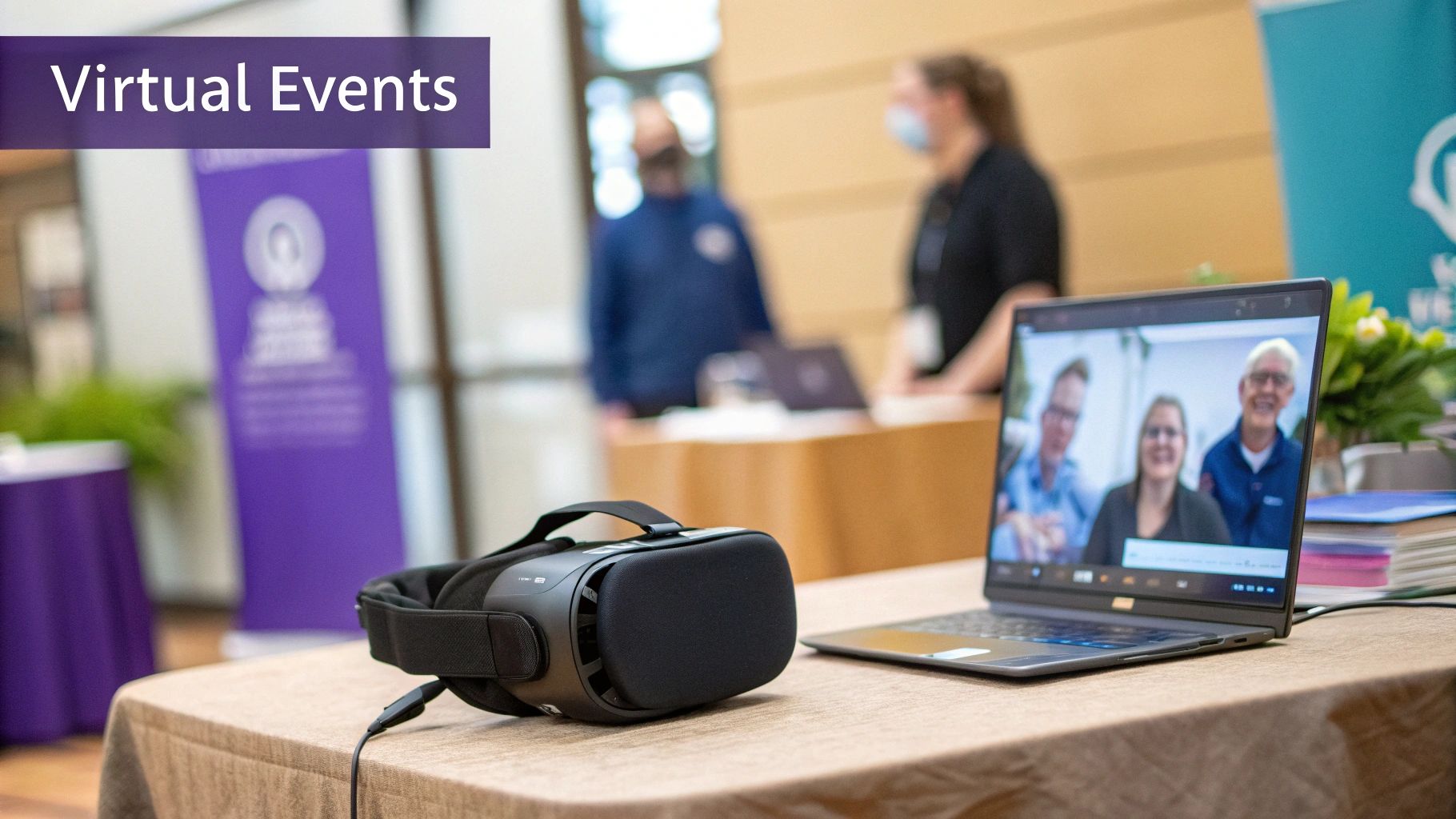
Event marketing is a powerful component of any modern enrollment marketing strategy, creating direct, meaningful connections between prospective students and your institution. By facilitating both in-person and virtual events, you provide immersive experiences that help prospects envision themselves as part of your community while building valuable relationships with faculty, staff, and current students.
https://www.youtube.com/embed/-QzEDhhuaiU
This approach moves beyond traditional open houses to include a diverse portfolio of engagement opportunities. For example, MIT’s highly interactive virtual open houses allow global access, while the University of Pennsylvania hosts industry-specific networking events that connect prospective graduate students directly with alumni and faculty in their desired fields. These events transform abstract interest into tangible excitement and a sense of belonging.
Actionable Implementation Tips
To maximize the impact of your event marketing, focus on seamless execution and strategic follow-up.
- Create Dedicated Event Landing Pages: Design a unique, easy-to-navigate landing page for each event. This page should clearly outline the event's value, feature key speakers, and include a simple registration form to capture leads effectively.
- Segment and Personalize Invitations: Use your CRM data to send targeted invitations. Invite prospects interested in engineering to a STEM faculty meet-and-greet, or promote a financial aid webinar to applicants who have started but not completed their FAFSA.
- Offer Hybrid Engagement Options: Record virtual events and make them available on-demand for those who couldn't attend live. This extends the life of your content and caters to different time zones and schedules, maximizing your reach.
- Implement Swift, Contextual Follow-Up: Contact all attendees within 24-48 hours with a thank-you message, a link to the event recording, and a clear next step, such as scheduling a one-on-one with an advisor or downloading a related resource.
7. Referral Programs & Word-of-Mouth Marketing
Referral programs systematically transform your greatest assets, your students and alumni, into a powerful recruitment channel. This enrollment marketing strategy leverages the credibility of word-of-mouth recommendations by incentivizing your community to refer qualified prospects. It's built on trust, as a recommendation from a peer or mentor often carries more weight than traditional advertising. This approach creates a direct pipeline of high-intent leads who are already warm to your institution's value proposition. For instance, the Bloom Institute of Technology (formerly Lambda School) famously offered tuition credits to students who successfully referred new enrollees, directly tying recruitment to community success. Similarly, many universities offer alumni referral awards, strengthening institutional ties while generating quality applications. A cornerstone of effective word-of-mouth marketing for enrollment is successfully building a referral program that is both rewarding and easy to use.
Actionable Implementation Tips
To launch a successful referral program as one of your core enrollment marketing strategies, focus on simplicity, motivation, and clear communication.
- Make Referrals Effortless: Design a simple, one-page digital form or a unique referral link that participants can share easily. The fewer steps required, the higher the participation rate.
- Offer Meaningful Incentives: The reward must be compelling enough to motivate action. This could be a tuition discount, a gift card to the campus bookstore, exclusive school merchandise, or a direct financial bonus.
- Equip Your Advocates: Provide referrers with a small digital toolkit that includes key program highlights, talking points, and links to relevant landing pages to ensure their messaging is accurate and effective.
- Promote the Program Consistently: Don't let your program become a "best-kept secret." Promote it regularly through student newsletters, alumni communications, and social media channels to maintain visibility and momentum.
8. Personalization & Marketing Automation
Personalization & Marketing Automation represents one of the most advanced and effective enrollment marketing strategies. It leverages data analytics and specialized technology to deliver highly relevant, individualized experiences to prospective students. Instead of sending generic messages, this approach tailors communications based on a prospect's specific behaviors, stated interests, and demographic data, creating unique journey paths that adapt in real time. This strategy automates the process of nurturing leads with content that truly resonates. For example, SNHU uses behavioral triggers to send follow-up emails about financial aid only to students who have visited that specific page on their website. Similarly, the University of Maryland's website can dynamically change its homepage content to feature programs or news relevant to a visitor's browsing history, making each interaction feel personal and responsive.
Actionable Implementation Tips
To successfully deploy these powerful enrollment marketing strategies, start with a solid foundation and scale systematically.
- Segment Before You Personalize: Begin by grouping your audience into broad segments (e.g., by state, intended major, or inquiry source). Use this as a base to build more complex, one-to-one personalization models over time.
- Ensure Data Integrity: Your automation is only as good as your data. Prioritize cleaning your CRM data and ensuring seamless integration between your website analytics, student information system (SIS), and marketing platforms.
- Balance Automation with Human Touch: Automate routine communications, like event reminders or application deadline alerts. Reserve human interaction for high-impact moments, such as a personal follow-up call from an admissions advisor after a campus visit. This strategic enrollment management approach combines efficiency with meaningful connection. Learn more about strategic enrollment management on motimatic.com/.
- Respect Privacy: Be transparent about how you use student data and provide clear, easy-to-find opt-out options for all marketing communications. Building trust is paramount for long-term engagement.
9. Retargeting & Remarketing Campaigns
Retargeting is a powerful enrollment marketing strategy designed to re-engage prospective students who have visited your website, interacted with your social media, or opened an email but did not convert. This approach uses targeted ads across various platforms to remind them of your institution and gently guide them back into the enrollment funnel, keeping your school top-of-mind during their critical decision-making period. This strategy recognizes that the path to enrollment is rarely linear. For instance, a student might visit your specific MBA program page, get distracted, and leave. Through retargeting, you can later show them an ad on social media or a news site featuring testimonials from MBA alumni or highlighting an upcoming application deadline. Penn State World Campus effectively uses this for its online programs, serving ads to users who have shown interest but haven't completed an inquiry form.
Actionable Implementation Tips
To make retargeting a core component of your enrollment marketing strategies, focus on segmentation and relevance.
- Segment Audiences by Intent: Create distinct audience lists based on user behavior. Someone who visited the homepage gets a general brand awareness ad, while someone who visited a specific degree page sees an ad about that program's career outcomes.
- Vary Creative by Funnel Stage: Prospects who only briefly visited need a soft reminder. Those who started an application but abandoned it may respond better to a more direct ad with a compelling call-to-action, like "Finish your application before the priority deadline."
- Set Frequency Caps: Avoid "ad fatigue" by limiting the number of times a single user sees your ad within a specific period. Showing the same ad too often can be intrusive and counterproductive, damaging brand perception.
- Align Messaging with the User's Journey: If a user downloaded a financial aid guide, your retargeting ads could focus on scholarship opportunities or offer a one-on-one consultation with a financial aid advisor. This demonstrates that you are paying attention to their needs.
10. Partnership Marketing & Channel Development
Partnership marketing is one of the most powerful enrollment marketing strategies for reaching qualified, pre-vetted audiences at scale. This approach involves building strategic relationships with corporations, community colleges, government agencies, and other organizations whose employees or members are ideal candidates for your programs. Instead of marketing to individuals one by one, you leverage a partner’s trusted network to gain credibility and direct access. This strategy creates a mutually beneficial pipeline. For example, Arizona State University's renowned partnership with Starbucks allows eligible employees to earn a bachelor's degree with full tuition coverage. Similarly, Western Governors University works directly with major healthcare systems and corporations to upskill their workforce, creating a steady stream of highly motivated adult learners. These collaborations go beyond simple referrals; they are integrated educational benefits that drive significant enrollment.
Actionable Implementation Tips
To effectively launch a partnership strategy, focus on creating clear, sustainable, and valuable relationships for both sides.
- Define Partnership Tiers: Create structured partnership levels (e.g., Gold, Silver, Bronze) with varying benefits like tuition discounts, application fee waivers, or dedicated advising. This clarifies the value proposition for potential partners.
- Equip Your Partners: Develop a comprehensive partner toolkit. Include co-branded marketing materials, email templates, key talking points, and a link to a dedicated landing page for their members to learn more and apply.
- Establish Clear Tracking: Create unique application links or dedicated landing pages for each partner. This is crucial for tracking referrals, measuring the ROI of each relationship, and demonstrating value back to your partners.
- Communicate and Nurture: Schedule regular check-ins with your partners to share performance data, success stories, and updates on new programs. A strong relationship management plan is key to long-term success.
Enrollment Marketing Strategies Comparison Matrix
| Strategy | Implementation Complexity 🔄 | Resource Requirements 🔄 | Expected Outcomes 📊 | Ideal Use Cases 💡 | Key Advantages ⭐ |
|---|---|---|---|---|---|
| Content Marketing & Educational Resources | Medium (requires skilled creators) | Moderate (content creation & strategy) | Long-term engagement and trust building 📊 | Attracting and educating prospects throughout enrollment funnel | Builds credibility, improves SEO, cost-effective |
| Social Media Marketing & Community Building | High (daily management & platform-specific content) | Moderate to high (social managers, content tools) | Real-time engagement and viral reach 📊 | Engaging Gen Z & visual learners on popular social platforms | Authentic campus culture, direct interaction |
| SEO & Paid Search | High (technical SEO + paid ads) | High (SEO experts & ad budgets) | Immediate visibility + sustained organic growth ⚡ | Targeting high-intent searchers actively seeking programs | Measurable ROI, highly targeted reach |
| Email Marketing & Lead Nurturing | Medium (automation setup + content) | Moderate (email tools & content creators) | High conversion via personalized nurturing 📊 | Nurturing leads with tailored messages over time | High ROI, scalable personalization |
| Influencer Partnerships & Student Ambassadors | Medium to high (relationship management) | Moderate (incentives & coordination) | Increased trust and authentic advocacy ⭐ | Peer-to-peer promotion and leveraging student/alumni influence | Credibility, extended reach, cost-effective |
| Event Marketing & Virtual Experiences | High (planning & technical setup) | High (staff & technology) | Strong emotional connection and engagement 📊 | Showcasing campus through immersive experiences | Personal connections, lead generation |
| Referral Programs & Word-of-Mouth | Medium (program management) | Moderate (incentives & tracking systems) | High-quality, pre-qualified leads ⭐ | Leveraging satisfied students/alumni to generate referrals | High conversion, lower acquisition cost |
| Personalization & Marketing Automation | High (technical setup & data management) | High (CRM & automation platforms) | Improved engagement and conversion rates ⭐ | Delivering tailored experiences at scale | Efficient resource use, scalable personalization |
| Retargeting & Remarketing Campaigns | Medium (ad management & segmentation) | Moderate (ad budgets & ad tech) | Increased conversions via re-engagement ⚡ | Re-engaging website visitors and interested prospects | Cost-effective re-engagement, measurable results |
| Partnership Marketing & Channel Development | High (relationship building & contracts) | Moderate to high (coordination & marketing) | Access to qualified prospects via partners ⭐ | Expanding reach through external organizations | Credibility, lower marketing costs, scalable |
Integrating Your Strategies for Maximum Enrollment Impact
Throughout this guide, we have explored ten distinct and powerful enrollment marketing strategies, from foundational SEO and content marketing to dynamic approaches like influencer partnerships and virtual events. While each tactic holds the potential to attract and engage prospective students, their true power is unlocked not in isolation, but through thoughtful integration. The most successful institutions don't just execute a series of disconnected campaigns; they weave these strategies into a cohesive, multi-channel ecosystem that guides students seamlessly from initial awareness to confident enrollment. Imagine the journey of a single prospective student. It might begin with a search query that leads them to one of your insightful, SEO-optimized blog posts. Days later, they see a current student’s authentic takeover on your Instagram story, which prompts them to follow your account. This action then triggers an automated email nurture sequence inviting them to a virtual tour of their program of interest. This interconnected experience feels natural, supportive, and deeply personal, building trust and momentum at every step. This is the essence of modern enrollment marketing.
From Silos to Synergy: A Unified Approach
Achieving this level of integration requires a strategic shift away from siloed thinking. Your social media team, content creators, and admissions counselors must work in concert, guided by a shared understanding of the student journey map.
- Awareness Stage: SEO, paid search, and broad-reach social media campaigns work together to introduce your institution to new audiences.
- Consideration Stage: Content marketing, email nurturing, and virtual events provide the detailed information and experiences needed to help students evaluate their options.
- Decision Stage: Personalized outreach, retargeting campaigns with specific calls to action, and student ambassador testimonials provide the final push needed to secure an application.
This integrated model ensures your messaging is consistent and that each interaction builds upon the last, creating a compounding effect that significantly enhances your overall marketing ROI. Managing this complex, multi-channel journey requires a robust technological foundation. It’s about leveraging data to understand where a student is in their decision-making process and using automation to deliver the right message on the right channel at precisely the right time.
By breaking down the barriers between your marketing functions and deliberately orchestrating how these enrollment marketing strategies interact, you create a powerful engine for growth. You move beyond simply generating leads to building genuine, lasting relationships. This holistic approach not only boosts application numbers but also attracts students who are a better fit for your institution, ultimately improving retention and fostering a stronger campus community. The future of enrollment marketing is not about doing more things; it’s about making everything you do work together more effectively.
Ready to unify your enrollment marketing strategies and create a seamless student journey? Discover how Motimatic uses behavioral science and AI-powered automation to deliver personalized, motivational messaging that guides students from inquiry to enrollment. Learn more at Motimatic.
See it on your own listOne list, one goal, and a randomized holdout to show the lift. Start a pilot