In the highly competitive higher education landscape, generic marketing no longer secures enrollment. Attracting, enrolling, and retaining the right students requires a sophisticated, multi-channel approach that speaks directly to their aspirations and motivations. Outdated tactics yield diminishing returns, making a strategic overhaul essential for institutional growth and stability. This article moves beyond surface-level advice to provide a comprehensive roundup of 10 powerful, modern university marketing strategies that deliver measurable results across the entire student lifecycle.
This guide is designed for immediate application. We will dissect each strategy, providing actionable implementation steps, real-world examples from leading institutions, and the specific metrics needed to track success. You will learn how to:
- Build authentic connections through student-led initiatives.
- Implement data-driven personalization at scale.
- Leverage immersive technologies for campus experiences.
- Activate your alumni network as a powerful marketing force.
From enhancing your digital footprint with advanced SEO to creating meaningful experiential events, these insights will help you build a more effective and resilient marketing ecosystem. Prepare to transform your approach and see a tangible impact on your enrollment funnels, retention rates, and overall institutional brand perception.
1. Harness the Power of Student Ambassador Programs
One of the most authentic and effective university marketing strategies is leveraging the voices of your current students. A student ambassador program formalizes peer-to-peer marketing by recruiting, training, and empowering students to share their genuine experiences with prospective applicants. These ambassadors act as relatable brand advocates, building trust in a way that traditional advertising simply cannot. They provide an unfiltered, credible perspective on everything from campus life and academic rigor to community and support services. For example, Arizona State University’s program selects 10-12 ambassadors each semester. These ambassadors represent a variety of The College's schools and departments, and engage with prospective students across various platforms. Similarly, the University of Alabama's Crimson Capstone lead tours for prospective students and other visitors. This approach is powerful because it humanizes your institution and creates personal connections that resonate deeply with Gen Z audiences.
Key Implementation Steps
- Diverse Recruitment: Actively recruit ambassadors from a wide range of academic majors, extracurricular interests, and diverse backgrounds to ensure all prospective students can see themselves represented.
- Comprehensive Training: Provide thorough training on brand messaging, communication best practices, and university talking points. However, encourage them to use their own voice and share personal stories.
- Structured Incentives: Create a clear structure of benefits for participation, such as exclusive networking opportunities, leadership development workshops, university merchandise, or even stipends.
- Content Management: Use social media management tools to streamline the sharing and tracking of ambassador-generated content, allowing you to monitor performance and amplify the best posts.
2. Digital Content Marketing & SEO
In today's digital-first world, one of the most crucial university marketing strategies is a robust content and Search Engine Optimization (SEO) plan. This involves creating valuable, relevant, and consistent content designed to attract and engage prospective students through search engines. By addressing their questions and concerns directly, you can capture their attention early in their decision-making journey and establish your institution as a trusted authority. This goes beyond simple advertisements, focusing instead on building a resource hub that draws organic traffic through blog posts, videos, and guides. For instance, Arizona State University's website, including its extensive blog, generates over four million monthly page views by covering topics students actively search for (estimates based on SEMRush). Similarly, the University of Pennsylvania's content hub has secured top search rankings for highly competitive education keywords by providing in-depth, high-quality information. This strategy works because it meets modern consumers where they are: online, seeking answers. To truly master digital growth, delve deeper into comprehensive SEO content marketing strategies.
Key Implementation Steps
- Target Long-Tail Keywords: Focus on specific, niche keywords related to your unique programs, campus location, and student life (e.g., "best undergraduate marine biology programs in Florida"). These have lower competition and higher conversion intent.
- Address Student Concerns: Create content that answers common questions about admissions, financial aid, career outcomes, and campus culture. Use formats like "how-to" guides, student success stories, and program-specific deep dives.
- Optimize for Local and Mobile: Ensure all content is optimized for mobile-first indexing and local search to capture students searching for universities in your geographic area.
- Leverage Internal Expertise: Feature content created by or with students and faculty. Their authentic perspectives provide credibility and unique insights that resonate with prospective applicants and their families.
Investing in SEO and content is a long-term play that builds sustainable organic traffic, reducing reliance on paid advertising and strengthening your digital presence for years to come.
3. Social Media Engagement & Community Building
A truly effective social media presence for a university goes far beyond simply posting updates. The goal is to cultivate a vibrant, interactive online community where prospective students, current attendees, alumni, and parents can connect with the institution. This strategic approach to social media transforms passive followers into active participants by showcasing authentic campus life, academic achievements, and student stories, all while fostering genuine two-way communication. It’s about creating a space for conversation, not just broadcasting a message.
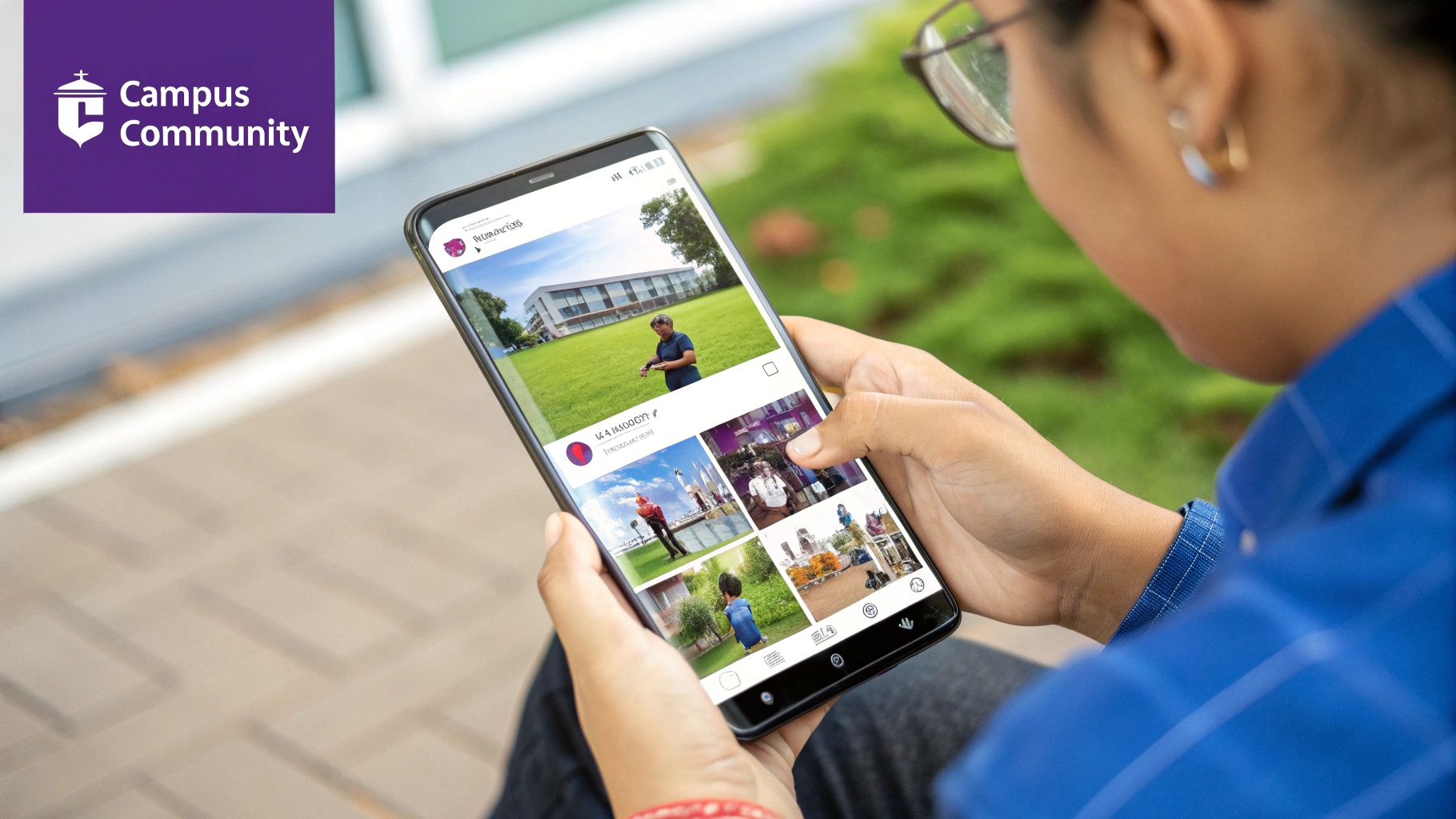
For instance, UCLA's TikTok account has amassed over 180,000 followers by featuring student-generated content, giving applicants a real taste of campus culture. The University of Michigan strategically uses Instagram Stories to highlight student experiences. Beyond just presence, universities must actively seek to increase social media engagement to foster these strong online communities. This focus on interaction builds a loyal following that feels personally connected to the university's brand and mission.
Key Implementation Steps
- Platform-Specific Strategy: Tailor your content to each platform’s strengths. Use Instagram Reels for quick campus tours, LinkedIn polls for professional development topics, and Facebook Groups for specific communities like admitted students or alumni chapters.
- Prompt & Authentic Interaction: Respond to comments and direct messages promptly, ideally within a few hours. This shows that you are listening and value your audience's input. Empower your team to engage with a consistent but human brand voice.
- Community-Focused Content: Create branded hashtags (e.g., #StateU) and encourage user-generated content by featuring student and alumni posts on your official channels. This builds a sense of ownership and community pride.
- Data-Driven Posting: Use platform analytics to identify the optimal times to post when your audience is most active. Regularly review metrics to understand what type of content resonates most and adjust your strategy accordingly.
4. Implement Data-Driven Personalization & CRM
In an era where customization is expected, a one-size-fits-all approach to communication is no longer effective. This is where data-driven personalization, powered by a robust Customer Relationship Management (CRM) system, becomes one of the most critical university marketing strategies. By leveraging student data and behavior analytics, institutions can deliver highly tailored messages, content, and experiences throughout the entire student lifecycle, from initial inquiry to post-graduation. This strategy moves beyond generic email blasts to create a meaningful, one-to-one dialogue with each prospective and current student. Universities can leverage their CRM to deploy personalized communications - such as working to improve application completion rates by implementing personalized web experiences based on user data. These examples, often facilitated by platforms like Salesforce Education Cloud or Slate, prove that a data-informed approach directly translates to higher enrollment and better engagement by making students feel seen and understood.
Key Implementation Steps
- Build a Clean Data Foundation: Before launching personalization campaigns, ensure your data is clean, accurate, and well-organized. Integrate data from various sources like your SIS, website analytics, and social media to create a unified student profile.
- Develop Detailed Student Personas: Create distinct personas for different student segments, such as international applicants, transfer students, first-generation students, or specific academic interests. This allows for more targeted and relevant messaging.
- Test and Optimize Continuously: Regularly test different personalization tactics, from subject lines to content recommendations. Use A/B testing to analyze performance and refine your rules for maximum impact.
- Ensure Data Privacy Compliance: Adhere strictly to data protection regulations like GDPR and FERPA. Be transparent with students about how their data is used and provide clear opt-out options.
- Train Your Team: Equip your admissions and marketing staff with the skills to effectively use the CRM and interpret data. Proper training ensures the technology is leveraged to its full potential.
5. Virtual and Augmented Reality Campus Experiences
Cutting-edge technology offers one of the most immersive university marketing strategies available today. By implementing virtual reality (VR) and augmented reality (AR), institutions can allow prospective students to experience campus life, tour facilities, and engage with academic programs from anywhere in the world. This is particularly valuable for international or out-of-state prospects who cannot visit in person, providing them with a rich, interactive preview that goes far beyond static photos or videos.

For instance, Stanford University's VR campus tours have reached prospective students globally, breaking down geographical barriers. To deliver truly immersive virtual and augmented reality experiences, understanding how to create an interactive website is crucial for engaging prospective students. These strategies make the abstract idea of campus life tangible and exciting.
Key Implementation Steps
- Prioritize High-Impact Areas: Start by developing VR/AR experiences for your most impressive locations, such as signature buildings, unique research labs, or vibrant student centers, to make a strong first impression.
- Ensure Mobile Compatibility: Design your virtual tours and AR applications to be fully functional and easily accessible on smartphones and tablets, as this is how most prospective students will engage with them.
- Integrate with Recruitment Touchpoints: Weave your VR/AR experiences into email campaigns, virtual information sessions, and social media promotions to create a cohesive and modern recruitment journey. Learn more about how these modern tools fit into broader college recruitment strategies.
- Gather User Feedback: Actively collect feedback from users to continuously refine the experience, fix technical issues, and improve the overall quality and immersiveness of your virtual offerings.
The following video demonstrates how a university can leverage virtual reality to provide an engaging and informative campus tour.
https://www.youtube.com/embed/SpQrPTroTx4
By adopting these technologies, universities can create memorable and persuasive experiences that significantly widen their reach and appeal to a tech-savvy generation of learners.
6. Alumni Network Leverage & Advocacy
Your alumni network is one of your institution's most valuable and underutilized marketing assets. Mobilizing alumni as brand advocates is a powerful university marketing strategy that extends beyond fundraising to actively influence recruitment. These individuals embody the long-term value of a degree from your institution, offering prospective students tangible proof of career success, professional networks, and personal growth. Their stories are authentic endorsements that resonate deeply with applicants and their families, who are increasingly focused on post-graduation outcomes. This approach leverages the deep emotional connection alumni feel toward their alma mater. For instance, Northwestern University's alumni referral program reportedly generates a significant portion of its new applications by formalizing this advocacy. Similarly, the University of Texas at Austin's extensive alumni network hosts hundreds of recruitment events globally each year, demonstrating how alumni can vastly expand an institution's reach. This strategy is effective because it showcases real-world success, turning graduates into a credible and influential part of your enrollment funnel.
Key Implementation Steps
- Segmented Outreach: Don't treat your alumni as a monolithic group. Segment them by industry, geographic location, graduation year, and extracurricular involvement to create highly targeted and relevant advocacy opportunities.
- Provide an Advocacy Toolkit: Equip your alumni with easy-to-use digital toolkits. Include pre-written social media posts, email templates for referrals, key university talking points, and links to your latest recruitment materials.
- Public Recognition: Create a system to formally recognize and celebrate your most active alumni advocates. Feature them in newsletters, on social media, or at exclusive events to encourage continued participation and inspire others.
- Trackable Impact: Implement referral codes or dedicated landing pages for alumni-driven inquiries. This allows you to track the direct impact of their efforts on applications and enrollment, proving the ROI of the program.
7. Targeted Programmatic Advertising & Retargeting
Moving beyond broad digital campaigns, one of the most sophisticated university marketing strategies is the use of programmatic advertising and retargeting. This approach involves using automated, data-driven technology to purchase digital ad space and deliver highly personalized ads to specific audience segments. Instead of buying ad space on a single website, programmatic advertising targets individual users across thousands of sites and apps based on their demographics, online behavior, and interests, ensuring maximum relevance and ad spend efficiency. For example, Southern New Hampshire University famously used a robust retargeting strategy that improved its conversion rates by an incredible 250% by re-engaging users who had previously visited their site. Similarly, the University of Phoenix’s programmatic campaigns resulted in a 35% lower cost-per-lead by precisely targeting high-intent individuals. This strategy works because it keeps your institution top-of-mind and delivers tailored messages to prospective students at critical points in their decision-making journey, from initial research to application submission.
Key Implementation Steps
- Create Detailed Audience Personas: Develop in-depth profiles of your ideal students, including their interests, online habits, and the types of content they consume. Use this to build precise targeting segments for your programmatic campaigns.
- Implement Proper Tracking: Ensure your website has tracking pixels (like the Meta Pixel or LinkedIn Insight Tag) correctly installed to build retargeting audiences and measure campaign attribution accurately.
- Use Compelling Creative: Design visually appealing and message-driven ad creatives that are optimized for different platforms and placements. A/B test headlines, images, and calls-to-action to identify what resonates most.
- Set Frequency Caps: To prevent ad fatigue and avoid annoying prospective students, set a limit on how many times an individual user will see your ad within a specific period.
- Optimize Bidding Strategies: Regularly review campaign performance data to adjust your bidding strategies, reallocate budget to the best-performing audience segments, and refine your targeting to improve ROI.
8. Partnership Marketing & High School Relations
A powerful university marketing strategy involves looking beyond direct-to-student advertising and building collaborative pipelines through partnership marketing. This approach focuses on creating strong, formalized relationships with high schools, community colleges, and educational organizations. By establishing these connections, universities can create a steady, reliable stream of qualified applicants who are already familiar with the institution's brand and academic pathways. This is a foundational element of a robust strategic enrollment management plan. For example, the University of California system has perfected this model through its community college transfer partnerships, which resulted in 18,653 students transferring in 2024. Similarly, Texas A&M University's dedicated high school relations program visits schools each year to build rapport with counselors and students. These partnerships move beyond simple recruitment visits, often including dual enrollment programs and embedded counselor relationships that provide immense value to both institutions and create a seamless transition for students.
Key Implementation Steps
- Dedicated Liaisons: Assign specific staff members as dedicated relationship managers for key partner high schools and community colleges to ensure consistent communication and nurturing.
- Provide Partner Resources: Offer valuable resources to partner institutions, such as professional development workshops for counselors, campus visit days for their students, or access to university library databases.
- Create Clear Pathways: Develop clear, well-documented articulation agreements and transfer pathways that make it easy for students and counselors to understand course equivalencies and admission requirements.
- Track and Share Success: Monitor the success of students who come from partner institutions and share those success stories (with permission) to reinforce the value of the partnership and inspire future applicants.
9. Influencer Marketing & Thought Leadership
Beyond traditional advertising, one of the most powerful university marketing strategies involves collaborating with trusted voices and establishing your institution as an intellectual hub. This dual approach combines influencer marketing with thought leadership, leveraging both external and internal experts to build credibility. By partnering with education influencers, industry leaders, and even your own renowned faculty, you can tap into pre-existing communities and showcase your university's expertise in an authentic, engaging way. For instance, MIT’s faculty are consistently featured as thought leaders in major media outlets, generating massive public exposure and reinforcing the university's brand as a global innovation powerhouse. On another front, the University of Southern California has successfully built a student influencer program that collectively reaches millions of followers, offering an authentic glimpse into campus life. This strategy is effective because it moves beyond self-promotion, providing genuine value and expert insights that attract and persuade prospective students.
Key Implementation Steps
- Identify Aligned Partners: Seek out influencers, alumni, and faculty whose personal brands and values align with your institution's mission. Focus on relevance and audience trust over sheer follower count.
- Empower Internal Experts: Create a platform for your own faculty and researchers to share their work. Support them with media training, content creation resources, and promotional channels to amplify their reach.
- Co-Create Authentic Content: Provide partners with clear guidelines but allow creative freedom to ensure the content feels genuine to their audience. Focus on storytelling and showcasing real-world impact.
- Build Long-Term Relationships: Prioritize sustained partnerships over one-off campaigns. Long-term collaborations feel more authentic and yield better results as the influencer becomes a true brand advocate.
10. Event Marketing & Experiential Engagement
A cornerstone of any comprehensive university marketing strategy is creating memorable, engaging experiences for prospective students and their families. Event marketing, both virtual and in-person, allows applicants to move beyond brochures and websites to interact directly with faculty, current students, and the campus environment. These experiential engagements are powerful because they build genuine emotional connections and help students envision themselves as part of your community, significantly influencing their final decision.
Key Implementation Steps
- Detailed Planning: Create comprehensive event timelines, run-of-show documents, and contingency plans for both virtual and in-person formats to ensure a seamless experience.
- Staff and Volunteer Training: Thoroughly train all staff, faculty, and student volunteers on key messaging, their specific roles, and how to create a welcoming atmosphere.
- Timely Follow-Up: Follow up with all attendees within 48 hours. Use personalized communications that reference their interests or questions to maintain momentum.
- CRM Integration: Integrate event registration and attendance data directly with your CRM system. This allows for comprehensive tracking of a prospect’s journey and informs future communication strategies.
University Marketing Strategies Comparison Matrix
| Strategy | Implementation Complexity 🔄 | Resource Requirements ⚡ | Expected Outcomes 📊 | Ideal Use Cases 💡 | Key Advantages ⭐ |
|---|---|---|---|---|---|
| Student Ambassador Programs | Medium: training and ongoing management | Moderate: staff coordination and training | Increased applications (+15%), social engagement (+40%), event attendance (+25%) | Peer-to-peer outreach, authentic student connection | High trust, cost-effective, builds engagement |
| Digital Content Marketing & SEO | High: requires content creation & SEO expertise | High: ongoing content development | Long-term organic traffic, improved brand awareness | Attracting prospects via search, thought leadership | Sustainable traffic growth, positioned as knowledge leader |
| Social Media Engagement & Community Building | Medium-High: constant platform management | High: social media team and tools | Direct engagement, viral content potential, increased campus visits | Brand culture showcasing, real-time communication | Authentic campus culture, real-time feedback |
| Data-Driven Personalization & CRM | High: technical setup and data integration | High: CRM platforms, data analytics expertise | Higher conversion rates, improved student experience | Personalized recruitment and retention | Relevant messaging, efficient targeting, predictive analytics |
| Virtual and Augmented Reality Experiences | High: technical development and hardware needed | High: VR/AR tech investment and updates | Increased inquiries (+30%), broader geographic reach | Remote prospect engagement, immersive campus tours | Overcomes location barriers, immersive tech appeal |
| Alumni Network Leverage & Advocacy | Medium: relationship building & management | Moderate: outreach and event organization | Increased applications (e.g., 15%), strengthened loyalty | Leveraging alumni networks for recruitment and fundraising | High credibility, access to professional networks |
| Targeted Programmatic Advertising & Retargeting | High: complex setup and continuous optimization | High: ad spend and technical expertise | Lower cost per lead (-35%), higher conversion rates (+250%) | Precise, scalable digital advertising | Efficient spend, scalable reach, detailed analytics |
| Partnership Marketing & High School Relations | Medium-High: relationship development takes time | Moderate: dedicated staff and travel | Large, steady pipeline and transfer volume | Building educational institution partnerships | Direct qualified access, long-term pipeline |
| Influencer Marketing & Thought Leadership | Medium: influencer coordination and content creation | Moderate: partnership management | Expanded reach, increased media impressions | Building credibility via trusted voices | Authentic endorsements, cost-effective reach |
| Event Marketing & Experiential Engagement | High: event planning and logistics intensive | High: staffing, venues, technology | High conversion rates, strong emotional connections | In-person or virtual engagement opportunities | Memorable experiences, direct interaction |
Integrating Your Strategies for Maximum Impact
Navigating the competitive landscape of higher education requires more than just a list of tactics; it demands a cohesive, integrated approach. The most successful university marketing strategies are not isolated initiatives but interconnected components of a comprehensive enrollment and retention ecosystem. The power isn't in choosing one strategy over another, but in orchestrating a symphony where each element amplifies the others. Imagine a prospective student’s journey. It might begin with a compelling blog post they found through a search engine (Content Marketing & SEO), leading them to your engaging Instagram profile (Social Media Engagement). From there, they join a virtual campus tour (VR/AR Experiences) and are so impressed they sign up for your newsletter. This action triggers a series of personalized emails (Data-Driven Personalization) inviting them to an online event (Event Marketing) where they interact directly with a student ambassador (Student Ambassador Programs). This seamless flow is the hallmark of a truly effective marketing machine.
Weaving a Cohesive Student Journey
Achieving this level of integration means breaking down the traditional silos between marketing, admissions, and student success teams. The data collected from programmatic ad campaigns should inform the content your team creates. Insights from student ambassador interactions should guide your social media messaging. The goal is to create a unified narrative that consistently communicates your university's unique value proposition at every single touchpoint. This integrated model moves beyond simple recruitment. It's about building genuine, lasting relationships. By leveraging your alumni network for advocacy and creating strong partnerships with high schools, you build a pipeline of not just applicants, but of well-informed, enthusiastic future students who are more likely to enroll and, crucially, to persist through graduation.
Your Actionable Blueprint for Integration
To begin harmonizing your efforts, focus on these key steps:
- Audit Your Ecosystem: Map out your current student journey. Identify where strategies connect and where gaps exist. Are your social media efforts aligned with your CRM follow-up sequences?
- Establish Shared Goals & Metrics: Ensure all teams are working towards the same key performance indicators (KPIs), from initial lead generation to enrollment and student retention. This fosters collaboration and a shared sense of purpose.
- Leverage a Centralized Tech Stack: Use a robust CRM and marketing automation platforms to connect your data points. This creates a single source of truth for understanding student behavior and personalizing communications at scale.
- Foster Cross-Functional Collaboration: Implement regular meetings between your marketing, admissions, alumni relations, and student affairs teams to share insights, plan campaigns, and refine your overall strategy.
Ultimately, mastering these modern university marketing strategies is about more than filling seats. It's about building a vibrant, thriving academic community. By thoughtfully combining the authenticity of human connection with the precision of data-driven technology, you can attract students who are the right fit, support them throughout their journey, and empower them to become successful, engaged alumni. The future of your institution depends on this holistic, student-centric vision.
Ready to automate and personalize your student engagement at scale? Motimatic uses behavioral science and an Adaptive Engagement Engine™ to deliver the right message at the right time, motivating students from application to graduation. Discover how you can enhance your university marketing strategies and boost enrollment and retention by visiting Motimatic.
See it on your own listOne list, one goal, and a randomized holdout to show the lift. Start a pilot