Let’s cut through the jargon. Digital enrollment marketing is the comprehensive game plan universities use to find, attract, and enroll students using online channels. It’s far less about isolated tactics like a single ad campaign and much more about creating a seamless, personalized journey for every single prospective student.
This strategy guides them all the way from their very first curious Google search to the moment they hit "submit" on their application.
What Is Digital Enrollment Marketing?

Think of it like a sophisticated, modern GPS for prospective students. Instead of handing everyone the same generic paper map (like an old viewbook), each student gets a custom-plotted route based on their unique interests, where they are in their decision-making process, and how they behave online. It's a fundamental move away from the one-size-fits-all campaigns of the past. This is a massive shift from the traditional world of college fairs and glossy print brochures. Why? Because today's students live online. They conduct deep research, form strong opinions, and narrow down their choices long before they ever think about speaking to an admissions counselor. A strong digital strategy ensures you're there to meet them at every one of those critical online touchpoints.
The Modern Approach to Recruitment
A modern enrollment strategy is all about weaving different online channels into a single, intelligent system designed to attract, engage, and ultimately, convert prospects. It’s not just about having a website or a social media profile; it’s about making them work together to create a powerful, unified experience. Here’s a quick overview of how the old and new ways stack up.
| Pillar | Digital Approach (Today) | Traditional Approach (Yesterday) |
|---|---|---|
| Data & Insights | Uses real-time analytics to understand what students want and optimize campaigns on the fly. | Relied on historical trends, surveys, and anecdotal feedback. |
| Communication | Delivers personalized messages based on program interest, location, or funnel stage. | Sent mass-market emails and brochures with generic messaging. |
| Channels | Creates a consistent presence across search, social media, email, and the university website. | Focused on physical events like college fairs, direct mail, and print ads. |
| Student Journey | Guides students from initial awareness all the way through to application and enrollment. | Concentrated heavily on the top of the funnel (generating inquiries). |
This pivot isn't just a trend; it's a strategic necessity. The global digital marketing market is on track to hit $1.3 trillion by 2033, growing at a staggering 13.6% annually. That growth signals a massive shift in where organizations—including universities—are putting their money to connect with their audiences.
At its core, digital enrollment marketing is about building relationships at scale. It uses technology to deliver the right message to the right student at precisely the right time, making a large, often overwhelming process feel personal and supportive.
For anyone working in higher ed, mastering these concepts is no longer optional. It's the key to hitting your enrollment targets in an increasingly crowded and competitive field. Adopting these methods will help you build an admissions process that's more efficient, more effective, and, most importantly, more student-centric. For a deeper dive into this topic, be sure to check out our comprehensive guide on higher education digital marketing.
The Essential Channels for Student Recruitment

Great digital enrollment marketing isn't about finding one magic bullet. It's more like conducting an orchestra. Each channel—search, social, email—is its own instrument with a unique sound, but true success comes from getting them all to play in harmony.
When these channels work together, they create a cohesive experience that guides a prospective student all the way from their first curious Google search to their final enrollment deposit. These are the engines of your recruitment strategy, making sure you’re visible and persuasive at every single stage of their decision-making.
Let's break down the core channels and how they actually work for a university.
Search Engine Optimization and Marketing
If you want to attract students, you have to be where they are looking. That means mastering both search engine optimization (SEO) and search engine marketing (SEM). These two work as a team to capture a student’s attention the very moment they start searching.
SEO is the long game. It’s the art and science of getting your university’s website to show up organically when a student types in a query like “best online MBA for working professionals” or “top undergraduate nursing programs in Texas.” It’s all about building your website’s authority and relevance over time so Google sees you as the best answer.
SEM, which most people know as pay-per-click (PPC) advertising, is your fast lane to visibility. It lets you place targeted ads at the very top of the search results for specific keywords. This is perfect for promoting application deadlines, a brand-new degree program, or reaching students in a particular state or country with pinpoint accuracy. A smart approach uses both, blending organic search traffic with paid promotion. You can dig deeper into various SEO and SEM strategies to see how they fit together.
Content Marketing That Builds Trust
Content marketing is where you stop selling and start helping. It’s about creating and sharing genuinely useful information that attracts the right kind of student and establishes your institution as a trusted authority. This isn’t just about slick digital brochures. It's about showing your value in action.
- Blog Posts: Write articles that answer the real, tough questions students are asking. Think "How to choose a graduate program that fits your career goals" or "What can you actually do with a psychology degree?"
- Virtual Tours: Bring your campus to life for students who can't visit in person. Immersive 360-degree tours of your labs, libraries, and dorms can make a huge impression.
- Webinars and Workshops: Host live online sessions with rockstar faculty members or current students. Let them talk candidly about the program, student life, or how to navigate the admissions process.
This strategy builds a relationship long before a student ever thinks about applying. By providing real value, you earn their trust and stay top-of-mind.
Content marketing is the difference between telling students you're the best and showing them why. It provides the proof points—faculty expertise, student success stories, and vibrant campus culture—that turn interest into conviction.
Social Media for Authentic Connection
Let's be clear: social media is not a digital bulletin board for campus announcements anymore. It’s a dynamic space for building a community, telling authentic stories, and engaging directly with prospective students where they already spend their time—on platforms like Instagram, TikTok, and LinkedIn.
The key word here is authenticity. Today's students can spot a polished marketing message from a mile away. They want to see real, unvarnished glimpses of life at your institution. Student-led Instagram takeovers, "day-in-the-life" TikToks, and live Q&A sessions with admissions counselors feel genuine and make your school feel accessible.
Social media's power here is undeniable. The global social ad market is set to grow by 12% in 2025, and social content now influences the buying decisions of 76% of all consumers—and a staggering 90% of Gen Z. This channel is simply non-negotiable.
Email Marketing for Nurturing Leads
With all the buzz around newer channels, it’s easy to forget about email. But don't. It remains one of the most powerful tools for personally guiding prospective students through the enrollment funnel. Once a student shows interest—say, by downloading a viewbook or signing up for a webinar—email marketing lets you keep the conversation going. And we're not talking about old-school "batch and blast" emails. Using a modern CRM, you can send automated, personalized email sequences triggered by a student’s actions.
- Welcome Series: After they first connect, send a series of emails introducing them to the university's mission and unique strengths.
- Program-Specific Content: If they showed interest in engineering, send them profiles of engineering faculty, news about student projects, and info on alumni career paths.
- Deadline Reminders: A gentle nudge to complete their application or submit financial aid forms can make all the difference.
Each of these channels is a critical piece of the puzzle. Our guide on effective student recruitment strategies offers even more ideas on how to weave them together. By combining their strengths, you create a powerful, multi-touchpoint journey that makes enrollment the natural next step for the right students.
Building Student Personas That Actually Work
If you want your digital enrollment marketing to hit the mark, you have to know exactly who you’re talking to. Spraying generic messages at a faceless crowd of "students" just doesn't work anymore. This is where student personas—detailed, semi-fictional profiles of your ideal students—become one of your most powerful tools.
Think of a persona less like a sterile demographic checklist and more like a character sketch for a story. It goes way beyond age and location to capture what really drives decisions: their academic goals, their digital hangouts, how they prefer to communicate, and the barriers holding them back.
Sending the same email to everyone is like a chef insisting on cooking only one meal for an entire restaurant. It’s guaranteed to miss the mark for most people. A well-built persona, on the other hand, lets you tailor your content, channel strategy, and tone to connect with specific groups in a way that feels personal and relevant.
Moving Beyond Basic Demographics
First things first: let's ditch the idea that a persona is just "18-22 years old, lives in the Midwest." While that data has its place, it tells you nothing about why a student might choose your university or what keeps them up at night. The most effective personas are built on psychographics—the attitudes, dreams, and values of your audience. To build personas that actually work, you need to dig deeper and answer questions like:
- What’s their end game? Are they laser-focused on career advancement, seeking a classic campus experience, or do they need a flexible online program?
- What are their biggest headaches? Is it the price tag? Juggling school with a full-time job? Or the fear that they just won’t fit in?
- Where do they live online? Are they deep in Google search results, binging student vlogs on YouTube, or building a network on LinkedIn?
- What kind of information do they trust? Do they rely on official university websites, or are they looking for candid peer reviews and interviews with faculty?
Answering these questions is how you turn a flat profile into a three-dimensional character you can actually have a conversation with.
A persona-driven approach is a game-changer for program-level marketing. An 'Aspiring MBA Candidate' researching top business schools has completely different needs and digital habits than a 'First-Generation Undergraduate' trying to figure out the FAFSA. Your strategy has to speak to both of them differently.
Gathering Real-World Data for Authentic Personas
Here’s the secret: the best personas aren't invented in a boardroom. They're pieced together from real-world data and actual human insights. Your job is to ground these fictional profiles in hard evidence so they truly reflect your audience.
Start with the data you already have. Your website and social media analytics are absolute goldmines. See which blog posts are getting the most reads, which program pages people spend the most time on, and what questions pop up over and over on social media. This tells you what your audience is genuinely curious and concerned about right now.
Next, you have to talk to people. Student surveys, one-on-one interviews with current students, and focus groups with recent grads offer priceless insights you can't get from a dashboard. Ask them what their search process was really like, what was helpful (or frustrating), and what finally tipped the scales for your institution. This human element is what makes a persona feel real and, most importantly, actionable.
A Practical Student Persona Template
Ready to get started? Here’s a simple template you can use to build out 3-5 distinct personas that cover your key student segments.
| Persona Component | Example Details for "Working Professional Wendy" |
|---|---|
| Name & Photo | Wendy, 32. A professional stock photo helps bring her to life. |
| Background & Role | Marketing manager at a mid-sized tech company. Has a B.A. in Communications. |
| Goals | Wants an online MBA to qualify for a senior leadership position within two years. |
| Challenges | Needs a flexible program that fits around a demanding 50-hour work week. Worried about the program's ROI and overall cost. |
| Digital Habits | Uses LinkedIn for professional networking. Researches programs on her laptop after 9 PM. Trusts data-driven articles and alumni success stories. |
| Key Message | "Advance your career on your schedule with an MBA designed for leaders." |
Creating personas like "Working Professional Wendy" forces you to think about a specific person every time you write an email, create a social post, or run an ad. This simple but profound shift in perspective is what turns broad marketing into a meaningful conversation that drives engagement and, ultimately, boosts enrollment.
Mapping the Digital Student Enrollment Journey
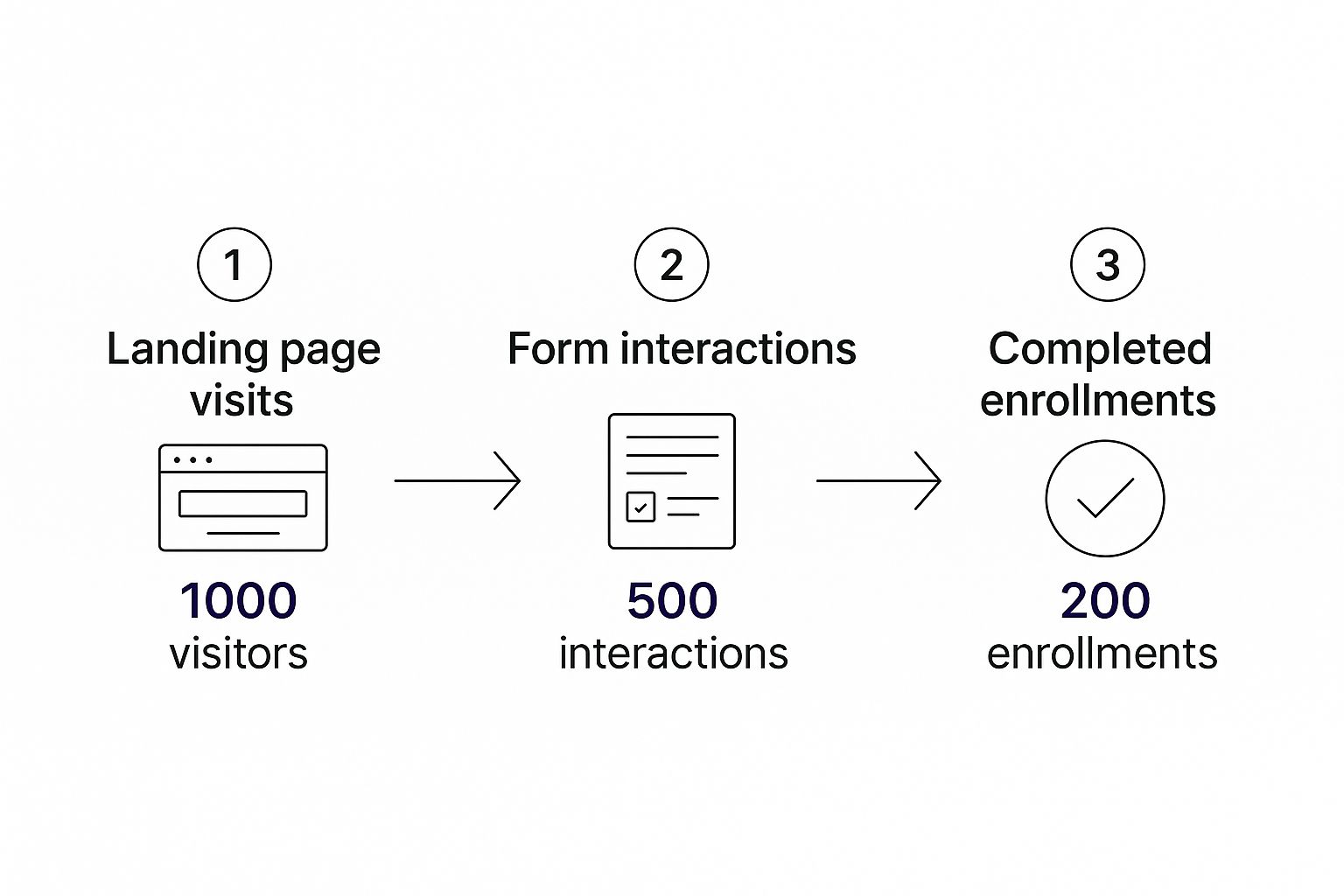
The journey from a curious high school senior to an enrolled freshman is never a straight line. It’s a messy, winding path filled with dozens of digital touchpoints, late-night questions, and tough decisions. To guide students effectively, you don’t just need marketing—you need a map. In digital enrollment, that map is the classic marketing funnel, adapted for the unique way students choose a college. Think of the funnel as a four-stage framework that helps you understand a student's mindset. It allows you to deliver the right message at the right time, turning strangers into applicants and, ultimately, into proud members of your next incoming class. When you map this journey, you're building a predictable, repeatable system for growth.
Stage 1: The Awareness Stage
This is the top of the funnel, where your only goal is to get on a prospective student's radar. They might not know your school exists yet, but they know they have a goal—maybe it’s advancing their career, or maybe it’s finally pursuing a passion. They’re typing broad searches into Google, things like “online data science master’s programs” or “best nursing schools near me.” Your job isn't to sell. It's to be the most helpful, visible answer to their questions.
- Search Engine Optimization (SEO): Your blog posts, program pages, and articles need to rank for the keywords your ideal students are using. When you answer their questions directly, you build instant authority.
- Targeted Social Media Campaigns: Use platforms like Instagram, Facebook, and LinkedIn to run awareness ads. Targeting users by their interests, demographics, and online behavior lets you introduce your institution to a perfectly matched audience.
At this stage, think broad. You’re casting a wide net to capture the attention of anyone who might be a good fit and planting a seed of recognition you can nurture later.
Stage 2: The Consideration Stage
Once a student knows your name, they enter the consideration stage. Now, they're actively researching and comparing their options. They’ve moved from general searches to specific questions, like “What is the student-faculty ratio at University X?” or “Does Program Y offer internship support?” This is where you shift from being visible to being valuable, building a real connection and earning their trust.
At the consideration stage, you transition from an advertiser to an advisor. Your goal is to provide deep, meaningful content that helps students envision themselves at your institution and makes them feel confident in their choice.
Here’s how you do it:
- In-Depth Content: This is the time for downloadable viewbooks, detailed program guides, and powerful student testimonials.
- Webinars and Virtual Events: Host live sessions with faculty, current students, or alumni. Give prospects a genuine taste of your campus community and academic rigor.
- Virtual Campus Tours: An immersive virtual tour is no longer a novelty; it's a necessity. It lets students from anywhere in the world explore your labs, libraries, and student centers, making the campus experience feel real and attainable.
This is your shot to show what makes your institution special and answer the one question on every student’s mind: “Is this the right place for me?”
Stage 3: The Application Stage
We’re getting close. At this point, a prospect has done their research, and your school is on their shortlist. The goal now is to turn that interest into a concrete action: hitting “submit” on an application. Your marketing has to become laser-focused and action-oriented. The name of the game is making the application process as seamless and encouraging as possible. Any friction here can cause a highly qualified prospect to drop off for good.
- Remarketing Ads: Don't let warm leads go cold. Remind students who visited your application page but didn't finish. A simple, encouraging ad on their social feed—“Your future awaits! Complete your application today”—can be incredibly effective.
- Simplified Application Portals: Your online application must be mobile-friendly, intuitive, and easy to use. Break it down into small, manageable steps to avoid overwhelming them.
- Application-Focused Emails: Send targeted emails with clear calls-to-action (CTAs), deadline reminders, and helpful tips for putting their best foot forward.
This stage is all about conversion. Every message, every link, and every button should be designed to remove barriers and motivate that student to take the final leap.
Stage 4: The Enrollment Stage
An acceptance letter isn't the finish line. The final—and arguably most important—stage is convincing admitted students to officially enroll. This is all about "yield." They’re likely holding multiple acceptance letters, weighing offers, and having second thoughts. Your job is to reinforce their decision and build a powerful sense of belonging before they ever step on campus. Personalization is everything here.
- Personalized Outreach: A congratulatory video from the dean, a welcome email from a future professor, or a quick call from a current student can make an enormous impact.
- Exclusive Admitted Student Groups: Create private Facebook or LinkedIn groups where new students can connect, ask questions, and start building their community.
- Financial Aid and Next Steps: Send crystal-clear, easy-to-understand information about financial aid packages, housing deposits, and orientation. Eliminate the confusion and anxiety that can derail their decision.
This final push solidifies the relationship, ensuring the students you worked so hard to attract become a vibrant part of your next incoming class.
Measuring Your Enrollment Marketing Success
You can't fix what you can't measure. In enrollment marketing, that means looking past the "vanity metrics" like social media likes or page views. While those numbers might feel good, they don’t tell you if you’re actually hitting enrollment targets or making a smart investment. Real success is measured by key performance indicators (KPIs) that tie directly to your institution's bottom line. These are the numbers that tell the true story of your marketing's impact, justify your budget, and help you make smarter decisions. They show you the health of your entire enrollment funnel, from a student’s first click to their final deposit.
From Vanity Metrics to Actionable KPIs
To get a clear picture of what's working, you have to track the numbers that truly matter. These KPIs help you understand not just what is happening, but why. Think of them as a diagnostic tool for your strategy, showing you exactly where to patch a leak or where to open the floodgates. Here are the essential metrics every enrollment team should be tracking:
- Cost Per Inquiry (CPI): This is how much you spend to generate one qualified lead or inquiry. It’s a gut check on your top-of-funnel efficiency.
- Cost Per Application (CPA): Taking it a step further, this calculates the cost to get a prospective student to hit "submit" on their application. A high CPA might be a red flag for friction in your application process.
- Lead-to-Student Conversion Rate: This is the big one. It tells you the percentage of leads that ultimately enroll. It's the ultimate measure of how well your entire funnel is performing.
- Enrollment Yield: This is the percentage of accepted students who actually enroll. A low yield rate can signal that your post-acceptance game needs work or that your offers aren't hitting the mark.
The best teams run on down-funnel numbers. If a channel generates thousands of cheap leads but none ever apply, it’s a failure. The goal isn’t just to fill the funnel—it’s to guide the right students all the way through it.
The Tools and Tactics for Measurement
Tracking these KPIs isn't magic; it just requires the right tools and a disciplined process. Your Customer Relationship Management (CRM) system, like Slate or HubSpot, is the command center for tracking each student's journey.
When you connect your CRM to a platform like Google Analytics, you can finally bridge the gap between marketing activity and enrollment outcomes. By using tracking links in your campaigns, for instance, you can see which specific email, social ad, or blog post drove the most applications. This lets you shift your budget in near real-time toward the channels and messages that are actually delivering students.
Here’s a quick breakdown of the essential metrics that should be on your dashboard.
Essential Digital Enrollment Marketing KPIs
This table highlights the most important metrics for tracking the performance and ROI of your digital enrollment campaigns.
| Metric (KPI) | What It Measures | Why It's Important |
|---|---|---|
| Cost Per Inquiry (CPI) | The ad spend required to get one student to express interest (e.g., fill out a form). | Helps you understand the cost-efficiency of your awareness and lead generation campaigns. |
| Cost Per Application (CPA) | The total marketing cost to secure one completed application. | Shows how effectively you're converting interested leads into serious applicants. |
| Lead-to-Student Rate | The percentage of initial leads that ultimately enroll in the institution. | Provides a high-level view of your entire funnel's health and marketing ROI. |
| Enrollment Yield | The percentage of admitted students who officially enroll. | Reveals the effectiveness of your final conversion and anti-melt strategies. |
This continuous loop of analysis is the engine of optimization. The more data you gather, the sharper your understanding of what drives enrollment becomes, allowing you to build more predictable and effective campaigns.
These data-driven insights are the backbone of all modern enrollment marketing strategies. By focusing on these core metrics, you stop guessing and start transforming your marketing from a cost center into a strategic driver of institutional growth.
Alright, let's get these best practices dialed in. Turning your digital enrollment strategy from a plan on paper into real, measurable results comes down to a few core tactics that genuinely connect with today's students.
It's less about shouting from the rooftops and more about having the right conversation at the right time.
Think of it as a checklist. You can use these points to audit what you’re already doing and spot opportunities to make your efforts work even harder. The goal is to move beyond generic email blasts and get personal. Using the data you already have in your CRM and from your website analytics, you can start grouping prospective students based on their real interests—like their intended major, where they live, or how far along they are in the admissions process.
This is how you make sure an aspiring nursing student sees content about your state-of-the-art simulation labs, while a future business major hears about your powerful alumni network. It shifts the perception of your school from a huge, faceless organization to a personal guide invested in their future.
Adopt a Mobile-First Mindset
Let's be real: today's prospective students live on their phones. They research schools, watch campus tours, and even fill out applications entirely on a mobile device. If your website, emails, or student portal are a pain to use on a phone, you've just created a massive roadblock. This isn't just a hunch. Students expect a smooth mobile experience, and a clunky interface is a surefire way to lose their interest. Your website has to load fast and be dead simple to navigate on a small screen. Forms need to be easy enough to complete with a thumb, and crucial information like application deadlines should be just a few taps away.
A mobile-first approach isn't a "nice-to-have" anymore. It's a non-negotiable for reaching Gen Z. If your digital presence isn't built for mobile, you're practically invisible to a huge chunk of your audience.
By making mobile design your top priority, you're meeting students exactly where they are. You're removing friction and making it that much easier for them to take the next step.
Harness the Power of Social Proof
Here’s a hard truth: prospective students trust their peers infinitely more than they trust your carefully crafted marketing slogans. That’s why social proof is one of the most powerful tools in your entire toolkit. It’s the real-world evidence that people just like them chose your institution and had a great experience. User-generated content is your golden ticket to building this kind of authentic credibility. Here are a few ways to put it to work:
- Showcase Student Testimonials: Don't just bury them on one page. Sprinkle quotes, short video clips, and success stories from current students and recent grads all over your website and social media.
- Encourage Online Reviews: Make it a point to ask students and alumni to leave reviews on platforms that matter, like Google, Niche, and Facebook.
- Amplify Alumni Success Stories: When your alumni land great jobs or achieve something amazing, share that news! It’s the clearest way to demonstrate the long-term value of a degree from your school.
This strategy works because you stop selling and start showing. Instead of just telling prospects how great your school is, you’re letting your community’s authentic success do the talking. It builds the kind of trust that makes your digital enrollment marketing not just more persuasive, but genuinely helpful.
Got Questions? We’ve Got Answers.
Even the most experienced enrollment teams run into questions when navigating the digital landscape. Let's tackle some of the most common hurdles you're likely to face as you build or refine your digital enrollment strategy.
How Can We Launch a Digital Strategy on a Small Budget?
Starting small doesn't mean thinking small. With a tight budget, the key is ruthless focus. Resist the temptation to be everywhere at once. Instead, pick your top 2-3 programs with the highest demand and go all-in on them. Start with low-cost tactics that punch above their weight:
- Master Your SEO: Optimizing program pages for specific search terms—think "online MBA for working mothers"—costs your team time, not ad dollars. It’s an investment that pays dividends for years.
- Get Real on Social: Lean into user-generated content. Student takeovers, candid video testimonials, and behind-the-scenes posts build trust and feel authentic, no big production budget required.
- Create One Great Resource: Instead of ten mediocre blog posts, build one incredible, high-value asset, like a definitive guide on "Choosing the Right Graduate Program," and promote it relentlessly.
Here’s the bottom line: a small, targeted budget will always beat a large, scattered one. Prove your ROI in a few key areas first. Success there builds the case for more resources down the road.
How Does AI Fit into Future Student Recruitment?
Think of artificial intelligence less as a futuristic robot and more as a hyper-efficient assistant. AI is already making enrollment marketing smarter and more personal. For instance, AI-powered chatbots are now a staple, giving prospective students instant answers 24/7. No more missed opportunities just because an inquiry came in after hours.
But it goes beyond chatbots. AI is brilliant at sifting through mountains of data to predict which students are most likely to enroll, so your team can focus its energy where it matters most. It also powers automated email campaigns that feel surprisingly human, sending messages triggered by a student’s specific actions—like downloading a program guide—to keep the conversation relevant and timely.
At Motimatic, we pair motivational science with intelligent automation to help colleges and universities connect with students at every point in their journey. Our platform is designed to boost enrollment and improve retention by making sure the right message finds the right student at the right time.
See how we help institutions like yours achieve their goals.
See it on your own listOne list, one goal, and a randomized holdout to show the lift. Start a pilot