When we talk about digital marketing in higher education, we're really talking about using the entire online world—search engines, social media, targeted ads, you name it—to find and attract prospective students. It's how you build your university's brand in an age where the first "campus visit" almost always happens on a screen.
Think of it as the modern-day college fair, but it's open 24/7 and accessible to anyone, anywhere. It’s a fundamental shift in how universities connect with a generation that starts its search for the right school online.
Your Digital Presence Is Your New Campus
Let's be honest, the way students pick a university has completely changed. The era of relying solely on glossy brochures and a handful of campus tours is long gone. Today, a university's first impression is its digital one, making a powerful online presence non-negotiable for staying relevant. Your website is the new campus tour. Your social media feed is the new student union, showcasing your culture and community in real-time. Your Google ranking? That's your reputation, front and center for the world to see. This is your new front door.
The Shift to a Digital-First Mindset
The journey to enrollment no longer begins with a drive to your campus. It starts with a simple search query typed into a phone, something like "best engineering programs near me" or "online MBA for working professionals." If your institution doesn't show up in that moment, you're essentially invisible. Today's students expect instant, relevant, and engaging information. They research, compare, and form strong opinions about universities well before they even think about filling out an application. A clunky or outdated digital presence sends a loud and clear message: this institution isn't keeping up.
A university's digital marketing strategy isn't just a side project for the communications team anymore. It's a core function of admissions, enrollment, and branding that directly impacts the bottom line.
Personalization and Performance Are Everything
Simply having a website and a few social media accounts isn't enough. Winning in this space demands a smart, data-driven approach. Personalization is absolutely critical; prospective students expect to see content that speaks directly to their academic interests, career ambitions, and unique situations.
This is where advanced advertising tools come into play. We're seeing institutions use platforms like Google's Performance Max (PMax) to drive more engagement and lower their cost-per-application. By leaning into data analytics to customize outreach, universities can dramatically improve their conversion rates, turning a casual browser into an enrolled student.
If you want to dig deeper, exploring these emerging marketing trends can help you get ahead. Ultimately, this combination of tailored messaging and efficient spending is what separates the most successful programs from everyone else.
Mapping the Modern Student's Digital Journey
To really nail digital marketing in higher education, you first have to understand that a student's path to enrollment isn't a straight line. It's more like a winding road with lots of detours. Think about it: every search, every social media post they see, and every website they visit influences their perception and, ultimately, their final decision. Getting a handle on this journey is crucial because it lets you show up with the right message at exactly the right time.
This whole process starts way before anyone even thinks about filling out an application. It's a journey with distinct stages, and a student's questions and needs change dramatically from one to the next. Your marketing needs to keep pace, acting less like a megaphone and more like a helpful guide.
The infographic below is a great starting point. It shows how marketing teams can map out these journeys by creating detailed personas for the students they want to reach.
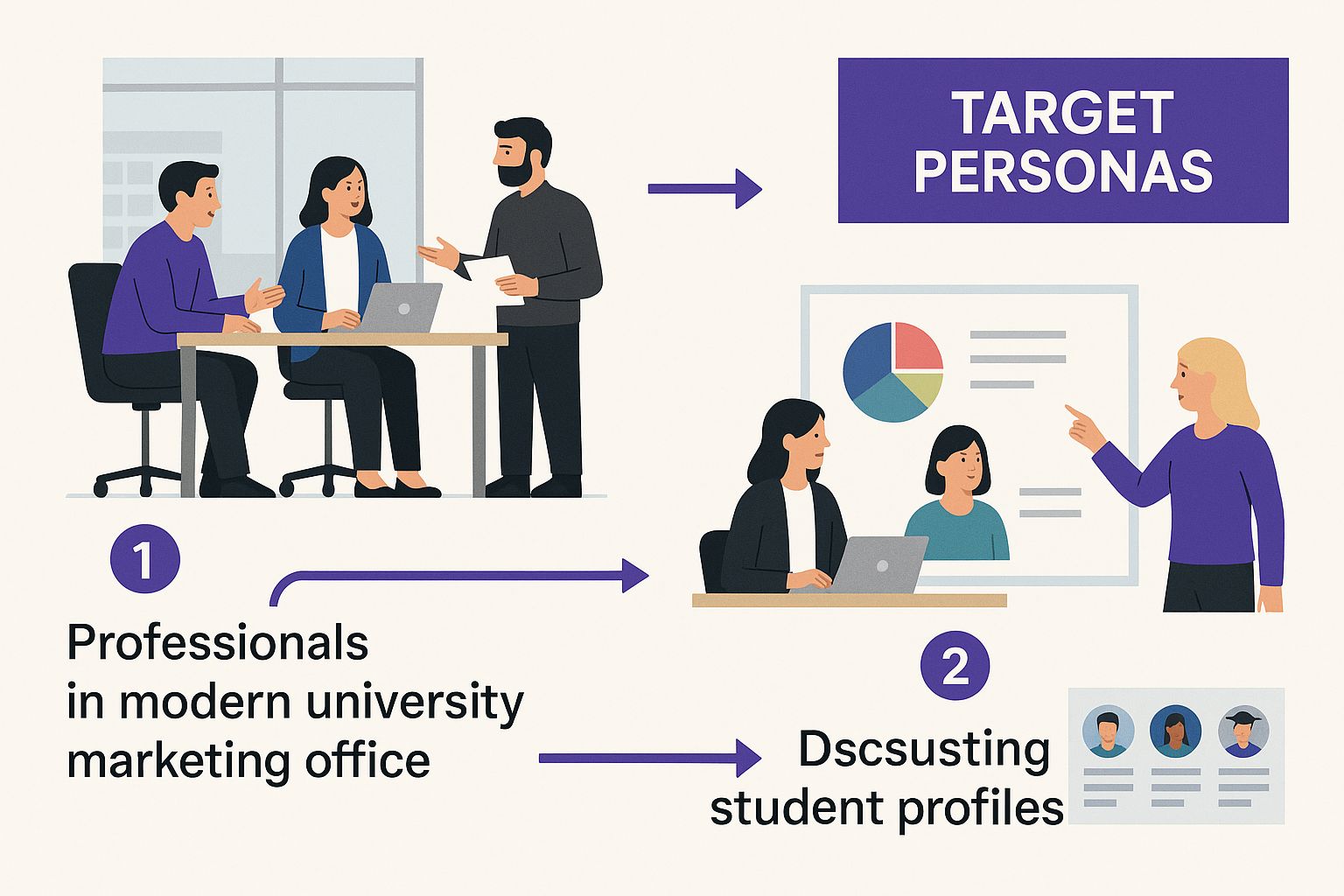
When you visualize your ideal students this way, your strategy suddenly feels much more grounded. It’s a powerful reminder that you're marketing to real people with real goals, fears, and motivations.
The Awareness Stage: The Spark of an Idea
This is the very top of the funnel, where everything is broad and exploratory. The potential student might be a high school junior just starting to daydream about college, or maybe a professional who’s been in the workforce for a decade and is thinking, "What's next for my career?" Their searches are general—things like "top business schools" or "what can I do with a psychology degree?" Your job here is all about inspiration and visibility. You need to plant a seed. Your content should focus on the big picture: exciting career paths, the life-changing value of a degree, and what's possible.
- Search Engine Optimization (SEO): Your blog and articles should answer those high-level questions. Forget just ranking for your university's name; focus on keywords tied to programs and career outcomes.
- Social Media: Get on Instagram and TikTok. Show off what campus life is really like. Share genuine student success stories. You're building a positive vibe around your brand.
- Video Content: A punchy, compelling video about a standout program or an inspiring alum can cut through the noise and make a lasting first impression.
The tone at this stage should be open and informative. You're establishing your institution as a credible, exciting place that’s worth a closer look.
The Consideration Stage: Getting Down to Brass Tacks
Okay, so they're aware of you. Now they're in the consideration phase, which means they're getting serious. They've got a shortlist of schools, and they're actively comparing them. Their research gets way more specific. They want to know about program details, who the faculty are, what the campus culture feels like, and—of course—how much it all costs.
This is where you bring the receipts. Students are looking for hard evidence and social proof that your university is the right academic and personal fit for them.
They're digging deep, asking questions like, "What research opportunities are there for biology majors?" or "What do students actually do for fun here?" Your digital marketing has to serve up clear, convincing answers.
- Detailed Program Pages: Your website needs robust pages for every single program. I'm talking curriculum details, faculty profiles with real credentials, and clear career paths.
- Virtual Tours: In this day and age, a high-quality virtual campus tour isn't a nice-to-have; it's a must. It gives students anywhere in the world a genuine feel for your campus and facilities.
- Student Testimonials: Nothing beats authenticity. Videos and quotes from current students are pure gold. They provide a trusted, peer-to-peer look at the real student experience.
At this point, your messaging pivots from broad inspiration to concrete proof. You’re showing them exactly what makes you different and better for them.
The Decision Stage: Making It Easy to Say "Yes"
The final hurdle. The student has probably narrowed their choice down to just two or three schools and is ready to take the plunge and apply. Their questions are now super practical, centering on application deadlines, financial aid packages, and the nitty-gritty of enrollment. Your one and only job here is to make this last step as smooth and painless as possible. Any friction at this point—a clunky form, a confusing webpage—can make a fantastic prospect give up and go elsewhere. Your higher education digital marketing should be laser-focused on clear calls-to-action and supportive guidance. This means simple online application forms, easy-to-use financial aid calculators, and direct, friendly access to admissions counselors who can help them seal the deal.
2. Choosing the Right Digital Marketing Channels

Once you’ve mapped out the student journey, the next big question is: where do you actually connect with these prospective students? Just throwing a bit of your budget at every popular platform is a surefire way to waste time and money. A smarter approach is to strategically pick the channels where your ideal students are already spending their time.
Think of it like fishing. You wouldn’t use the same bait in the same spot to catch every type of fish. In the same way, the digital channels you use to reach a high school junior exploring liberal arts programs should be completely different from those you use to engage a working professional looking for an MBA.
The Bedrock: Foundational Channels for Visibility
A few channels are non-negotiable for any modern higher education digital marketing plan. They form the foundation of your online presence and are essential for capturing initial interest.
- Search Engine Optimization (SEO): This is all about being the answer when a student has a question. Good SEO ensures that when someone searches for "best nursing schools in California" or "online data science master's degree," your program pages and articles show up. It’s your ticket to being discovered.
- Content Marketing: This is where you find your voice. Through helpful blog posts, program guides, and student success stories, you build authority and answer the questions that keep students up at night. It builds trust long before they ever think about hitting "apply."
- Social Media: This is your campus, but online. Platforms like Instagram, TikTok, and LinkedIn are where you bring your school's culture to life. You can share authentic student stories and build a real community in a way a static webpage never could.
These three don't work in isolation; they feed each other. Great content gives your SEO strategy something to rank. SEO, in turn, drives organic traffic to that content. And you share all of it on social media to build your community and let your brand's personality shine. This integrated approach is the core of strong marketing for universities.
Getting Specific with Paid Ads and Video
While the foundational channels build your reputation over time, paid advertising gives you immediate, laser-focused reach. Pay-Per-Click (PPC) ads on Google or social platforms let you put your message directly in front of highly specific groups of people. Want to reach students based on their search history, location, or specific interests? You can do that. This makes paid ads incredibly powerful for launching new programs or connecting with niche audiences, like international students or military veterans.
Video isn't just a trend anymore; it's a dominant force in higher education marketing. We consistently see video ads achieve significantly higher click-through rates (CTR) compared to static images, making them far more effective at grabbing and holding attention.
This highlights a simple truth: visual storytelling works. A short, powerful video can communicate your school's unique value much faster than paragraphs of text. Platforms like YouTube and Instagram Reels have become essential tools for any serious enrollment strategy.
Comparing Digital Marketing Channels for Student Recruitment
So, how do you decide where to put your budget? This table breaks down the most common channels, helping you see where each fits into your overall strategy and the student's journey.
| Channel | Primary Goal | Best-Fit Journey Stage | Key Performance Indicators (KPIs) |
|---|---|---|---|
| SEO | Organic Visibility | Awareness, Consideration | Keyword Rankings, Organic Traffic, Bounce Rate |
| PPC Ads | Targeted Lead Gen | Consideration, Decision | Cost Per Click (CPC), Conversion Rate, Cost Per Acquisition |
| Content Marketing | Build Authority | All Stages | Time on Page, Gated Content Downloads, Inbound Links |
| Social Media | Community Building | Awareness, Consideration | Engagement Rate, Follower Growth, Website Clicks |
| Email Marketing | Lead Nurturing | Consideration, Decision | Open Rate, Click-Through Rate (CTR), Application Starts |
This comparison makes it clear how each channel serves a distinct purpose. For instance, when you're planning events like virtual open houses or application workshops, you need to lean on a mix of these channels and deploy effective strategies for promoting events online to get people to show up. Ultimately, by thoughtfully selecting and blending these channels, you create a seamless, integrated strategy that guides students from their very first Google search all the way to their final application.
5. Crafting Your Message and Measuring Success

Great marketing isn’t just about getting in front of people; it’s about connecting with them. Once you’ve figured out where to find your ideal students, you need to figure out what to say. This means moving past those generic university taglines and crafting messages that speak directly to the hopes, fears, and goals of each specific student persona you’re targeting.
Think of it this way: your message is the bridge connecting a student's ambition to what your institution actually offers. For a high school senior, that bridge is built with stories of a vibrant campus life and the thrill of academic discovery. But for a mid-career professional looking at an MBA, it's built with promises of career advancement, flexible scheduling, and a clear return on their investment.
Developing Your Unique Value Proposition
Every school thinks it’s special. Your unique value proposition (UVP) is what proves it. It's the simple, compelling answer to a prospective student's most important question: "Why should I choose you over all the other options?"
This isn’t the place for vague buzzwords like "academic excellence" or "innovation." It’s time to get specific. Instead of just saying you have "world-class faculty," you could highlight a professor whose groundbreaking research just got published, or whose industry connections consistently land students top-tier internships.
Here are a few ways to sharpen your value proposition:
- Focus on Outcomes: Tie your programs directly to career success. Use real alumni stories, hard employment statistics, or partnerships with major employers in your field.
- Highlight Your Niche: Do you have a one-of-a-kind research lab? A study abroad program that no one else offers? An unbeatable student-to-faculty ratio? Put that front and center.
- Speak to the Feeling: Beyond the academics, what is the experience like? Emphasize your supportive community, your collaborative learning environment, or your deep commitment to social impact.
When you take this targeted approach, your higher education digital marketing stops being a broadcast and starts being a conversation, showing students you genuinely understand what they're looking for.
Moving Beyond Vanity Metrics
Alright, let's talk about measurement. In the world of digital marketing, it's incredibly easy to get sidetracked by "vanity metrics." These are the numbers that look impressive on a report but don't actually tell you if you're hitting your enrollment goals. Things like likes, shares, and follower counts feel good, but they don’t keep the lights on. To build a strategy that actually works—and lasts—you have to focus on metrics that track the student journey and measure your financial efficiency. This is how you prove your marketing spend is worth it and make smarter decisions down the road.
The most successful marketing teams I've worked with are the ones who can draw a straight line from a specific ad campaign to a newly enrolled student. They've shifted from measuring activity to measuring impact.
This means getting comfortable with a new set of key performance indicators (KPIs) that tell a much more powerful story.
The Metrics That Truly Matter
To build a real, data-driven enrollment engine, your team needs to become obsessed with a few core metrics. These KPIs go beyond simple online engagement and get right to the heart of what it costs to attract and enroll a new student. Here are the three most important metrics every higher ed marketer should master:
- Cost Per Inquiry (CPI): This tells you exactly how much you're spending for every prospective student who raises their hand—whether that’s by filling out an RFI form, signing up for a webinar, or downloading a viewbook. A low CPI is a great sign that your top-of-funnel messaging is resonating.
- Cost Per Application (CPA): This takes it a step further. It tracks the total cost to get a prospect to hit "submit" on their application. If your CPA is climbing, it might point to a problem in your application process or a disconnect between your initial ads and what's required to apply.
- Cost Per Enrolled Student (CPE): This is the bottom line. The big one. It calculates your total marketing spend to get one new student in the door. Understanding your CPE is absolutely critical for forecasting your budget and proving a clear return on investment (ROI) to university leadership.
When you start tracking these numbers religiously, your marketing department transforms from a cost center into a predictable growth driver for the institution.
Understanding the Costs and ROI of Your Campaigns
https://www.youtube.com/embed/OyM2T2t4OoE
Let's talk about the elephant in the room: the budget. Figuring out how much to spend on digital marketing in higher ed can feel like a shot in the dark. You know you need to invest to grow enrollment, but justifying the cost—and proving it actually works—is a constant pressure.
The most important shift you can make is to stop viewing your marketing spend as just another expense. Think of it as a strategic investment. When you have a solid handle on the real-world costs and potential returns, you can move from guesswork to confident, data-backed decisions. This not only helps you set realistic goals but also gives you the evidence you need to champion your budget and show a clear return on investment (ROI).
Breaking Down Your Campaign Costs
The truth is, there's no single magic number for what a student lead or a new enrollment should cost. The price tag can swing wildly depending on what you’re marketing. For example, attracting applicants for a competitive MBA program is going to be a much heavier lift (and a bigger budget item) than promoting an undergraduate liberal arts degree.
To build a smart budget, you need to get familiar with the key cost metrics that really matter in enrollment marketing strategies. Recent industry benchmarks give us a pretty good starting point. On average, you can expect the cost per inquiry for online and continuing education programs to be around $140. This breaks down further, with graduate programs costing about $157 per inquiry and undergraduate programs hovering around $128.
When you look at the ultimate goal—a new student in a seat—the numbers get bigger. The average cost per enrolled student is $2,849. But again, this varies. It’s about $3,804 for graduate programs, $1,505 for undergrads, and a much lower $599 for non-credit courses.
Tying Analytics to Your Financial Return
Knowing the industry averages is one thing, but tracking your own performance against them is where the real magic happens. This is how you start fine-tuning your spending to get the best possible return. A strong analytics setup isn't just a nice-to-have; it's the engine that drives your marketing efficiency.
A great analytics system transforms your marketing from a collection of hopeful tactics into a predictable, measurable growth engine. It shows you exactly which channels are bringing in students, so you can pour fuel on the fire and stop wasting money on what isn't working.
Imagine being able to trace a student’s entire path, from their first click on a social media ad all the way to their submitted application. That's the kind of insight that lets you calculate the true ROI of your campaigns with surgical precision. It’s what separates decent marketing from truly great marketing. If you want to get better at demonstrating the financial impact of your work, it’s worth learning how to measure social media ROI. Ultimately, when you get a firm grip on your costs and ROI, you change the entire conversation around marketing. Your team is no longer just "running ads." You're strategically managing an investment portfolio, with every dollar aimed squarely at hitting specific enrollment goals. That's the bedrock of sustainable growth in today's higher education world.
Common Questions About Higher Education Digital Marketing
Let's cut to the chase. When it comes to digital marketing for colleges and universities, the same core questions pop up again and again. As new platforms emerge and student expectations shift, it's easy to get lost in the weeds. This section tackles some of the most common challenges I see university marketers wrestling with. My goal is to give you straightforward, practical answers you can actually use, whether you're trying to nail down a budget or figure out how to create content that doesn't feel like a stuffy brochure.
How Much Should a University Budget for Digital Marketing?
Everyone wants a magic number, but the truth is, there isn't one. A common benchmark you'll hear is 5-10% of the university's total operating budget, but frankly, that’s just a starting point. Your budget really depends on your specific goals. Are you trying to grow enrollment by 20%? Is one of your flagship programs in a hyper-competitive market? These factors matter far more than a generic percentage. A much smarter way to think about this is to build your budget from the ground up. Start with your key performance goals—namely, what's your target Cost Per Inquiry and, most importantly, your Cost Per Enrolled Student? When you anchor your budget to concrete outcomes, you can justify every dollar and ensure your spending is directly tied to bringing new students through the door.
Which Social Media Platform Is Best for Student Recruitment?
The best platform is simply where your future students are hanging out. Spreading yourself thin with a one-size-fits-all approach is a recipe for wasted effort and money. You have to be strategic and meet students where they are.
- For Undergraduates: You absolutely have to be on Instagram and TikTok. These platforms are built for visual storytelling. Think day-in-the-life takeovers, authentic clips of campus events, and student-generated content that shows what it's really like to be part of your community.
- For Graduate & Professional Students: LinkedIn is king. This is where you can showcase the real career value of your programs. Spotlight your brilliant faculty, share groundbreaking research, and draw a straight line from a degree to a better job.
The bottom line is simple: match the message to the medium and the audience.
What Is the Most Important Metric to Track?
While it's tempting to focus on vanity metrics like website traffic or follower counts, the one KPI that truly proves your value to leadership is the Cost Per Enrolled Student. This is the metric that cuts through the noise and directly ties your marketing spend to bottom-line results: new students paying tuition.
Focusing on Cost Per Enrolled Student is how you change the narrative. It reframes the marketing department from a "cost center" to a "growth engine." It gives you the hard numbers needed to defend your budget and make smart decisions about where to invest next.
Tracking this is especially critical as institutions face challenges like the demographic enrollment cliff. When every student counts, proving the efficiency and quality of your marketing becomes essential. For a deeper dive, it's worth understanding why lead quality is the new KPI when navigating the enrollment cliff.
How Can We Create Content That Stands Out?
Please, step away from the generic campus beauty shots and lofty mission statements. The key to creating content that actually connects with prospective students is authenticity and storytelling. For more insights and digital marketing services, you can also explore the dalm.co website.
Get a camera in the hands of your real students and let them talk about a project that fired them up. Interview an alum about how their degree landed them their dream job. Have a passionate professor break down their complex research in a 60-second video that even a high school senior would find fascinating.
Use Reels and TikTok to capture the unscripted, genuine energy of your campus. In a sea of polished and predictable marketing, being real is your biggest competitive advantage.
At Motimatic, we specialize in turning these insights into action. Our platform uses behavioral science to deliver personalized, motivating messages that guide students from their first inquiry all the way through to graduation, boosting enrollment and retention for our partner institutions. Learn how we can help you reach your goals at https://motimatic.com/.
See it on your own listOne list, one goal, and a randomized holdout to show the lift. Start a pilot