

An academic advisor’s job goes far beyond just ticking a box on your class schedule. They are one of the most important people in a student's corner, acting as a primary support system for everything from academic planning to personal growth on the road to graduation.
Think of them as a GPS for your degree—they help you navigate the twists and turns of complex requirements and find the most efficient route to the finish line.

Unpacking the Modern Advisor Role
Let's get one thing straight: the old-school view of an advisor as just a schedule-approver is completely outdated. Today’s academic advisors are dynamic, multifaceted professionals who act as a student's guide through the maze of higher education. Their role has grown into a powerful blend of mentor, strategist, and resource connector.
At its core, an advisor’s job is to take a dense, often confusing program catalog or degree audit and turn it into a clear, step-by-step plan. They help you understand not just what courses to take, but when and why, ensuring you're always making real, timely progress toward that diploma.
To give you a clearer picture, here’s a quick breakdown of their core functions.
Core Functions of an Academic Advisor
A summary of the primary duties academic advisors perform to support student success.
| Responsibility Area | Description | Impact on Students |
|---|---|---|
| Academic Planning | Helping students select courses, understand degree requirements, and create a multi-semester plan to ensure on-time graduation. | Provides a clear, actionable roadmap, reducing stress and preventing costly delays or unnecessary classes. |
| Career Exploration | Connecting academic majors to potential career paths, internships, and professional development opportunities. | Helps students see the long-term value of their education and make informed decisions that align with their goals. |
| Policy Navigation | Explaining university policies, academic standards, deadlines, and procedures, such as add/drop dates or academic probation. | Empowers students to make informed choices and avoid common pitfalls that could derail their progress. |
| Resource Connection | Directing students to vital campus services like tutoring, financial aid, counseling, and wellness centers. | Ensures students get the right support at the right time, addressing challenges before they become crises. |
| Progress Monitoring | Regularly checking in on a student's academic performance and well-being to provide proactive support and intervention. | Creates a safety net, helping students stay on track and fostering a sense of accountability and belonging. |
This table shows just how much goes on behind the scenes. An advisor is truly a central hub for student success.
It’s About More Than Just Academics
Beyond the course catalog, an advisor’s duties cover a much wider spectrum of support. They’re trained to help you pinpoint your personal values, explore career paths that genuinely excite you, and connect you with crucial campus services you might not even know you need. This can include pointing you toward:
- Tutoring and writing centers to sharpen your skills
- Mental health and wellness services for personal support
- Financial aid offices to navigate funding
- Career development centers to build your resume
This holistic approach is what makes a great advisor so valuable. They see the whole student, not just the transcript. Research backs this up, showing that advisors are key in helping students define both personal and career goals while connecting them to the broader campus support network. The role is a linchpin for student success, even if it looks a little different from one campus to the next.
A Confidential Partnership
Of course, none of this works without trust. A fundamental part of an advisor’s job is protecting student privacy. They handle a lot of sensitive academic and personal information, which means they operate under very strict confidentiality guidelines. Understanding the principles of FERPA compliance and student data protection is critical to building that trusting and effective relationship.
At its heart, the partnership between a student and an advisor is built on trust and a shared goal: your success. By viewing your advisor as a strategic guide, you can unlock a powerful resource dedicated to helping you achieve your academic and personal potential.
The Four Pillars of Student Advising
To really get a handle on what an academic advisor does, it helps to think of their role as a structure built on four essential pillars. These pillars support your entire college experience: Academic Planning, Career Guidance, Personal Development, and Institutional Navigation.
Each one is a distinct area of support, but they all lock together to give you a stable foundation for success. This isn't just a checklist of tasks; it’s a way to see how your advisor's guidance is connected and comprehensive.
Let’s break them down one by one.
Pillar 1: Academic Planning
This is the one everyone knows about. At its core, academic planning is about creating a clear, semester-by-semester roadmap to get you to graduation on time. Think of your advisor as a strategist, helping you build a schedule that's both efficient and manageable. This breaks down into a few key actions:
- Course Selection: They help you pick the right classes in the right order. No more getting stuck because you missed a prerequisite.
- Requirement Tracking: They make sure you’re checking all the boxes for your major, minor, and general education credits. No nasty surprises in your senior year.
- Timely Graduation: They map out a path to finish your degree in four years (or whatever your goal is), which saves you a ton of time and money.
Pillar 2: Career Guidance
Modern advising isn't just about the classes you take—it’s about connecting those classes to your future career. Advisors help you see how a major translates into a real-world profession and what you can do right now to become a strong job candidate later.
They act as a bridge between the classroom and your professional goals. For example, they can show a political science major how to find opportunities in public policy, law, or nonprofit work, and then point them toward relevant internships or networking events. It's proactive career coaching, and it's a huge part of what they do.
The image below shows just how central academic, personal, and career needs are to the entire advising process.
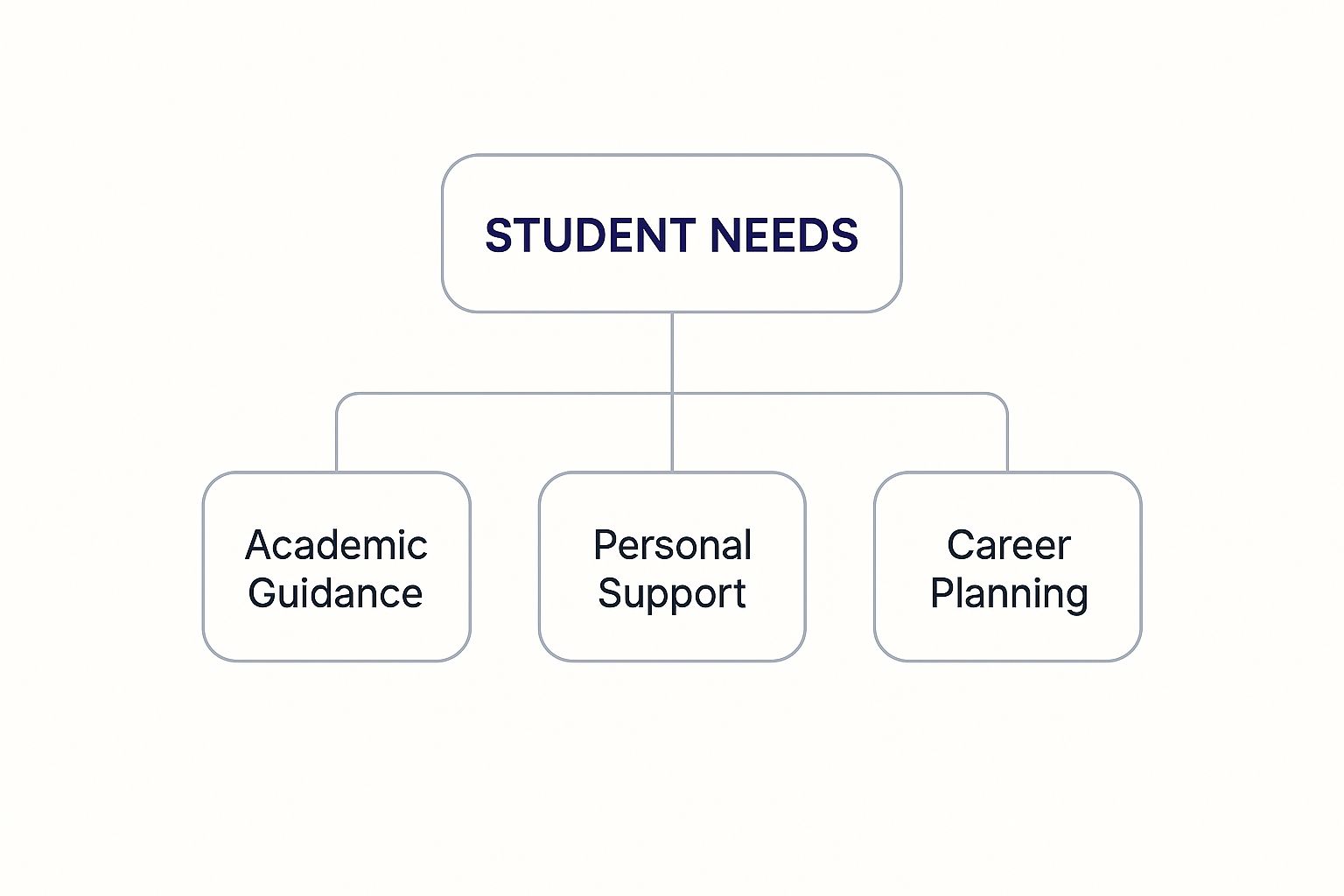
This makes it clear: career advising isn’t some side task. It's a fundamental part of how advisors support student development.
Pillar 3: Personal Development
An advisor's job often goes beyond academics to support your growth as a person. Let's be real—college is hard. Advisors are trained to help you build resilience, sharpen your time management skills, and work through personal challenges that get in the way of your studies.
They often become a trusted confidant and your first point of contact when you're struggling, whether it’s with grades, stress, or just feeling completely overwhelmed.
This pillar is all about supporting the whole student. Personal well-being is directly tied to academic success, and understanding the science behind student outcomes shows just how much motivation and personal support drive achievement.
Pillar 4: Institutional Navigation
Universities are big, complicated places with their own rules, deadlines, and bureaucracies. This fourth pillar is about your advisor acting as your expert guide through it all.
Think of them as your go-to resource for decoding university policies and getting connected to other campus services.
Need help with financial aid, mental health counseling, tutoring, or study abroad programs? Your advisor knows exactly who to call and where to send you. They help you cut through the red tape so you get the right support from the right office, right when you need it.
Why Good Advising Can Be So Hard to Find
Ever walk out of an advisor's office feeling more like a case number than a student? You’re not alone. While most academic advisors are deeply committed to helping students succeed, the reality is that systemic issues in higher education often get in the way.
Understanding these behind-the-scenes challenges isn't about making excuses—it's about setting realistic expectations and seeing why a real institutional investment in advising is so critical. The quality of your advising experience isn't just about one person's effort; it's shaped by the very structure of their job.

Burnout, Turnover, and Limited Growth
High caseloads are just one piece of a much larger, more complex puzzle. Advisors themselves are often dealing with professional pressures that lead to burnout and high turnover rates, which directly impacts the students they serve. There’s nothing more disruptive than having the trusted advisor you’ve built a rapport with leave mid-semester. Several factors create this challenging environment:
- Stagnant Pay: Advisor compensation often fails to keep pace with their level of education and the sheer complexity of their work.
- Limited Career Ladders: Many see few clear paths for professional advancement within their institutions, prompting them to look for opportunities elsewhere.
- Intense Emotional Labor: The weight of guiding hundreds of students through one of the most pivotal times of their lives is immense.
These aren't just internal HR issues; they have a direct and measurable impact on https://motimatic.com/university-student-retention/. When advisors are overworked, under-supported, and burning out, their ability to forge the strong, supportive relationships that keep students on track is compromised. Consistent, high-quality advising isn't a "nice-to-have." It’s a cornerstone of student success and institutional health, and it demands meaningful support from the top down.
How Technology Is Reshaping Advising
Academic advising is no longer about paper forms and manual checklists. The entire field is in the middle of a massive shift, blending smart technology with the irreplaceable human touch to build a far more effective, proactive model of student support.
Think of it as the jump from a static paper map to a live GPS. The old map gave you the basic directions, sure. But a GPS gives you real-time data, finds better routes on the fly, and warns you about traffic jams before you're stuck in them. That's exactly what technology is doing for advising today.
These tools are finally letting advisors get out ahead of problems. Instead of just reacting to issues as they pop up, they can have more strategic, meaningful conversations focused on a student's actual goals, not just tedious administrative tasks.
From Reactive to Proactive Support
The single biggest change technology brings to an advisor's day-to-day is the power to use data for early intervention. Universities are now leaning on predictive analytics to spot students who might be at risk of falling behind, often based on subtle signals like a dip in grades or lower engagement in their coursework. This data-first approach means advisors can reach out before a small stumble turns into a full-blown crisis. For instance, if the system flags a student struggling in a critical prerequisite course, their advisor can step in immediately with resources like tutoring or a study skills workshop.
Technology transforms the advising role from that of a scheduler to a strategic coach. By automating administrative tasks and providing deep insights, these tools free up advisors to focus on what matters most: building strong, supportive relationships with their students.
This doesn't make the human element obsolete—it supercharges it. When software handles the routine stuff, advisors suddenly have more time for the high-impact work of mentorship, coaching, and personal guidance that truly shapes a student's success.
Creating a High-Tech, High-Touch Experience
The modern vision for academic advising is all about this "high-tech, high-touch" philosophy. It’s a powerful combination of digital platforms and personalized coaching designed to boost student outcomes and, ultimately, graduation rates by making support more targeted and accessible. It’s easy to see how this works in practice. Digital platforms are streamlining everything from communication to planning:
- Centralized Hubs: Students can see their entire degree plan, book appointments, and chat with their advisors all in one place.
- Automated Reminders: Smart systems can send out automatic nudges about critical deadlines for registration, financial aid, or graduation applications.
- Clear Pathways: Schools can map out precise, four-year degree pathways, giving students a clear line of sight to the finish line from day one.
Major programs like the California State University Graduation Initiative 2025 show this model in action. They pair students with specially trained advisors who use predictive analytics to connect them with the right support services at the right time. This blend of smart tech and real-world support is a proven recipe for better engagement and more timely graduations.
Building a Strong Partnership with Your Advisor
Think of your academic advisor as one of your most valuable allies in college. But like any strong partnership, it’s a two-way street. Your advisor has responsibilities to you, absolutely. But you also have an active role to play in making that relationship truly effective.
Taking ownership of your advising sessions can turn them from simple check-ins into strategic planning meetings for your future.
Here’s the thing: your advisor is the expert on the university—its policies, programs, and people. But you are the expert on you. To make every minute of your meeting count, you need to come prepared, be honest about your goals and struggles, and view your advisor as a strategic resource, not just a schedule-approver.

Making Every Meeting Count
Showing up to an advising appointment unprepared is like going to the doctor without knowing your symptoms. You’ll get some general advice, sure, but you’ll miss out on the specific diagnosis that could really help. A little prep work goes a very long way.
Before you walk through their door, review your degree audit and jot down a few potential courses. Most importantly, write down your questions. This one simple act shifts the dynamic from passive to active, showing your advisor you're invested in your own education.
This kind of proactive engagement is a cornerstone of the most successful student success initiatives that institutions are using to boost student outcomes. When you come prepared, your advisor can provide specific, actionable guidance that addresses what’s really on your mind.
Smart Questions to Ask Your Advisor
Moving beyond "What classes should I take?" unlocks a much deeper level of support. The right questions can open doors to opportunities you didn't even know existed. Try to frame your questions around both your immediate needs and your long-term aspirations. Here are a few examples to get you started:
- "My goal is to work in marketing. What kinds of internships or campus clubs should I be looking into this semester to build my resume?"
- "This required course has a reputation for being tough. What resources, like tutoring or study groups, do students who do well in it typically use?"
- "I'm thinking about adding a minor in data analytics. Can we talk about how that would change my graduation timeline and what the career benefits might be?"
- "Could you look over my four-year plan with me? I want to make sure I haven't missed any key prerequisites for my upper-level courses."
A strong advising partnership empowers you to take control of your academic journey. Honesty and clear communication are essential; be open about your challenges, whether it's a tough course, a personal issue affecting your studies, or uncertainty about your major.
This kind of transparency is what allows your advisor to connect you with the right resources before a small snag turns into a major roadblock. Building this rapport creates a powerful support system dedicated to helping you navigate the complexities of college and achieve everything you’re capable of.
Your Advising Questions, Answered
Students almost always have a few key questions about how academic advising works. Getting clear, straightforward answers is what separates a decent advising relationship from a truly great one—and it’s the key to feeling confident about your path. Let's cut through the confusion and tackle some of the most common questions we hear about an academic advisor's role.
How Often Should I See My Advisor?
There isn't a single magic number here, but here's a good rule of thumb: plan to meet with your advisor at least once every semester. That meeting is your non-negotiable check-in for course registration and making sure you're set for the next term. But truly effective advising is more than just a semesterly transaction. You should absolutely connect with your advisor anytime you're:
- Thinking about changing your major or tacking on a minor.
- Hitting an academic rough patch or dealing with personal challenges that are impacting your classes.
- Looking into internships, research projects, or study abroad programs.
- Getting ready for graduation and figuring out what comes next.
Think of it less like a required appointment and more like an ongoing conversation.
What’s the Difference Between an Advisor and a Faculty Mentor?
This is a great question, and it's easy to get the two confused. While both are here to help you succeed, they operate in different spheres.
Your academic advisor is a trained professional who knows the university's policies, degree requirements, and campus resources inside and out. They are your go-to guide for navigating the system and making sure you stay on a clear path to graduation.
A faculty mentor, on the other hand, is a professor who works directly in your field of study. They offer deep, subject-specific wisdom, giving you the inside track on research, different career paths in your discipline, and professional connections.
In short: an advisor helps you navigate the institution, while a faculty mentor helps you navigate your field. Both are incredibly important for a rich, well-rounded college experience.
Can I Talk to My Advisor About Personal Problems?
Yes, absolutely. While your advisor isn't a licensed therapist, they are a critical first point of contact and a confidential resource. A core part of an advisor's job is connecting you to the right support systems on campus.
If you’re feeling overwhelmed by stress, dealing with health issues, or facing other personal hurdles, your advisor is trained to connect you with the experts who can help—like the campus counseling center, wellness programs, or student advocacy offices. They're a safe place to start.
Motimatic uses data and behavioral science to help universities provide personalized student support at scale, boosting both retention and student success. See how our platform can strengthen your advising programs and guide every student toward their degree by exploring our solutions.
See it on your own listOne list, one goal, and a randomized holdout to show the lift. Start a pilot