In the competitive landscape of higher education, enrolling a student is only the first step. The true measure of an institution's success lies in its ability to retain that student through to graduation. Student attrition represents not just a significant loss of tuition revenue but a failure to fulfill the core promise made to that individual. As student demographics, expectations, and challenges evolve, so too must our approaches to keeping them engaged, supported, and on the path to completion.
This article moves beyond generic advice to provide a comprehensive roundup of nine evidence-backed, actionable student retention strategies. We will explore practical frameworks that successful institutions are using right now to boost persistence and graduation rates. For enrollment and student success teams, this is a roadmap to building a resilient, supportive ecosystem that transforms student potential into graduate success.
We'll cover specific tactics from implementing early alert systems and intrusive advising models to fostering powerful learning communities and enhancing mental health support. The principles of fostering this persistence often align closely with broader insights from effective customer retention strategies, where a focus on experience and support is paramount. Each strategy is unpacked with details on implementation, real-world examples, and fresh perspectives on how to address modern challenges like financial instability and the need for flexible, technology-enhanced support. This guide is designed to equip your team with the tools needed to not only enroll students but to ensure they thrive.
1. Implement Proactive Early Warning Systems
Early Warning Systems (EWS) are a cornerstone of modern student retention strategies, shifting institutional support from a reactive to a proactive model. These data-driven platforms monitor a range of academic and behavioral indicators, such as fluctuating grades, declining Learning Management System (LMS) engagement, and irregular attendance. The goal is to identify students at risk of dropping out long before they reach a crisis point. By leveraging predictive analytics, an EWS can flag a student who is subtly disengaging. This allows advisors and faculty to intervene with targeted, personalized support. The purpose is not surveillance but to create an intelligent safety net, ensuring no student slips through the cracks unnoticed.
Key Insight: A successful EWS translates data into action. It transforms passive observations, like a drop in forum participation, into an automated, timely alert for an advisor, prompting a meaningful conversation that can alter a student's trajectory.
How Early Warning Systems Drive Retention
Instead of waiting for a student to fail a midterm or officially withdraw, an EWS provides leading indicators of struggle. For example, a system might trigger an alert when a first-generation student's login frequency drops by 50% in a historically difficult STEM course. This prompts a personalized outreach message from their advisor, offering resources like tutoring or a one-on-one check-in. This proactive approach allows institutions to allocate resources more efficiently and provide support that is both timely and relevant. These systems are effective because they significantly shorten the time between identifying a problem and delivering a solution, directly boosting retention.
Real-World Success and Implementation
Institutions pioneering this student retention strategy have seen remarkable results. Georgia State University's widely cited GPS Advising system helped increase graduation rates by 5 percentage points.
https://www.youtube.com/embed/b-iWwZOb9mo
Actionable Tips for Implementation
- Start Small: Begin with foundational indicators like attendance and grades before integrating more complex metrics like social engagement or co-curricular participation.
- Ensure Buy-In: Provide comprehensive training for faculty and advisors on how to interpret EWS alerts and use the system effectively. Their adoption is critical for success.
- Maintain Transparency: Be open with students about what data is being collected and how it is used to support their success. This builds trust and encourages them to engage with outreach efforts.
- Balance Automation and Human Touch: Use the system to flag at-risk students, but ensure the intervention itself is personal and empathetic. Human judgment should always guide the final support action.
2. Adopt Intrusive Academic Advising
Intrusive Academic Advising, also known as proactive advising, is a high-impact student retention strategy that fundamentally reverses the traditional advising model. Instead of waiting for students to seek help, advisors regularly and systematically initiate contact, especially with students showing early signs of academic or personal difficulty. This approach involves mandatory meetings, close progress monitoring, and building sustained relationships.

The term "intrusive" does not mean invasive; it means intervening. This model, championed by organizations like NACADA and the Complete College America initiative, is built on the principle that structured, required support helps students navigate challenges before they become insurmountable.
Key Insight: Intrusive advising transforms the advisor-student dynamic from a transactional service to a developmental partnership. By initiating contact, advisors show they are invested in the student's success, which builds the trust necessary for students to be vulnerable and ask for help.
How Intrusive Advising Drives Retention
This proactive model is especially effective for first-generation students, students on probation, or those in demanding programs who may be hesitant to ask for help. By requiring touchpoints, institutions ensure that every student has a direct connection to a support figure. An advisor might schedule a mandatory mid-semester check-in for all first-year students to discuss time management, rather than waiting for them to underperform on exams. This strategy creates a structured support network that normalizes seeking guidance. When students know an advisor will be reaching out, it removes the barrier of uncertainty and fosters a sense of belonging, directly impacting persistence and success.
Real-World Success and Implementation
Several institutions have demonstrated the power of intrusive advising. The University of South Carolina’s famous University 101 program integrates mandatory advisor meetings to help first-year students acclimate. At Sinclair Community College, intensive, proactive advising for at-risk student populations has led to significant gains in course completion and retention rates.
Actionable Tips for Implementation
- Define Triggers and Protocols: Establish clear criteria for when and how advisors should intervene, such as a drop in grades, poor attendance, or a student being placed on academic probation.
- Invest in Training: Equip advisors with skills in both academic guidance and holistic support, including active listening and motivational interviewing techniques. They need to be prepared to discuss more than just course selection.
- Leverage Technology: Use advising software or CRM systems to track student interactions, schedule regular check-ins, and send automated reminders for mandatory appointments.
- Balance Support with Autonomy: While the approach is proactive, the goal is to empower students, not enable dependency. Frame interventions as a way to build skills and connect students with resources that foster their independence.
3. First-Year Experience Programs
The transition into higher education is a critical period where students are most vulnerable to attrition. First-Year Experience (FYE) programs are a powerful student retention strategy designed to ease this transition by integrating new students into the academic and social fabric of the institution. These comprehensive initiatives typically include orientation courses, learning communities, and dedicated mentorship to provide a structured support system from day one. FYE programs go beyond simple orientation by actively teaching students how to be successful in a college environment. They connect students with peers, faculty, and essential campus resources, fostering a strong sense of belonging that is directly linked to persistence. The goal is to build a foundation of confidence and competence during the first two semesters.
Key Insight: The most effective FYE programs are not just a single course or event. They are a holistic, year-long ecosystem of support that embeds academic skills, social integration, and resource awareness into the core of the first-year curriculum.
How First-Year Experience Programs Drive Retention
FYE programs act as a crucial bridge between high school and the rigors of university life. By combining academic content with essential college success skills like time management, study strategies, and financial literacy, these programs equip students with the tools they need to thrive. For instance, a First-Year Seminar might group students by major, allowing them to form an immediate peer network while learning about the expectations of their chosen field from a dedicated faculty mentor. This early, structured engagement helps demystify the college experience and reduces the feelings of isolation that often lead to withdrawal. It is one of the most reliable student retention strategies because it addresses the academic, social, and emotional needs of new students simultaneously.
Real-World Success and Implementation
The impact of FYE programs is well-documented. The University of South Carolina’s pioneering University 101 program is a cornerstone of the movement and has been shown to improve both retention and graduation rates significantly. Similarly, Belmont University’s First-Year Seminars and Northern Arizona University's First-Year Learning Communities create small, supportive cohorts that have led to higher first-year persistence rates compared to non-participants. These programs succeed because they create multiple touchpoints for support, ensuring that students build meaningful relationships and know exactly where to turn for help. This framework, popularized by leaders like Dr. John Gardner and the Gardner Institute, has become a national model for student success.
Actionable Tips for Implementation
- Integrate Skills: Weave academic content with practical college success skills. Do not treat them as separate subjects; show students how to apply study strategies directly to their coursework.
- Foster Connections: Design activities that require peer interaction and collaboration. Use learning communities or cohort models to create strong social bonds.
- Leverage Peer Mentors: Train successful upper-division students to serve as peer mentors. They can provide relatable advice and serve as accessible role models.
- Connect to Campus: Explicitly introduce students to key campus resources like the writing center, career services, and counseling. Make visiting these offices part of a course requirement.
- Assess and Evolve: Continuously gather feedback from students and faculty to assess program effectiveness. Use this data to refine the curriculum and support structures each year.
4. Financial Aid and Emergency Funding
Financial instability is a leading cause of student attrition, often derailing academic journeys for reasons unrelated to academic performance. A comprehensive financial support strategy goes beyond traditional scholarships to include emergency aid, micro-grants, and robust financial literacy education. These programs provide a critical safety net, addressing the unexpected financial shocks that can force students to choose between paying rent and paying tuition. The goal is to remove financial barriers before they become insurmountable. By offering timely, accessible funding for emergencies like a car repair, medical bill, or temporary job loss, institutions can provide the stability students need to persist and succeed. This is a powerful and direct student retention strategy that tackles a root cause of dropout.
Key Insight: Emergency aid is most effective when it is fast, accessible, and coupled with support. The true value lies not just in the funds, but in showing students that the institution is invested in their holistic well-being and is ready to help them navigate life’s unexpected challenges.
How Financial Support Drives Retention
An unexpected expense of just a few hundred dollars can be the final straw for a student living on a tight budget. Emergency funding programs address this head-on. For example, when a student’s laptop breaks mid-semester, a micro-grant can get them a replacement within days, preventing them from falling behind in their coursework. These interventions are highly effective because they resolve an immediate crisis, allowing the student to refocus on their studies. These programs also build a stronger sense of belonging and institutional loyalty. When students feel supported during a crisis, their connection to the university deepens. As organizations like The Hope Center for College, Community, and Justice have shown, addressing basic needs insecurity is fundamental to improving student outcomes. Learn more about overcoming financial barriers to retention.
Real-World Success and Implementation
Institutions that prioritize this student retention strategy have seen significant returns. Amarillo College's acclaimed No Excuses Poverty Initiative provides a comprehensive network of support services, including emergency aid, which has contributed to a dramatic increase in its graduation rates. Similarly, Scholarship America’s Dreamkeepers program, implemented at numerous colleges, offers emergency grants that have been shown to help 90% of recipients stay in school. Northeastern University’s We Care program offers another strong model, providing students with emergency funds for everything from food insecurity to travel costs for family emergencies, ensuring students have a reliable place to turn.
Actionable Tips for Implementation
- Establish a Clear Process: Create a simple, low-barrier application for emergency aid. Define clear eligibility criteria and ensure a rapid decision-making process to address crises in a timely manner.
- Combine Funding with Counseling: Pair emergency grants with mandatory or optional financial literacy counseling. This helps students manage the immediate crisis and build skills for long-term financial stability.
- Promote Resources Proactively: Don't wait for students to be in crisis. Market financial aid and emergency resources during orientation, through campus-wide emails, and via faculty and advisor referrals.
- Build Community Partnerships: Collaborate with local non-profits, food banks, and community foundations to expand the pool of available resources and provide wrap-around support for students.
5. Learning Communities and Cohort Models
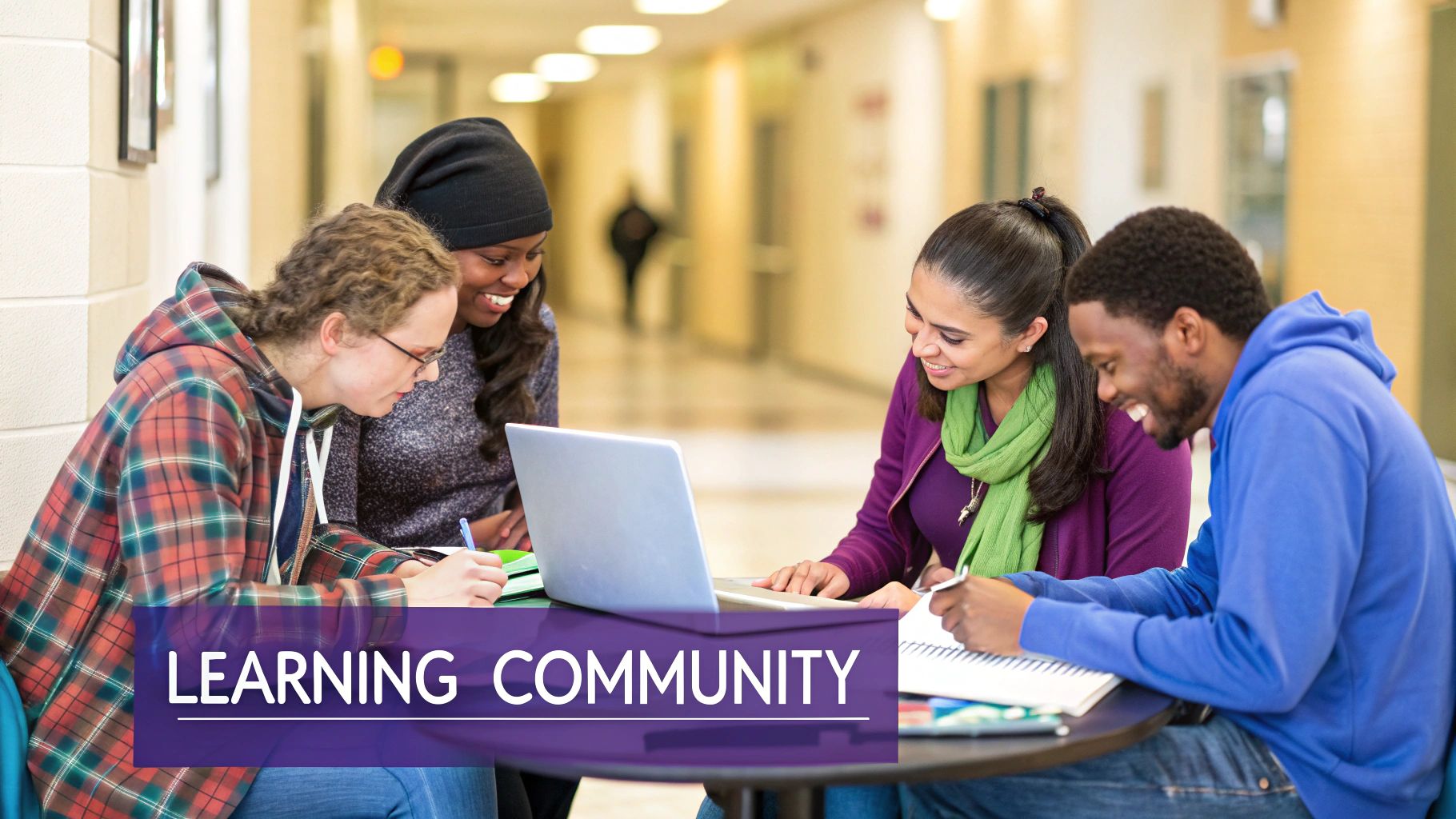
Learning Communities and Cohort Models are powerful student retention strategies that combat feelings of isolation by creating small, supportive academic families within a large university setting. These structured programs group students together to take one or more courses as a unified cohort, often linked by a common theme or major. This shared academic journey fosters strong peer relationships, collaborative learning, and a deeper sense of belonging. The core principle, advocated by researchers like Vincent Tinto, is that integrating students into the academic and social fabric of an institution significantly boosts persistence. By creating these micro-communities, institutions help students build the connections and support networks essential for navigating the challenges of higher education.
Key Insight: Learning communities transform the anonymous lecture hall experience into a collaborative, team-based environment. This shift from passive learning to active engagement not only improves academic outcomes but also forges the social bonds that make students feel connected to their institution.
How Learning Communities Drive Retention
Instead of students navigating their first year alone, a cohort model provides an instant peer network. Students in a learning community study together, tackle shared assignments, and develop relationships with faculty who are often teaching collaboratively. This structure provides built-in academic and social support, which is especially critical for first-generation students or those in demanding programs.
To enhance student persistence, particularly within these communities, it's beneficial to explore broader strategies for building thriving online communities, as these principles can be adapted to foster engagement in both virtual and in-person settings. This integrated approach ensures the community remains strong and supportive across all platforms.
Real-World Success and Implementation
The impact of this student retention strategy is well-documented. The University of Washington’s Freshman Interest Groups (FIGs) place small groups of 20-25 students into a cluster of courses, led by a peer advisor. Similarly, LaGuardia Community College has seen significant improvements in student success and graduation rates by linking courses like English and sociology around a common theme, creating a cohesive educational experience. Portland State University's Freshman Inquiry program also uses year-long, theme-based courses to build strong cohort identity.
Actionable Tips for Implementation
- Create Meaningful Connections: Design the curriculum so that linked courses genuinely complement each other, requiring students to integrate knowledge across disciplines.
- Select and Train Faculty: Choose instructors who are enthusiastic about collaborative teaching and provide them with joint planning time and professional development.
- Structure Peer Interaction: Don't assume friendships will form automatically. Build structured group projects, study sessions, and co-curricular activities into the program.
- Monitor Group Dynamics: Be prepared to facilitate conflict resolution and ensure all students feel included. Early intervention can prevent negative dynamics from derailing the cohort.
- Assess Both Outcomes: Evaluate success not just by academic metrics like GPA, but also through surveys and focus groups that measure students' sense of belonging and social integration.
6. Mental Health and Wellness Support
Prioritizing comprehensive mental health and wellness support is a critical component of modern student retention strategies. This approach moves beyond basic counseling services to create a campus-wide culture of well-being, addressing the psychological and emotional barriers that directly impede academic success. It involves a holistic ecosystem of support, including accessible counseling, crisis intervention, wellness programming, and stress management resources.
The goal is to dismantle the stigma surrounding mental health and ensure students have the tools to manage stress, anxiety, and other challenges before they escalate into academic disengagement or withdrawal. By treating student well-being as a prerequisite for learning, institutions can create a more supportive and resilient student body.

Key Insight: Effective mental health support is not a siloed service; it is deeply integrated into the academic and social fabric of the university. When faculty are trained to recognize distress and academic advisors can seamlessly refer students to wellness resources, retention becomes a shared, campus-wide responsibility.
How Mental Health and Wellness Support Drives Retention
Anxiety, depression, and burnout are significant contributors to attrition. A student struggling with their mental health is less likely to attend class, complete assignments, or engage with their peers, creating a cycle of academic decline. Proactive wellness support disrupts this cycle by providing timely, accessible interventions. Instead of waiting for a student to fail, this strategy offers preventative resources like stress-reduction workshops before finals week or peer support groups for students facing similar life challenges. By normalizing the need for support and making it easy to access, institutions empower students to build coping mechanisms, which directly correlates with their ability to persist through academic and personal difficulties. For a deeper look into this connection, you can learn more about how mental health and wellness support impacts retention on motimatic.com/.
Real-World Success and Implementation
The impact of this approach is evident across higher education. The University of California system's comprehensive mental health initiatives have expanded services and integrated wellness into the student experience, leading to increased help-seeking behavior. Many institutions partner with The JED Foundation to become a JED Campus, a program that helps schools evaluate and strengthen their mental health, substance misuse, and suicide prevention programs to support student well-being. Similarly, the University of Michigan's expansion of its Counseling and Psychological Services (CAPS) has demonstrably improved access and reduced wait times, ensuring students get help when they need it most.
Actionable Tips for Implementation
- Integrate Services: Embed counselors within academic departments or residential halls to reduce barriers and make support more visible and accessible.
- Train Your Campus Community: Provide faculty, staff, and student leaders with training, like QPR (Question, Persuade, Refer), to help them recognize warning signs of distress and know how to connect students with professional help.
- Leverage Technology: Utilize telehealth platforms and mental wellness apps to offer flexible, on-demand support that meets students where they are.
- Develop Peer Programs: Create and fund peer-led wellness programs and support groups, as students are often most comfortable seeking initial help from their peers.
7. Build Accessible Academic Success Centers
Academic Success Centers are centralized hubs designed to bolster student learning and persistence. These centers move beyond simple tutoring by offering a holistic suite of services, including writing assistance, study skills workshops, and specialized instruction for challenging courses. They function as a critical academic safety net, providing students with the tools and support needed to navigate difficult subject matter and develop effective learning strategies. By centralizing these resources, institutions make support visible and accessible, reducing the stigma often associated with seeking help. The primary goal is to empower students, helping them build confidence and master the academic skills essential for graduation and one of the most effective student retention strategies.
Key Insight: The most effective Academic Success Centers are positioned not as remedial services for struggling students, but as enhancement hubs for all students looking to excel. This inclusive marketing encourages high-achievers and at-risk students alike to engage, normalizing academic support as a key part of the university experience.
How Success Centers Drive Retention
Academic Success Centers directly combat one of the primary drivers of attrition: academic difficulty. When students struggle in foundational or high-DFW (D, F, Withdrawal) rate courses, they often become discouraged and question their ability to succeed. These centers provide timely, targeted interventions that can turn a potential failure into a learning opportunity. By tracking usage data and correlating it with academic outcomes, institutions can demonstrate the clear value of these services. For example, a student who regularly attends Supplemental Instruction (SI) sessions for a challenging chemistry course is more likely to pass and persist in their STEM major. This proactive support directly addresses academic underpreparedness and strengthens a student's connection to the institution. To further explore this connection, you can learn more about the impact of academic support on retention rates.
Real-World Success and Implementation
Many institutions have pioneered this retention strategy, demonstrating its profound impact. The University of Texas at Austin's Sanger Learning Center is a prime example, offering a comprehensive range of services from one-on-one tutoring to public speaking support. Similarly, Purdue University's Academic Success Center and the various Student Success Centers across the California State University system have become integral to their retention efforts by providing accessible, high-quality academic support. These centers are often guided by principles from organizations like the College Reading and Learning Association (CRLA) and models like Supplemental Instruction, originally developed at the University of Missouri-Kansas City, which ensures a high standard of evidence-based practice.
Actionable Tips for Implementation
- Market for Enhancement: Frame your services as a way for all students to gain a competitive edge, not just as a fix for poor grades. Use positive language like "level up your skills" or "master your courses."
- Use Data to Direct Resources: Analyze which courses have the highest failure and withdrawal rates and proactively build support structures, like dedicated tutors or group study sessions, around them.
- Train Tutors Holistically: Ensure tutors are not only experts in their subject matter but are also trained in metacognitive strategies and effective pedagogy to teach students how to learn.
- Integrate with Faculty: Foster strong partnerships between the success center and academic departments. Encourage faculty to include information about the center in their syllabi and even host workshops in their classes.
8. Foster Faculty Development and Engagement
Faculty are on the front lines of student interaction and play a pivotal role in shaping the learning experience. Fostering faculty development and engagement is a powerful student retention strategy that equips instructors with the tools and pedagogical knowledge to create more inclusive, supportive, and effective classroom environments. This goes beyond subject matter expertise, focusing on training in high-impact teaching practices, early intervention techniques, and student-centered course design. By investing in faculty, institutions empower them to become active partners in retention efforts. When instructors feel confident in their ability to engage diverse learners and identify students in need of support, the entire academic ecosystem becomes more responsive and nurturing, directly contributing to student persistence and success.
Key Insight: Student retention is not solely an administrative function; it is a pedagogical one. Training faculty in retention-focused teaching transforms every classroom into a hub of student support, making academic engagement the primary driver of persistence.
How Faculty Engagement Drives Retention
Well-trained faculty can recognize early signs of disengagement that data systems might miss, such as a student's hesitant tone in class or a change in their non-verbal cues. Professional development programs give them a framework for addressing these subtle indicators. For example, training on inclusive pedagogy can help an instructor redesign a syllabus to be more welcoming to first-generation students, while workshops on active learning can reduce DFW (D, F, Withdraw) rates in historically difficult courses. This approach creates a culture where teaching excellence and student success are intrinsically linked. It shifts the faculty mindset from simply delivering content to actively cultivating an environment where every student has the opportunity to thrive.
Real-World Success and Implementation
Institutions that prioritize this student retention strategy have seen tangible improvements. The University of Nevada, Las Vegas (UNLV) runs a Faculty Success Program that provides mentorship and resources, contributing to a more engaged faculty and a supportive student atmosphere. Similarly, Georgia Southern University's Faculty Learning Communities create collaborative spaces for instructors to explore and implement evidence-based teaching strategies aimed at boosting student outcomes. These initiatives prove that when faculty are supported, students benefit directly.
Actionable Tips for Implementation
- Connect to Faculty Interests: Frame professional development around topics faculty are passionate about, such as discipline-specific teaching challenges or integrating new technologies, and link these to retention goals.
- Provide Evidence-Based Strategies: Ground all training in solid educational research. Share data and case studies that demonstrate the direct impact of specific teaching practices on student success and retention rates.
- Foster Peer Collaboration: Create opportunities for faculty to learn from each other. Peer-led workshops, learning communities, and mentorship programs are often more effective and build a stronger sense of shared purpose.
- Recognize and Reward Participation: Acknowledge the time and effort faculty invest in development. Offer stipends, course releases, or formal recognition in promotion and tenure considerations to incentivize engagement.
9. Technology-Enhanced Support Systems
Technology-enhanced support systems are a critical component of modern student retention strategies, moving beyond traditional support hours to offer 24/7 access to essential services. These digital platforms and mobile applications consolidate academic resources, communication channels, progress tracking, and support services into a single, accessible hub. The goal is to meet students where they are, providing instant, on-demand support that integrates seamlessly into their daily lives. By centralizing tools for everything from course registration to tutoring requests, these systems empower students to manage their academic journey independently. They create a frictionless experience, reducing the administrative barriers that can often lead to frustration and disengagement, especially for non-traditional or first-generation students.
Key Insight: The true power of these systems lies in their ability to create a connected campus ecosystem. When a student can check their grades, schedule an advising appointment, and access library resources from one app, the institution becomes a supportive partner rather than a complex bureaucracy.
How Technology-Enhanced Support Systems Drive Retention
These platforms act as a digital lifeline, ensuring support is always within reach. For instance, a student struggling with a concept late at night can access an AI-powered tutoring bot or find supplemental course materials without waiting for an office to open. This immediacy removes obstacles to learning and provides timely assistance before a minor issue can escalate into a major academic problem. Furthermore, these systems gather valuable data on student behavior, helping institutions understand which resources are most effective. For comprehensive support, technology-enhanced systems are key, as demonstrated by insights into how AI in higher education is providing new avenues for personalized assistance. This continuous feedback loop allows for the refinement of services to better meet student needs.
Real-World Success and Implementation
Leading institutions have successfully leveraged technology to boost student success. Arizona State University's eAdvisor platform provides students with a clear, interactive degree map, proactively flagging when they deviate from their path to graduation. Likewise, the University of Central Florida's Student Success platform offers personalized "to-do" lists and nudges, guiding students through critical academic milestones and connecting them with relevant campus resources.
Actionable Tips for Implementation
- Ensure an Intuitive User Experience: Design platforms that are user-friendly and mobile-first. A clunky or confusing interface will deter adoption and defeat the purpose of the system.
- Integrate with Existing Systems: To create a seamless experience, the platform must integrate with the institution's LMS, Student Information System (SIS), and other core technologies.
- Provide Robust Training and Support: Offer comprehensive training for both students and staff to maximize adoption and ensure users can leverage all available features effectively.
- Balance Tech with Human Interaction: Use technology to streamline processes and provide on-demand information, but ensure it complements, rather than replaces, meaningful human interaction with advisors, faculty, and support staff.
Student Retention Strategies Comparison Matrix
| Item | Implementation Complexity 🔄 | Resource Requirements ⚡ | Expected Outcomes 📊 | Ideal Use Cases 💡 | Key Advantages ⭐ |
|---|---|---|---|---|---|
| Early Warning Systems | High: Requires technology & training | High: Data systems and analytics | Early risk identification; improved retention | Institutions with data infrastructure and proactive culture | Proactive intervention; data-driven insights |
| Intrusive Academic Advising | Medium-High: Frequent advising needed | High: Advisor time and training | Early problem detection; increased engagement | Colleges seeking strong advisor-student relationships | Builds trust; consistent personalized support |
| First-Year Experience Programs | Medium: Program development required | Medium-High: Institutional support | Improved transition; better retention rates | New student orientation and transition support | Enhances belonging; integrates academic/social |
| Financial Aid & Emergency Funding | Medium: Program design & funding | High: Continuous financial resources | Immediate financial relief; reduced departure | Institutions addressing financial barriers directly | Targets financial causes; quick ROI |
| Learning Communities & Cohort Models | Medium-High: Coordination & planning | Medium-High: Faculty and admin | Strong peer support; academic engagement | Large institutions promoting community and collaboration | Peer networks; deeper learning |
| Mental Health & Wellness Support | High: Specialized staff & programming | High: Trained professionals | Improved well-being; crisis prevention | Campuses with growing mental health needs | Reduces stigma; supports overall student success |
| Academic Success Centers & Tutoring | Medium: Staffing and program setup | Medium: Staff and facilities | Academic skill improvements; persistence | Students needing academic skill development | Direct skill support; tailored tutoring |
| Faculty Development & Engagement | Medium: Training & culture change | Medium: Time and incentives | Enhanced teaching quality; broad impact | Institutions focusing on teaching and retention culture | Leverages faculty-student contact; culture building |
| Technology-Enhanced Support Systems | High: Tech development & integration | High: Development, maintenance | 24/7 access; scalable personalized support | Tech-savvy campuses seeking scalable support platforms | Continuous access; adaptive support |
Building an Integrated Ecosystem for Student Persistence
We have explored a comprehensive suite of powerful student retention strategies, from the data-driven precision of Early Warning Systems to the compassionate support offered by Mental Health and Wellness Centers. Each approach, whether it's the structured community of a First-Year Experience Program or the proactive guidance of Intrusive Academic Advising, offers a distinct and valuable tool for fostering student success. However, the true alchemy of student persistence lies not in deploying these tactics as standalone solutions, but in weaving them into a cohesive, interconnected, and campus-wide support network. The most effective institutions understand that student retention is not the responsibility of a single department. It is a shared mission. An early alert from a predictive analytics platform is only as good as the response it triggers. This alert must seamlessly connect to a trained advisor who can reach out, a tutoring center ready to provide academic help, and an emergency aid fund that can resolve a sudden financial crisis. Likewise, the community built within a Learning Cohort is strengthened when its faculty are engaged and trained in student-centered pedagogy, creating a truly supportive academic home.
Moving from Siloed Efforts to a Holistic Model
The critical shift required is one from isolated, departmental initiatives to an integrated ecosystem. Think of it as moving from a series of disconnected life rafts to a fully equipped, interconnected fleet. In a siloed model, a student in distress might be aware of a tutoring center but unaware of the counseling services that could address the underlying anxiety impacting their studies. They might know about their academic advisor but not the emergency grant that could keep them from dropping out over a car repair bill. This fragmentation places the burden of navigation squarely on the student, often at the moment they are least equipped to handle it. An integrated model, by contrast, creates multiple pathways to the right support. It ensures that data, insights, and resources flow freely between departments.
- Data Integration: An early warning flag in one system should trigger notifications and action items across advising, financial aid, and student life platforms.
- Process Collaboration: When an advisor identifies a non-academic barrier, they have a clear, established protocol for referring the student to wellness or financial aid counselors, with a system for follow-up.
- Unified Communication: Technology can serve as the connective tissue, ensuring that communications from different departments are coordinated, not contradictory. This prevents "outreach fatigue" and ensures students receive the right message at the right time.
Your Actionable Next Steps
Mastering these student retention strategies is no longer optional; it is essential for institutional vitality and, more importantly, for fulfilling the promise we make to every student who enrolls. The value extends far beyond improved metrics on a dashboard. It translates directly into more graduates, stronger alumni networks, enhanced institutional reputation, and a more profound societal impact. When we successfully guide students from enrollment to empowerment, we are not just retaining them; we are launching them into lives of greater opportunity and fulfillment. To begin building your own integrated ecosystem, consider these immediate steps:
- Conduct a Resource Audit: Map out every student support service available on your campus. Identify who "owns" it, how students access it, and where the gaps and overlaps exist.
- Form a Cross-Functional Retention Committee: Bring together leaders from academic affairs, student life, financial aid, the registrar's office, and institutional research. This group should be empowered to break down silos and pilot integrated initiatives.
- Invest in Connective Technology: Evaluate platforms that can help scale personalized communication and bridge the gaps between your various support services, ensuring students are not just informed, but actively nudged toward the resources designed for their success.
By adopting this holistic, data-informed, and deeply student-centered philosophy, your institution can create an environment where every student has the opportunity not just to persist, but to truly thrive.
Ready to scale your outreach and ensure every student is aware of the critical resources you offer? Motimatic uses cutting-edge behavioral science to deliver personalized, motivational nudges that guide students toward success, bridging the gap between your services and the students who need them most. See how you can enhance your student retention strategies by visiting Motimatic today.
See it on your own listOne list, one goal, and a randomized holdout to show the lift. Start a pilot