When people talk about digital transformation in higher education, they’re not just talking about buying new software or putting courses online. Think of it as a complete rewiring of how a university works, using technology to improve everything from how a student first applies to how they interact with the institution long after graduation.
It’s about strategically redesigning the very bones of the university to become more agile, more focused on the student, and ready for whatever the future holds.
What Is Higher Education Digital Transformation?
To get a real feel for this, picture a city undergoing a massive infrastructure overhaul. They aren't just patching a few potholes. They're redesigning traffic patterns, installing a smart energy grid, and overhauling public services to work better for everyone. That’s the scale we're talking about—a total reimagining of the entire student journey. This is a strategic, campus-wide shift. The goal is to break down the old, clunky silos between departments and build a single, connected ecosystem where decisions are driven by good data, not just old habits.
Beyond Software: It's a Cultural Shift
At its core, this kind of transformation is just as much about people and culture as it is about technology. It demands a real change in mindset, moving away from rigid, traditional processes toward a model that puts the student’s needs first. This means getting departments like admissions, academics, and IT—which often operate in their own separate worlds—to actually collaborate. On a practical level, it means swapping out manual, paper-heavy administrative chores for slick, automated workflows. This doesn't just make things run faster; it frees up staff to focus on what really matters, like giving students personalized support or creating new, exciting programs. For instance, processes like hiring and admissions can be greatly improved with tools like digital interviews.
The Role of Data and Analytics
Data is the engine powering this entire evolution. In fact, the market for big data analytics in education is expected to hit a massive $47.82 billion by 2027. This isn't just about collecting information; it's about using it intelligently. Universities can now use predictive models to see which students might be struggling, allowing them to step in with the right support at the right time.
By pulling data from every corner of the university—the learning management system (LMS), the student information system (SIS), and other engagement tools—institutions can finally get a true 360-degree view of each student.
This complete picture empowers university leaders to make smarter, evidence-based decisions that lead to better results for everyone. Some of the biggest impacts are seen in areas like:
- Personalized Learning Paths: Crafting custom academic journeys and support based on how individual students learn and progress.
- Proactive Student Support: Spotting students who are falling behind early and offering them targeted help before it’s too late.
- Optimized Enrollment Funnels: Analyzing applicant data to fine-tune recruitment and boost enrollment numbers.
- Smarter Curriculum Development: Using course performance and career data to keep academic programs relevant and valuable.
Ultimately, digital transformation isn’t a project with a finish line. It's a continuous commitment to adapting and using technology to better serve students, empower staff, and ensure the university not only survives but thrives for years to come.
Why Digital Transformation Is No Longer Optional
The image of a university as a slow, unchanging institution, bound by tradition, is fading fast. Today, a perfect storm of external pressures and internal demands has made higher education digital transformation an absolute must. For most schools, it's no longer a matter of if they should change, but how quickly they can adapt to stay relevant. These aren't just abstract trends; they're real-world forces hitting everything from enrollment numbers to student happiness and the long-term financial stability of the institution. Sticking with outdated ways of doing things is a genuine threat to survival.
The New Student Standard
Let's be honest: today’s students grew up with Netflix, Amazon, and on-demand everything. They’ve been conditioned to expect seamless digital experiences and personalized recommendations in every part of their lives, and education is no exception. A clunky, disjointed journey from application to graduation just won't cut it anymore. This gap between expectation and reality is where many institutions stumble. Modern learners are looking for:
- Learning on Their Terms: They want to access lectures, materials, and support whenever and wherever they need it, on whatever device they're using.
- Personalized Communication: Forget generic email blasts. Students pay attention to messages that are relevant to them, their program, and their specific needs.
- Intuitive Digital Tools: They expect user-friendly portals for registration, financial aid, and course planning—not confusing interfaces and technical roadblocks.
A Fiercely Competitive Landscape
The fight for students is no longer a local affair. It’s global. Universities are all competing for a student pool that, in some parts of the world, is actually shrinking. At the same time, public trust in the value of a degree is under more scrutiny than ever, putting immense pressure on institutions to prove their worth. This is where digital-first universities gain a massive advantage. By using data analytics, they can sharpen their recruitment strategies, tap into new markets, and develop innovative programs that attract the best and brightest. Those who don't keep up risk looking out of touch, unable to prepare students for what comes next.
The risk of doing nothing is huge. This isn't just about falling behind the competition. It's about facing lower enrollment, wasting precious resources, and damaging your school's reputation in a world that now operates online.
Preparing Graduates for a Tech-Driven Workforce
Beyond improving campus operations, there's a more fundamental responsibility at play: preparing students for their careers. The modern workplace is being fundamentally reshaped by artificial intelligence, data science, and automation. Employers aren't just looking for subject-matter experts; they need graduates who are digitally literate and can adapt on the fly. This makes higher education digital transformation a core part of the curriculum itself. Universities must weave technology into the fabric of learning, creating environments where students learn to collaborate digitally, analyze complex data, and master the tools they’ll use in their professional lives. To ignore this is to do students a major disservice, leaving them unprepared for the job market and ultimately cheapening the value of their degree.
The Four Pillars of a Successful Transformation
Kicking off a higher education digital transformation project can feel massive and a bit chaotic. It's easy to get lost. To bring some order to that chaos, it’s helpful to think of the entire effort as being supported by four distinct pillars. These pillars give your strategy a solid foundation and a clear direction, ensuring you build an institution that's modern, effective, and ready for whatever comes next.
Think of them as the support columns for the future of your university. Each one is essential on its own, but they have to work together to create a stable, successful result. Let's break down what each one entails.
To get started, here’s a quick overview of the four pillars that form the foundation of a modern digital strategy in higher education.
Four Pillars of Higher Education Digital Transformation
| Pillar | Focus Area | Key Outcomes |
|---|---|---|
| 1. The Student-Centric Experience | Redesigning every touchpoint around student needs, from prospective applicant to engaged alum. | Seamless onboarding, personalized support, proactive advising, and increased student satisfaction. |
| 2. Operational Agility | Automating manual processes and integrating disconnected campus systems. | Reduced administrative workload, fewer errors, improved staff efficiency, and greater institutional responsiveness. |
| 3. Data-Driven Decisions | Making data a shared, strategic asset for informing decisions across the institution. | Evidence-based policies, optimized resource allocation, better student retention, and enhanced academic programs. |
| 4. Innovative Learning Models | Using technology to create more engaging, flexible, and effective educational experiences. | HyFlex classrooms, immersive learning (VR/AR), personalized feedback, and increased accessibility for all learners. |
This table shows how each pillar contributes to a stronger, more resilient institution by focusing on specific areas and delivering tangible results.
Pillar 1: The Student-Centric Experience
The first—and arguably most important—pillar is to put the student at the very center of everything you do. This is a real shift from old, institution-first processes. It means rethinking the entire student journey to make it intuitive, personal, and smooth, from their first click on your admissions page to their lifelong connection as an alum.
At every step, the guiding question should be, "How can we make this better for our students?" This requires genuine empathy for what they're going through, using technology to eliminate frustrating hurdles and add real value.
Success here looks like:
- A Unified Digital Front Door: Prospective students can find everything they need—program info, applications, status updates—in one simple, mobile-friendly portal.
- Personalized Onboarding: Instead of generic emails, new students get tailored communications and checklists that walk them through registration, financial aid, and orientation.
- Proactive Academic Support: Smart systems flag students who might be struggling based on their engagement, alerting advisors to step in with help before it's too late.
Pillar 2: Operational Agility
Behind every great student experience is a well-oiled administrative machine. Operational agility is the second pillar, and it’s all about swapping out dated, manual workflows for automated, integrated systems. When you do this right, you free up your staff from tedious paperwork and empower them to focus on more meaningful, high-impact work.
Think of a university's back office as its central nervous system. If the signals are slow or require someone to manually connect the dots, the entire organization feels sluggish. Robust API integration platforms are a key part of the solution here, creating seamless connections that speed up these crucial workflows.
This pillar is built on:
- Integrated Systems: The Student Information System (SIS), Learning Management System (LMS), and CRM aren't siloed anymore. They "talk" to each other, sharing data automatically.
- Automated Workflows: Repetitive tasks in HR, finance, and enrollment get automated, which cuts down on errors and saves thousands of hours.
- A Cloud-First Approach: Moving to the cloud gives you the power to scale up or down as needed without buying expensive new hardware every time.
Pillar 3: Data-Driven Decisions
The third pillar is about moving away from making decisions based on gut feelings and anecdotes. Instead, you build a culture that runs on evidence and analytics. In a truly digital institution, data isn't just locked away in departmental spreadsheets—it's a shared strategic asset that helps you optimize everything from curriculum development to budget allocation. For an in-depth look at this, you can explore the role of higher education data analytics in our comprehensive guide. This approach helps leaders make confident, evidence-based choices that produce measurable results.
A data-mature institution doesn't just collect information; it uses it to ask hard questions, challenge assumptions, and uncover hidden opportunities. It's the difference between flying blind and navigating with a full suite of instruments.
The infographic below shows some of the common hurdles, like legacy systems and skill gaps, that a solid data strategy can help you clear.
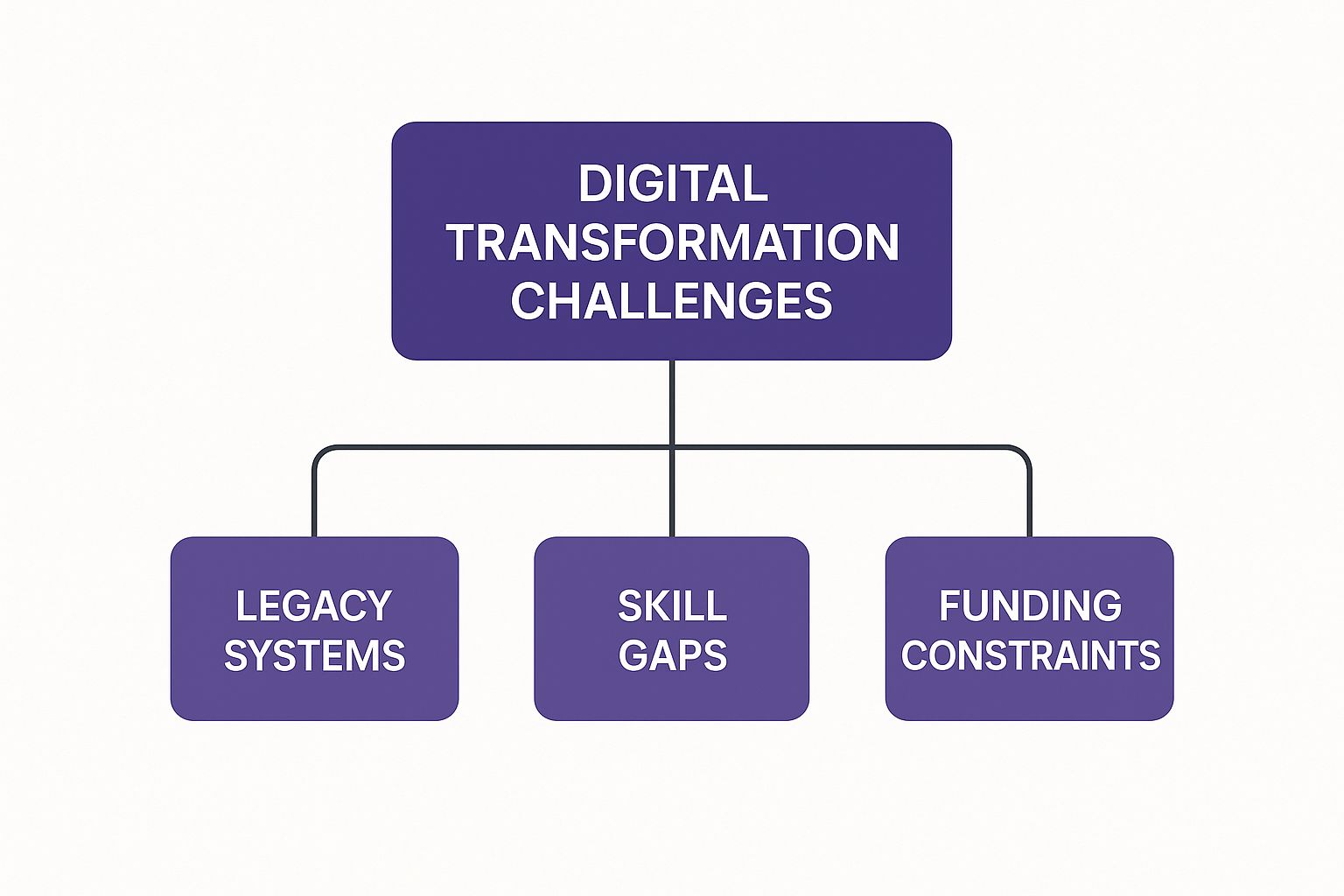
As the image highlights, interconnected challenges like outdated tech, workforce skills, and tight budgets all need to be tackled together for any transformation to stick.
Pillar 4: Innovative Learning Models
Finally, the fourth pillar gets to the heart of what a university does: teach and learn. This is about more than just putting lectures on video. It’s about using technology to craft educational experiences that are more engaging, effective, and accessible for today's students. You're essentially reimagining the classroom.
This is where you can blend proven teaching methods with powerful new tools to create something special.
Examples of these new models in action include:
- Hybrid and HyFlex Classrooms: Giving students the choice to attend in person, join live online, or watch recordings on their own time. This respects different learning styles and busy schedules.
- Immersive Learning with VR/AR: Creating virtual science labs, historical simulations, or medical training scenarios that give students hands-on experience without physical risk or limitations.
- AI-Powered Tutoring and Feedback: Using AI tutors to offer students personalized, 24/7 help and instant feedback on their work, allowing them to master subjects at their own speed.
Overcoming Common Implementation Hurdles
While the vision of a connected, student-first university is powerful, the journey there is rarely a straight line. It's littered with very real, very human obstacles. A successful higher education digital transformation isn't just about buying shiny new software; it's about navigating the messy, complex world of people and institutional habits.
Ignoring these hurdles is the fastest way to end up with stalled projects and a lot of wasted money. The smart move is to face them head-on, turning potential disasters into manageable challenges. This takes a clear strategy, but more than anything, it takes a serious commitment to communication.
Winning Over Faculty and Staff
One of the biggest roadblocks you'll hit is internal resistance. This is completely normal. Faculty and staff aren't just cogs in a machine; they're the heart of your institution. When change comes for their daily work, you have to handle it with respect.
Their resistance usually isn't about blocking progress. It’s often rooted in very real concerns: an overwhelming new workload, the steep learning curve for unfamiliar tools, or a genuine fear that technology will strip the humanity out of education.
To turn skepticism into support, you can't just send out a memo. You have to build a coalition.
Here's how you start:
- Share the Steering Wheel: Create committees with representatives from every corner of campus—faculty, IT, admissions, student services. When people feel heard during the process, they're far more likely to get behind the results.
- Make Training Matter: Ditch the generic, one-size-fits-all training sessions. Offer hands-on workshops that speak directly to a professor’s discipline or a department's specific workflow.
- Answer "What's In It for Me?": Don't just talk about institutional goals. Show them exactly how a new system will save them three hours of grading, eliminate a tedious administrative task, or help them connect with at-risk students more effectively.
Managing Costs and Securing Investment
Let's be honest: digital transformation costs money. The upfront investment in new platforms, licenses, and getting everything set up can put a serious strain on already stretched budgets. Without a rock-solid financial plan, even the most promising projects can wither away.
The biggest financial risk isn't the cost of investment—it's the cost of doing nothing. Clinging to outdated systems creates inefficiencies, hurts enrollment, and erodes your competitive edge. That's a much higher price to pay in the long run.
To get the green light, you have to connect the dots between spending and strategy. Show the board how a new CRM will directly boost application numbers or how an analytics platform will improve your retention rate. You have to frame the conversation around return on investment (ROI), not just cost.
Navigating Data Security and the Digital Divide
The more student data you collect, the bigger your responsibility is to protect it. A data breach isn't just an IT problem; it can destroy your institution's reputation and lead to devastating financial consequences. A tough cybersecurity plan has to be baked into your digital strategy from day one. It's not optional.
At the same time, you have to confront the digital divide. Not every student has a quiet place to study, a reliable internet connection, or a modern laptop. Assuming they do creates a massive equity gap.
This gets even more complicated when you realize students don't all want the same thing. Despite the rise of online learning, many still crave the on-campus experience. Your digital platforms need to offer genuine flexibility, supporting students across all these different modes and circumstances.
By anticipating these hurdles—faculty buy-in, budget battles, data security, and digital equity—and planning for them, you build the resilience you need to see your transformation through to the finish line.
Real-World Examples of Digital Transformation in Action
It’s one thing to talk about the theory behind digital transformation in higher education, but seeing it work in the real world is where the potential really clicks. The most innovative universities aren't just discussing change; they're on the ground, rolling out new initiatives, solving tough problems, and seeing real, measurable improvements. These success stories aren't just for inspiration. They serve as a practical road map, showing what’s truly possible when a clear vision is backed by the right technology. Let's look at how a few institutions have created a better experience for everyone involved—from students to faculty.
Georgia Tech’s Accessible Master’s Degree
Georgia Institute of Technology was wrestling with a huge, common problem: how do you make a world-class graduate degree more affordable and available to more people without watering down the quality? Their answer was the Online Master of Science in Computer Science (OMS CS), a program that completely shook up the world of graduate education.
By teaming up with a MOOC provider, they were able to offer the entire degree for a tiny fraction of the on-campus price—starting at under $7,000. The program runs on a smart mix of pre-recorded lectures, busy online discussion forums, and even AI-powered teaching assistants to handle a massive number of students without a hitch.
The results were incredible. The OMS CS program suddenly gave thousands of students from all over the globe a shot at a Georgia Tech education they couldn't have accessed otherwise, whether due to cost or location. It was definitive proof that you could deliver a top-tier education at an enormous scale, opening the door for a much more diverse student body.
Arizona State University and Adaptive Learning
Arizona State University (ASU) has earned its reputation as a leader in educational innovation. One of their biggest wins came from tackling a stubborn issue that plagues colleges everywhere: high failure rates in entry-level math courses, which often stop students from ever finishing their degrees. ASU’s solution was to go all-in on adaptive learning technology. They swapped the traditional one-size-fits-all math class for a platform that tailors the experience to each individual student. The software uses algorithms to figure out a student's strengths and weaknesses on the fly, feeding them the exact content, practice problems, or support they need in that moment.
You can think of it as a personal tutor for every single student. It lets them focus on the concepts they’re stuck on and breeze through the material they’ve already got down. The classroom shifts from a passive lecture hall to a dynamic, personalized learning hub.
The effect was felt almost immediately. ASU watched pass rates in its developmental math courses climb significantly, which helped thousands more students clear a major academic hurdle and stay on the path to graduation. It’s a perfect example of how technology can directly fuel student success initiatives by fixing academic roadblocks right where they start.
Purdue University’s Proactive Advising System
Purdue University wanted to get ahead of student retention issues, so they built a brilliant data-driven tool called "Signals." The whole point was to create an early-warning system that could flag students who were falling behind before it was too late. The platform works by pulling in data from all over campus—the learning management system, student records, and other engagement tools. It crunches the numbers on student behaviors like how often they log in, when they submit assignments, and their grades. Based on that analysis, it creates a risk score, which advisors and professors see as a simple traffic light icon.
- Green: The student is doing great and right on track.
- Yellow: The student is showing early warning signs and could use a little nudge.
- Red: The student is at high risk of failing and needs someone to step in right away.
This elegantly simple system allowed advisors to shift from being reactive to proactive. Instead of waiting for a student to come to them with a problem, they could reach out with targeted help, connecting students to tutors or other resources. The Signals program has been a major factor in boosting Purdue’s retention rates, showing that smart data can spark meaningful human conversations that lead to much better student outcomes.
Building Your Future-Ready Institution

Embarking on a path of higher education digital transformation isn't about tackling a project with a finish line. It’s a fundamental shift in mindset—a continuous commitment to evolving, staying agile, and keeping the student experience at the heart of every decision. To become a future-ready institution, you must weave a culture of innovation directly into your school’s DNA.
This means looking past isolated tech upgrades and adopting a much broader perspective. Every single initiative, from a small pilot program in one department to a massive campus-wide system overhaul, needs to connect back to a single, unifying purpose: creating more value for students and securing the institution's relevance for years to come.
Turning Strategy Into Reality
The road ahead requires a smart blend of people, processes, and technology. It’s about giving faculty the tools they actually want to use, smoothing out the administrative friction that slows everyone down, and designing a student journey that feels seamless and personal. As you build this future, think about incorporating modern tools like interactive video solutions for education to bring learning to life. Getting this strategic alignment right is more critical than ever. Institutions are under immense pressure to prove that their academic programs lead to real-world careers. This is why adopting career-focused curricula, offering flexible degree options, and using data to guide decisions are no longer just nice ideas—they're essential for showing prospective students a clear return on their investment. To see how data is shaping institutional strategy, explore these insights on top higher education trends.
True transformation is achieved when technology becomes an invisible, enabling force—powering better decisions, deeper engagement, and greater success for every student.
The final piece of this puzzle is connecting with students effectively. A strong communication plan is vital for engaging students at every stage, from their first inquiry to the day they graduate. You can learn more about boosting your outreach in our guide to https://motimatic.com/higher-education-digital-marketing/. By championing these changes, your institution won't just survive—it will thrive.
Frequently Asked Questions
When you start digging into a digital transformation plan for your college or university, a lot of practical questions naturally come up. Below are some straightforward answers to the questions we hear most often from higher education leaders as they map out their own journey.
What's The Best First Step For A University Starting Its Transformation?
It's tempting to jump right into shopping for new software, but that's not the place to start. Your best first step is actually a deep, honest look at where your institution stands right now. You can't draw a map to your destination if you don't know your starting point. Start by digging into the biggest frustrations your students and staff face every day. Is your admissions process a maze of confusing forms and dead ends? Are professors fighting with clunky classroom tech? Are key departments still buried under piles of paperwork?
Find one significant, visible problem and solve it first. A small, early victory is incredibly powerful. It builds momentum and proves the value of the entire initiative, which makes getting support for bigger projects much easier later on.
Pick something manageable that will deliver a clear, noticeable improvement. For example, streamlining the course registration experience or piloting a new student support chatbot are great places to begin.
How Can We Measure The ROI Of Our Digital Investments?
Measuring the return on your digital investments goes far beyond just cutting costs. While saving money on administrative tasks is great, the real value is found in metrics that align with your institution's reason for being: student success and long-term health. To get a true picture of your ROI, you'll want to track a mix of metrics.
- Enrollment and Recruitment: Look for a bump in your application-to-enrollment conversion rates. Are you attracting more of your top-choice students? Has the cost to recruit each new student gone down?
- Student Retention and Success: This is a big one. Keep an eye on first-year retention, course completion, and graduation rates. Even a 1% increase in retention can mean a massive boost in revenue.
- Operational Efficiency: Track the hours your staff gets back from no longer doing manual data entry. You can also measure fewer IT help desk tickets and faster turnaround times for administrative processes.
- Alumni and Donor Engagement: A better student experience often leads to more engaged, supportive alumni. Watch for growth in alumni event attendance and, of course, increases in annual giving.
How Does Digital Transformation Change The Role Of Faculty?
Digital transformation gives faculty the power to evolve from being presenters of information into architects of learning experiences. Think about it: when technology can handle repetitive tasks like grading multiple-choice quizzes, it frees up professors' time for what they do best—connecting with students. This shift means faculty can spend less energy on administrative burdens and more on mentoring, leading rich discussions, and offering personalized, one-on-one feedback. It also unlocks exciting new ways to teach, allowing them to bring in tools like virtual science labs or global online collaboration projects. The role becomes less about the lecture and more about guiding students toward discovery.
What Is The Biggest Mistake Institutions Make?
The single biggest mistake we see is treating higher education digital transformation as just a technology project. It’s not. It's a cultural change initiative.
Too many institutions pour all their resources into picking and launching a new platform, thinking the software itself is the magic bullet. But if you don't address the human side of the equation—getting faculty on board, providing real training, and rethinking outdated workflows—those expensive new tools will just gather digital dust.
Real change only happens when you change how people work and think. Forgetting about the cultural shift is a direct path to a very expensive failure.
Ready to guide your students from enrollment to completion with proven, science-backed engagement strategies? Motimatic delivers personalized, scalable messaging that boosts retention and improves outcomes without adding to your team's workload. Learn how our platform can help you achieve your student success goals.
See it on your own listOne list, one goal, and a randomized holdout to show the lift. Start a pilot