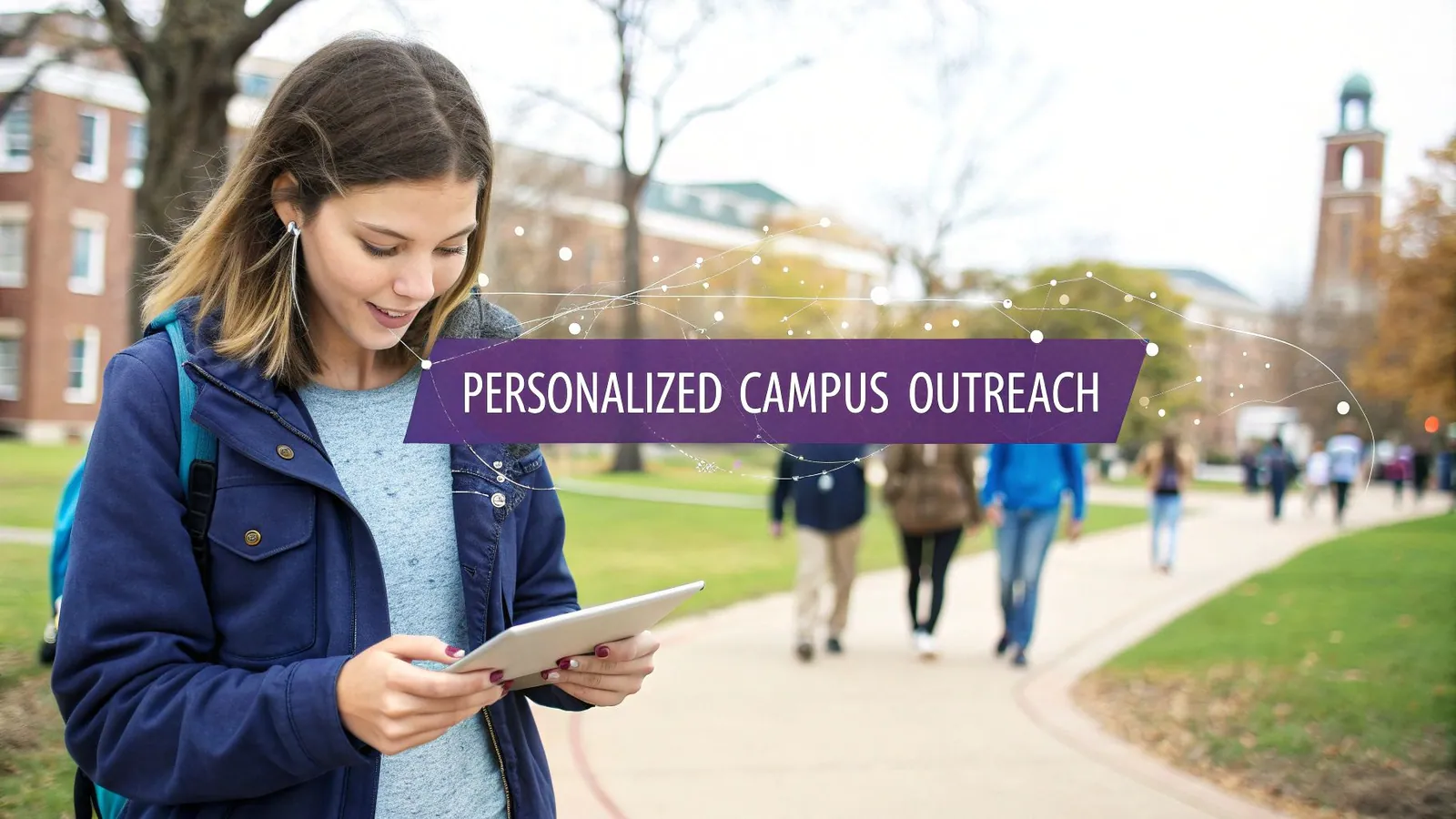
The days of one-size-fits-all college mailings are officially over. If you're still blasting out generic "Apply Now" postcards to every name on a list, you're falling behind. Today's prospective students expect you to know them, and that's where personalized marketing for colleges becomes your most powerful recruitment tool.
It’s about moving beyond mass communication to create genuine, one-to-one connections, even when you're reaching thousands.
Why Generic College Outreach No Longer Works
Think about the world your prospective students live in. They're digital natives, completely at home with the hyper-personalized experiences they get from platforms like Netflix and Amazon. They simply expect the same level of individual attention from the colleges they're considering. A generic viewbook just doesn't cut it anymore. This shift forces a new mindset. We have to stop broadcasting a single, loud message and start building real relationships. It's about showing a student you understand their specific path—whether that's a deep-seated passion for marine biology or a pressing need for information on first-generation student support.
The Impact of Individualized Attention
When you show a student you’ve been listening, they feel seen. They feel valued. And that’s the entire game.
Imagine a prospective student who has only ever clicked on your engineering program's webpage. Instead of getting the same campus-wide newsletter as everyone else, they receive a targeted email inviting them to a virtual Q&A with a current engineering major. That’s the difference.
This kind of targeted outreach hits on several key goals:
- It builds trust. You're proving you're paying attention to their individual journey.
- It’s instantly relevant. The message cuts through the digital noise because it speaks directly to their stated interest.
- It drives action. A relevant invitation is far more likely to get a click and a registration than another generic open house announcement.
The data here is pretty compelling. Research shows that 99% of marketers agree personalization strengthens customer relationships.
This new approach demands a shift from old-school tactics to a more modern, student-centric strategy. The differences are stark when you compare them side-by-side.
Traditional vs. Personalized Marketing Approaches
| Attribute | Traditional Marketing | Personalized Marketing |
|---|---|---|
| Core Strategy | Broadcast a uniform message to a wide audience. | Deliver relevant messages to specific audience segments. |
| Primary Tactic | Mass mailings, general ads, generic email blasts. | Dynamic content, behavioral triggers, targeted social ads. |
| Audience View | A large, undifferentiated group (e.g., "all high school seniors"). | Unique individuals with distinct interests, needs, and concerns. |
| Communication | One-way: The college speaks at the student. | Two-way: The interaction feels like a conversation. |
| Goal | Generate mass awareness and a high volume of leads. | Nurture qualified leads and build genuine relationships. |
| Measurement | Clicks, open rates, overall application numbers. | Engagement, conversion rates per segment, student journey progression. |
The table makes it clear: one approach is about casting the widest net possible, while the other is about using the right bait for the right fish.
From Mass Communication to Meaningful Connection
Ultimately, this is less about fancy new technology and more about a fundamental change in mindset. The goal is to make every single interaction feel like a personal conversation, even when you’re communicating with thousands of potential applicants at once. It's the difference between shouting into a crowded stadium and leaning in for a focused discussion.
This requires you to actually use your student data to shape their experience. Think dynamic website content that changes based on a visitor's location or major of interest. Or social media ads targeted specifically to students who have shown an interest in your honors college.
This is what personalized marketing for colleges is all about. It's how you prove your institution isn't just another choice—it's the right choice for them.
Building Your Foundation with Smart Data
Let's be honest: truly effective personalized marketing isn't about guesswork. It’s built on a bedrock of high-quality, ethically gathered data. This information is the fuel for every relevant email, targeted ad, and helpful message you send.
Without it, you’re just adding to the noise in a student’s already crowded inbox.
The real goal here is to move beyond the basics—a student's name and email address won't cut it anymore. To do this right, you need to understand their intent and what really matters to them. That means collecting meaningful data points that paint a much clearer picture of who they are and what they’re looking for on their path to enrollment.
Going Beyond Basic Demographics
To create outreach that genuinely helps, you have to collect information that signals a student’s specific interests and where they are in their decision-making process. This is the information they actively give you, and it’s pure gold. Think about the key data points you can gather:
- Declared Academic Interests: What programs or majors did they mention on an inquiry form? This is your first, most obvious clue.
- Website Browsing Behavior: Which pages have they visited? Did they spend ten minutes on the financial aid section or keep coming back to a specific athletics page? That behavior tells a story.
- Geographic Location: Are they in-state, out-of-state, or an international prospect? This one detail can completely change the relevance of your entire messaging strategy.
- Engagement History: Have they attended a virtual tour? Did they open every email about the arts department or download your guide for transfer students?
These aren't just details; they are direct lines into a student’s mindset. They allow you to segment your audience with real precision, ensuring a student interested in nursing gets information about your health sciences program, not a generic pitch for the liberal arts college.
The core principle is simple: use data to make the student's journey easier and more valuable. When your communications show you actually understand their needs, you build trust. That trust strengthens their connection to your institution long before they ever apply.
Essential Tools for Data Management
Okay, so gathering all this great information requires a cohesive tech stack. A disjointed system where data lives in separate, disconnected spreadsheets is the enemy of effective personalization. It just won't work. Your whole toolkit needs to be built around a central hub.
A Customer Relationship Management (CRM) platform is non-negotiable. This system is your single source of truth, housing all student data and interaction histories in one accessible place. You’ve probably heard of the big ones in higher ed, like Slate or Salesforce.
But the CRM can't work in a silo. It needs to integrate seamlessly with your other key tools:
- Website Analytics: To track on-site behavior and pinpoint those high-intent pages.
- Dynamic Web Forms: To capture specific interests directly from students when they request information.
- Email Marketing Platforms: To log engagement data like opens and clicks, feeding it right back into the student's profile in the CRM.
When these systems are connected, you create a powerful, reliable data ecosystem. This allows your team to stop chasing down scattered information and start crafting authentic, one-to-one engagement that actually drives results. It’s the essential first step in building a successful personalized marketing strategy.
Mapping the Modern Student Journey
To send the right message at the right time, you have to get inside a student’s head and walk their path. Real, effective personalized marketing for colleges isn't about broad assumptions; it’s about creating a detailed, almost cinematic visualization of that journey. You just can’t talk to a high-achieving local applicant the same way you would an international transfer student.
While every student carves a unique path, they all move through similar phases. The real work is in identifying the critical moments—the touchpoints—where a perfectly timed, personalized message can make all the difference. This hands-on mapping process helps your team get ahead of student needs and deliver real value when it counts.
This visual gives you a sense of how a team might plot out these strategies.
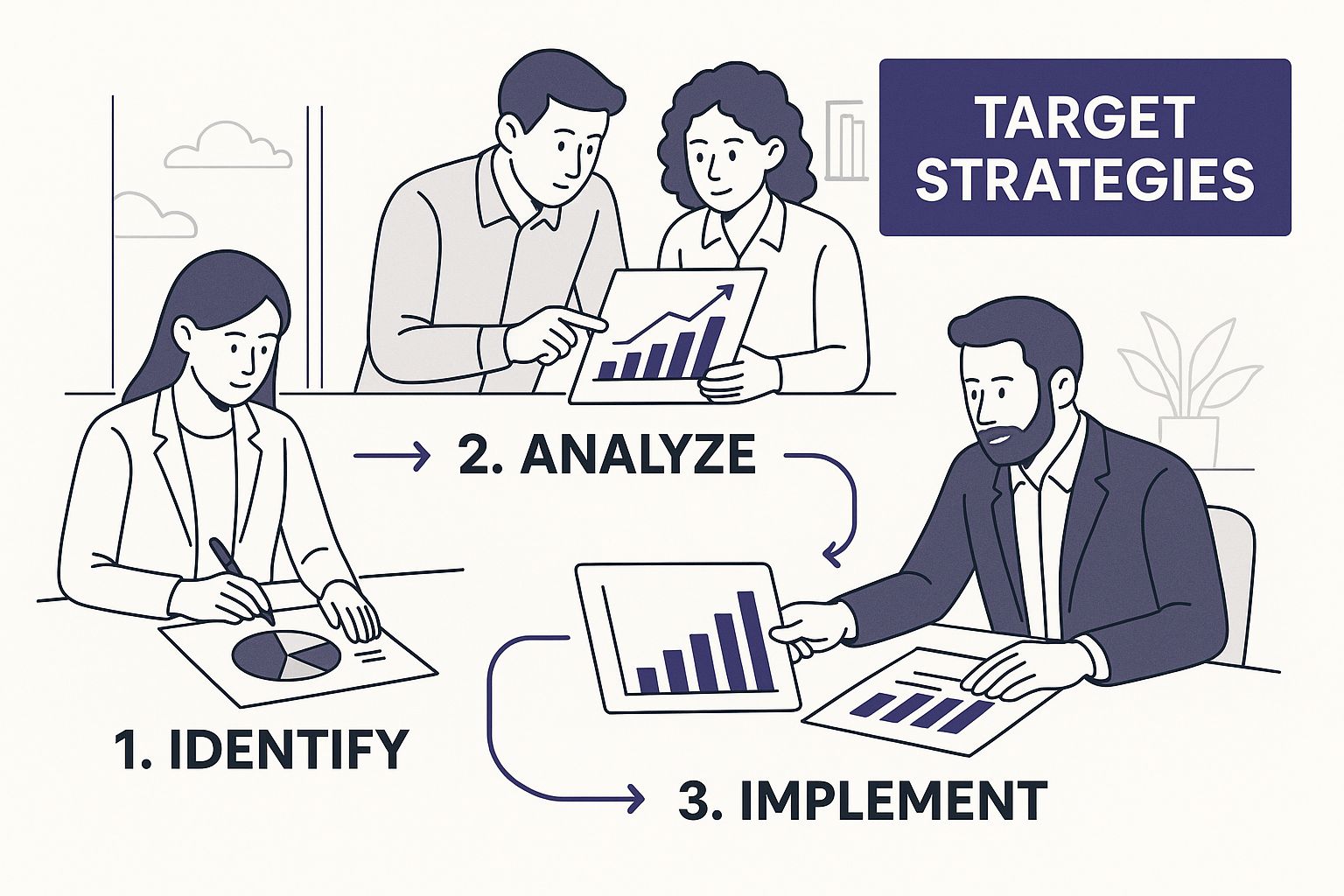
By laying out the entire journey, you immediately see where the communication gaps are and, more importantly, where your personalized content can bridge them.
Pinpointing Critical Touchpoints
Think about the pivotal moments in a prospective student's decision-making process. These are the touchpoints where you either forge a stronger bond or risk losing them to the noise entirely. Your journey map should trace interactions across every channel you own:
- Initial Discovery: That first Google search for "best business schools" or an encounter with one of your ads on TikTok.
- Early Engagement: When they take a small step, like signing up for your mailing list, downloading a viewbook, or following your college's Instagram.
- Deeper Consideration: This is when they're invested. They're attending a virtual tour, clicking through specific program pages, or digging into your scholarship database.
- Final Decision: The home stretch. They’re interacting with financial aid calculators, starting an application, and, ultimately, deciding whether to submit a deposit.
A great example: let's say a prospect spends a lot of time on your financial aid page. That’s a huge signal. This is the perfect trigger to send an automated, personalized follow-up about specific scholarship deadlines or an invite to a webinar on affording college. It shows you're paying attention and offering help, not just another sales pitch.
Creating Actionable Student Personas
Here's the thing: a journey map is only as good as the student persona it’s built for. A generic map is too fuzzy to be useful. Your first move should be developing a few distinct profiles representing the key segments of your applicant pool. Let's imagine three common personas:
- The Out-of-State Arts Major: Their journey is all about the creative details. They're likely digging into faculty bios, taking virtual tours of your studio spaces, and looking for alumni success stories in their field.
- The First-Generation STEM Prospect: This student is probably focused on what kind of support they'll get. They're looking for information on first-gen scholarships, mentorship programs, and testimonials from students who share their background.
- The Local Transfer Student: Their path is completely different. They need clear, no-nonsense information on credit transfers, articulation agreements with their community college, and flexible class schedules that fit their life.
By building out these detailed personas and their unique journeys, your team can finally stop guessing what students want. You’ll have a clear, data-informed playbook for all your higher education digital marketing efforts. You'll know exactly what to say, when to say it, and why it will resonate with that specific student at that specific moment.
Crafting and Automating Personalized Messages
Okay, your data is organized and you’ve mapped out your student journeys. Now for the fun part: turning all that hard work into compelling, automated messages that actually connect with prospective students.
This is the moment where your personalization strategy stops being a spreadsheet and starts feeling like a real conversation. The goal here is to be genuinely helpful and personal—not creepy or invasive.
It all begins with dynamic content. Instead of blasting the same generic email to your entire list, you can build a single, smarter template. This template automatically pulls in specific details based on who's opening it. For example, a prospect who flagged an interest in biology gets an email featuring a "Biology Program Spotlight." At the same time, another student who's into business sees a "Meet Our Business Faculty" section instead. Same email, totally different experience.
From Static Content to Adaptive Experiences
This idea extends far beyond email. Think about your most valuable digital real estate: your website.
Imagine a prospective student from California lands on your homepage. Instead of the standard campus beauty shots, what if they were greeted with a banner highlighting your strong alumni network in their state? Or maybe a video testimonial from a current student from the West Coast.
That small tweak makes a huge difference. It instantly builds a connection and shows the student you're paying attention to their context. It’s how you go from being just another faceless institution to a place they could actually see themselves.
This screenshot shows just how powerful this can be when fueled by the right tools. It’s not just about segmentation anymore; it's about making hyper-personalization a scalable reality for your team.
By using rich data, you can deliver content that feels uniquely relevant to each individual, a massive leap from old-school marketing tactics.
Automation That Triggers Real Connections
The real magic happens when you layer in marketing automation. Automation is what lets you deliver these perfectly timed, personalized messages at scale—without burning out your team. The whole system runs on triggers based on student actions (or inaction). Here are a few real-world examples of how this works:
- Behavioral Trigger: A student visits the financial aid page three times in one week. That action can automatically trigger a friendly email with a link to your scholarship database and an invite to a financial aid webinar. No manual work required.
- Interest Trigger: A prospect downloads the viewbook for the College of Engineering. Boom. They’re now in a specialized email nurture sequence built just for future engineering students, full of relevant deadlines, faculty stories, and lab features.
- Inactivity Trigger: Someone started an application but hasn't touched it in two weeks. A gentle, automated reminder email can be the perfect nudge to get them back on track and across the finish line.
Of course, to make this all happen, you need the right engine. It’s worth exploring the best email marketing services and platforms to find a tool that can handle this kind of sophisticated automation and reporting.
Hyper-personalized marketing in higher education has drastically transformed how colleges engage prospective students, especially by leveraging data analytics and AI-driven tools. This strategy uses data like browsing behavior and academic interests to guide prospective students through personalized curriculum pathways, increasing their likelihood of enrollment. You can discover more insights about these marketing trends on higher-education-marketing.com.
At the end of the day, the goal is to make your communications feel like they're coming from a helpful guide, not a pushy salesperson. When you combine smart data with thoughtful automation, you build trust and give students the confidence they need to take the next step. For more ideas on engaging prospects, check out our guide on powerful student recruitment strategies.
Measuring Success and Optimizing for Enrollment
You’ve launched your personalized marketing campaign. That's a huge step. But the real work is just beginning. How do you actually know if it’s working?
Simply tracking email opens or website clicks just won't give you the full picture. To really understand the impact, you have to get laser-focused on the key performance indicators (KPIs) that map directly to your enrollment goals.
The question isn't, "Did they open the email?" It should be, "Did that personalized email convince them to sign up for a campus tour?" or "Did our targeted ad campaign bring in more applications from that key out-of-state region?" It’s about connecting every action to a meaningful outcome.
Defining Your Most Important KPIs
To measure what matters, you need to define what success looks like at each stage of your funnel. This is how you build a clear, data-driven picture of what’s clicking with students and what needs a rethink.
Your most critical metrics should follow a prospective student from their very first inquiry all the way to their first day of class.
Here are the KPIs I’ve seen make the biggest difference:
- Inquiry-to-Application Rate: What percentage of students who ask for information actually go on to apply? This is your first real test of how well your early-stage nurturing is working.
- Application Completion Rate: Of those who start an application, how many see it through to the end? A low number here is a major red flag, often pointing to friction in the application itself or a gap in your supportive messaging.
- Applicant-to-Admit Rate: This helps you evaluate the quality of the applicants your personalized campaigns are attracting. Are you bringing in mission-fit students?
- Admit-to-Deposit Rate (Yield): This is the ultimate bottom-line metric. What percentage of admitted students actually pay their deposit and commit? A strong yield rate is the best signal that your personalized approach has built a genuine connection.
Focusing on quality leads is a non-negotiable. As you dig into these numbers, you might find some valuable context in our article on why student quality is the new KPI in the face of the enrollment cliff.
Using Data to Continuously Improve
The data you collect shouldn't just sit in a final report. It’s the fuel for a continuous improvement loop, and this is where A/B testing becomes your best friend. A/B testing lets you test one variable at a time to see what truly resonates with different student segments. For example, you could test two distinct email subject lines for your out-of-state prospects. Or you might compare two different landing page layouts for your main ad campaign. Does a message emphasizing "career outcomes" outperform one focused on "campus life" for your business school prospects? You’ll never know for sure without testing it.
The most effective personalization strategies in college marketing directly improve engagement and conversion rates. Tracking conversions through critical funnel stages—like inquiry form submissions, event attendance, and completed applications—is essential. By examining these rates, colleges can quantify how personalized messages drive student action. Institutions that adopt this approach report significant, measurable improvements. You can learn more about how personalization impacts higher ed marketing on foleon.com.
This data-driven feedback cycle is what gives personalized marketing for colleges its power. It shifts your strategy from guesswork to a predictable, optimizable system, ensuring every dollar of your budget is spent on what actually drives enrollment.
Common Questions About College Personalization
Even with a solid game plan, I know that kicking off a personalized marketing effort can feel a little daunting. A lot of questions tend to bubble up right as teams are ready to get started.
Let's tackle those questions head-on. Answering these common concerns usually gives teams the confidence they need to move forward, turning those "what ifs" into real momentum.
Here are the straightforward answers to the questions we hear most often from our partners in higher ed.
What Is the First Step Our College Should Take?
Before you can personalize a single email, you need to get your data house in order. Seriously, this is the one step you can't skip. You need a single, unified view of each prospective student, or you'll be flying blind. For most schools, this means choosing and truly committing to a Customer Relationship Management (CRM) system.
Start by pulling data from all your different sources—website forms, event sign-ups, third-party lead lists, you name it. Once it's all flowing into one place, you can start simple. Segment your audience by something clear and actionable, like their home state or their declared major.
Don't try to do everything at once. Pick one or two high-impact segments, build a small, focused campaign, and see what you learn. This approach builds momentum without burning out your team.
How Much Data Is Enough Without Being Intrusive?
This is a great question. The line between helpful and creepy is all about value. You should only collect data that directly helps you create a more relevant and useful experience for the student. It really boils down to two types:
- Explicit Data: This is the information students give you directly, like their intended program or high school graduation year.
- Behavioral Data: These are the digital breadcrumbs they leave behind, like visiting the financial aid page three times or downloading the viewbook for the College of Arts & Sciences.
Steer clear of gathering sensitive personal info that has nothing to do with their college search. A good rule of thumb is to ask, "Will this piece of data let me send a more helpful message?" If the answer is a clear "yes," you're on solid ground. And, of course, always be transparent in your privacy policy about what you collect and why.
The biggest mistake I see is teams using data just because they have it. This almost always leads to marketing that feels invasive. Referencing every single page a student clicked on their last visit feels less like you're helping them and more like you're watching them. The goal is to be relevant, not omniscient.
Can a Small College with a Limited Budget Do This?
Absolutely. Personalization is a strategy, not just a suite of expensive tools. Smaller schools can get huge wins by focusing on high-impact, low-cost tactics.
For instance, most modern email platforms let you do the basics, like using a student’s first name and mentioning their city. That’s a start. The next step could be building a few different email nurture streams for your top three or four academic programs.
Another budget-friendly move is creating targeted landing pages for your digital ad campaigns. Instead of dumping all your ad traffic onto the main homepage, send prospects who clicked an ad for your nursing program to a page that’s all about nursing. The core idea is simply to be more relevant, and you don’t need a massive AI platform to start making those kinds of connections.
Ready to guide every student from their first click to graduation day? Motimatic uses behavioral science and intelligent automation to deliver personalized messaging that drives enrollment and improves student success.
Discover how Motimatic can help you reach your goals.
See it on your own listOne list, one goal, and a randomized holdout to show the lift. Start a pilot