
Why College Enrollment Marketing is Critical for Your Institution's Survival
College enrollment marketing is the strategic use of data-driven outreach, personalized messaging, and multi-channel campaigns to attract, engage, and convert prospective students into enrolled students. Here's what you need to know: Core Components of College Enrollment Marketing:
- Lead Generation: Paid ads, SEO, content marketing, and name buys to attract prospects
- Nurture Campaigns: Email sequences, SMS, and retargeting to maintain engagement
- Yield Tactics: Virtual tours, parent outreach, and personalized follow-up to convert admits
- Technology Stack: CRM, marketing automation, chatbots, and analytics tools
- Personalization: Behavioral triggers, major-specific messaging, and demographic targeting
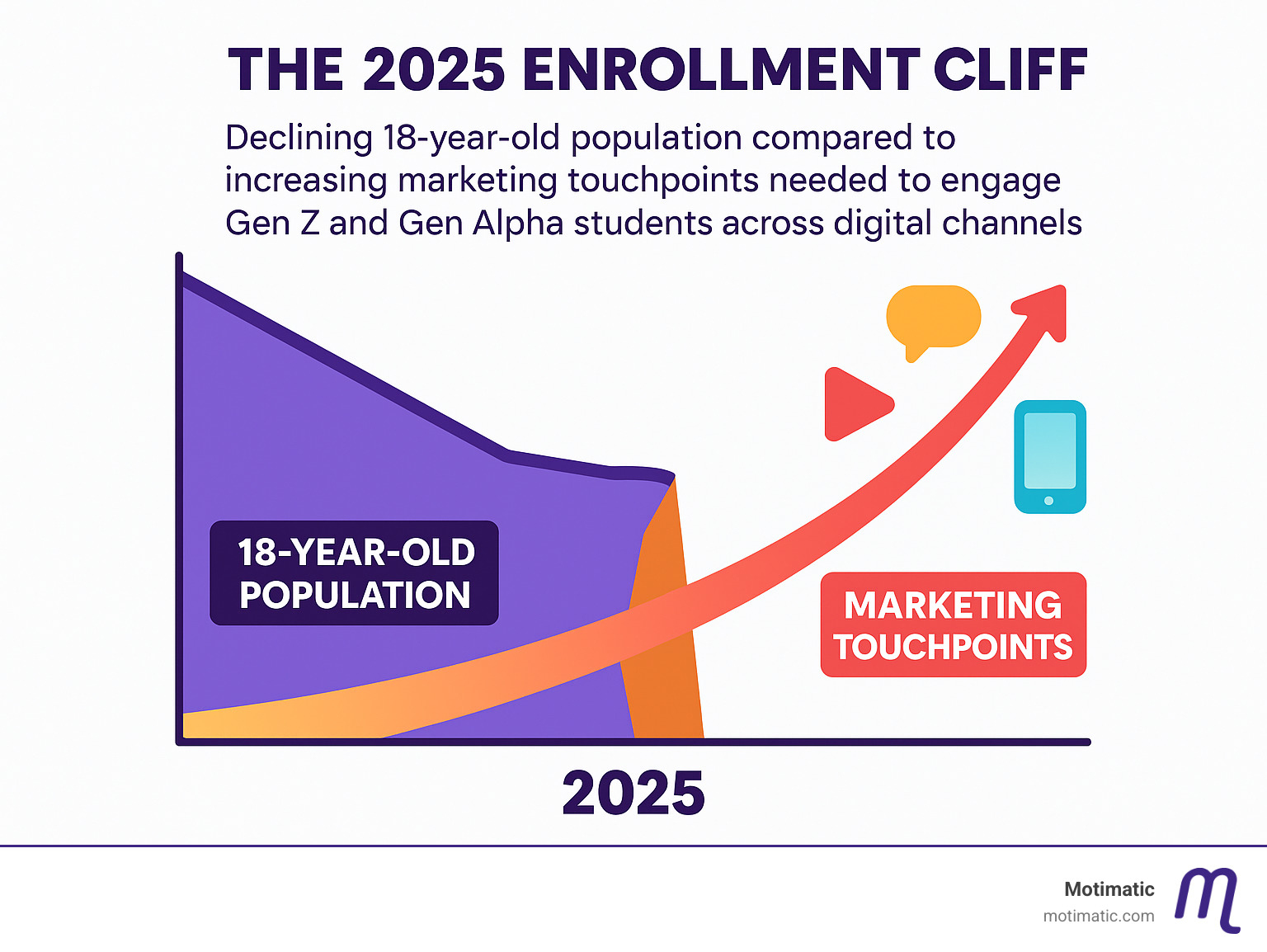
The urgency is real. College enrollment has declined for eight consecutive years, with community colleges particularly affected. The demographic "enrollment cliff" hits in 2025 when there will be fewer 18-year-olds due to declining birth rates after the 2009 recession. Yet despite these challenges, institutions using strategic enrollment marketing are seeing results - retargeting campaigns perform up to 10 times better than standard display ads, and personalized communication can boost ROI by as much as 200%.
Modern students expect fast, digital-first experiences across mobile devices. They want personalized content that speaks to their goals, not generic institutional messaging. Meanwhile, 91% of individuals are more likely to engage with organizations that provide relevant, personalized communications. This isn't just about marketing tactics - it's about institutional survival.
College Enrollment Marketing 2025: Core Principles
The landscape of higher education marketing has fundamentally shifted. We're no longer dealing with predictable enrollment patterns or one-size-fits-all approaches. According to Forbes research on declining enrollment rates, institutions face unprecedented challenges that require sophisticated, data-driven responses. The traditional wide-net approach is dead. Today's successful institutions accept a "flipped funnel" strategy that prioritizes quality over quantity, focusing on highly engaged prospects rather than casting the widest possible net. This shift toward student-centricity and omnichannel engagement isn't just trendy - it's essential for survival in 2025's competitive landscape.
Defining College Enrollment Marketing
College enrollment marketing goes far beyond traditional university marketing. While university marketing builds long-term brand equity among alumni, donors, and the general public, enrollment marketing zeroes in on one critical goal: converting prospective students into applicants and enrolled students.
This precision outreach targets specific audiences with custom messaging designed to move prospects through the inquiry-to-yield funnel. It's not about broadcasting your institution's achievements - it's about answering the specific questions prospective students and their families have at each stage of their decision-making process.
The most effective enrollment marketing strategies include parent inclusion from the start. Research shows that two-thirds of students involve parents in their college search, making family engagement a crucial component of any successful campaign. This means creating dual-track messaging that speaks to both student aspirations and parent concerns about ROI, safety, and career outcomes.
Why College Enrollment Marketing Matters in 2025
The enrollment cliff isn't just coming - it's here. The national birth rate fell by nearly 23% between 2007 and 2022, according to CDC data. This demographic reality means fewer traditional college-age students competing for the same number of seats across thousands of institutions.
Simultaneously, Gen Alpha students (born after 2010) are entering the college consideration phase with expectations shaped by AI-powered personalization, instant gratification, and seamless digital experiences. They've grown up with Netflix recommendations, Amazon's predictive shopping, and TikTok's algorithm-driven content feeds. Generic college brochures and mass email campaigns simply won't cut it.
There's also a growing trust gap to address. Public confidence in higher education has dropped to just 36%, according to Gallup research. This means institutions must work harder to demonstrate value, build credibility, and overcome negative brand perceptions that can cause up to 30% fewer prospective student inquiries.
The good news? Institutions that accept strategic college enrollment marketing are seeing remarkable results. In fall 2024, there was a 5.5% rise in freshman enrollment from the previous year, proving that the right strategies can overcome demographic headwinds.
Data-Driven Funnel Tactics That Actually Enroll Students

The most successful enrollment marketing campaigns combine multiple digital channels with behavioral science principles to create seamless prospect journeys. Our Higher Education Digital Marketing approach focuses on tactics that deliver measurable enrollment lift, not just vanity metrics.
Retargeting campaigns are the secret weapon most institutions underuse. These campaigns perform up to 10 times better than standard display ads because they target prospects who have already shown interest by visiting your website or engaging with your content. Combined with strategic SEM/PPC campaigns, display advertising, SEO optimization, and content hubs, retargeting creates a comprehensive digital ecosystem that keeps your institution top-of-mind throughout the lengthy college selection process.
Top-of-Funnel Lead Generation
Effective lead generation starts with understanding that not all prospects are created equal. Quality trumps quantity every time. The most successful institutions use a combination of name buys, look-alike modeling, microSEARCH campaigns, and social storytelling to attract high-intent prospects.
Name buying has evolved beyond simple demographic targeting. Today's sophisticated approaches focus on behavioral indicators and academic interests rather than just geography and test scores. Look-alike modeling uses machine learning to identify prospects who share characteristics with your current successful students, dramatically improving conversion rates.
MicroSEARCH campaigns allow institutions to test new markets for under $50,000, providing valuable data about geographic expansion opportunities without major budget commitments. Meanwhile, social storytelling leverages authentic student voices and behind-the-scenes content to build emotional connections with prospects.
The key is creating content that positions the student as the hero of their own story, not your institution as the star. This subtle shift in messaging approach can significantly improve engagement rates and conversion metrics.
Mid-Funnel Engagement & Nurture
Once prospects enter your funnel, the real work begins. Email workflows remain the backbone of nurture campaigns, but they must be supplemented with SMS messaging, webinars, and other touchpoints to maintain engagement in today's crowded digital landscape.
Email campaigns should deliver value at every touchpoint, answering common questions about programs, campus life, financial aid, and career outcomes. The most effective sequences are triggered by specific behaviors - visiting certain web pages, downloading resources, or attending virtual events.
SMS messaging is particularly powerful for time-sensitive communications. Research shows that 9 out of 10 prospective students are open to enrollment-related text messages, and SMS typically delivers higher open rates than email.
| Communication Method | Average Open Rate | Best Use Cases |
|---|---|---|
| 15-25% | Detailed information, nurture sequences | |
| SMS | 90-95% | Time-sensitive updates, event reminders |
| Phone calls | 5-10% answer rate | High-touch personal outreach |
Webinars and virtual events provide opportunities for real-time interaction and relationship building. The most successful institutions host regular sessions featuring faculty, current students, and alumni to address specific topics like program details, campus life, and career outcomes.
Bottom-Funnel Yield & Melt Mitigation
Converting admitted students into enrolled students requires a different approach than attracting initial interest. Virtual tours, campus visits, parent campaigns, yield texting, and geofencing all play crucial roles in the final decision-making process.
Virtual tours have become essential infrastructure, not optional add-ons. Research shows that 81% of students who visit a campus report that it significantly influences their enrollment decisions. For students who cannot visit in person, high-quality virtual experiences can provide similar emotional connection and decision-making support.
Parent campaigns are particularly important during the yield phase. Parents often have the final say on college choices, especially when financial considerations are involved. Dedicated parent communication tracks should address concerns about cost, safety, career outcomes, and support services.
Geofencing technology allows institutions to deliver targeted messages to prospects and families when they visit competitor campuses or attend college fairs. This location-based marketing can be particularly effective for capturing prospects who are actively comparing options.
Personalization & Technology: Winning Gen Z and Gen Alpha Hearts
Today's college prospects expect personalization that goes far beyond inserting their name into email subject lines. They want experiences custom to their academic interests, career goals, geographic preferences, and communication styles. This level of personalization requires sophisticated technology and strategic implementation.
AI chatbots have evolved from simple FAQ responders to sophisticated conversation partners that can speak with an actual person to solve detailed inquiries. The most effective chatbots integrate with your CRM system to provide personalized responses based on a prospect's previous interactions and stated interests.
Dynamic content systems allow websites to display different messaging, images, and calls-to-action based on visitor behavior and demographics. Interactive maps and predictive analytics help prospects visualize their potential campus experience while providing valuable data about their interests and preferences.
Our Enrollment Marketing Strategies emphasize the importance of behavioral triggers that respond to specific actions prospects take. This approach ensures that every interaction feels relevant and timely, rather than generic and promotional.
Hyper-Personalized Journeys
True personalization requires understanding that different prospects need different information at different times. A prospective engineering student has different questions than someone considering liberal arts. A first-generation college student needs different support than someone from a college-educated family.
Behavioral triggers should initiate specific communication sequences based on actions like visiting program pages, downloading resources, or attending events. Major-specific messaging ensures that prospects receive relevant information about their areas of interest, while parent segments address family concerns and decision-making processes.
The most sophisticated institutions create dynamic personas that evolve based on prospect behavior. If someone initially shows interest in business programs but later explores education courses, their messaging should adapt accordingly. This level of responsiveness requires robust technology infrastructure and careful planning.
Tech Stack Essentials for College Enrollment Marketing
Your technology stack should support seamless data flow between systems while providing actionable insights for optimization. Essential components include:
CRM Systems: The foundation of all enrollment marketing efforts, storing prospect data and interaction history
Marketing Automation: Email sequences, SMS campaigns, and behavioral triggers
Stealth Visitor Tracking: Identifying website visitors who haven't provided contact information
Chatbot Technology: 24/7 engagement and lead qualification
Virtual Tour Software: Immersive campus experiences with mobile optimization
The key is integration. Disconnected systems create data silos that prevent effective personalization and make it difficult to measure ROI across channels.
Inclusive & Diverse Outreach at Scale
Effective enrollment marketing must reach diverse audiences without creating separate, unequal experiences. This means designing campaigns that are inclusive from the ground up, not added as an afterthought.
DEI scholarships should be prominently featured in all marketing materials, not hidden in separate sections. Multilingual advertising campaigns should maintain consistent messaging while adapting to cultural preferences and communication styles. Accessible design ensures that all prospects can engage with your content regardless of ability.
The most successful institutions create marketing materials that reflect the diversity they want to see in their student body. This visual representation helps prospects see themselves as part of your campus community.
Building & Measuring a Strategic Enrollment Marketing Plan
A strategic enrollment marketing plan is more than a collection of tactics - it's a comprehensive framework that aligns resources, timelines, and goals to deliver measurable results. The most successful institutions follow a structured approach that balances short-term enrollment needs with long-term brand building.
SMART goals provide the foundation for all strategic planning. Specific, Measurable, Achievable, Relevant, and Time-bound objectives ensure that everyone understands what success looks like and how progress will be measured. OKRs (Objectives and Key Results) help translate high-level goals into actionable steps that individual team members can execute.
Baseline metrics are essential for measuring improvement. You need to understand your current performance across all channels before implementing new strategies. This includes conversion rates at each funnel stage, cost per lead by channel, and lifetime value of enrolled students by source.
The balance between long-term and short-term tactics is crucial. Short-term tactics like paid social ads and email blasts can drive immediate results, while long-term strategies like SEO and content marketing build sustainable competitive advantages. Our Strategic Enrollment Management approach helps institutions find the right balance for their specific situation.
Budget alignment ensures that resources are allocated based on expected returns, not just historical spending patterns. The Enrollment Marketing Diagnostics Checklist provides a framework for evaluating current performance and identifying optimization opportunities.
Seven Components of a Winning Plan
Every successful enrollment marketing plan includes these essential elements:
- Clear Goals: Specific enrollment targets by program, demographic, and timeline
- Defined Audiences: Detailed personas for students, parents, and influencers
- Selected Tactics: Channel mix based on audience preferences and budget constraints
- Organized Campaigns: Time-bound initiatives with clear objectives and success metrics
- Allocated Budget: Resource distribution based on expected ROI by channel
- Realistic Timeline: Implementation schedule that accounts for seasonal enrollment patterns
- Measurable KPIs: Metrics that directly connect to enrollment outcomes
The most effective plans are living documents that evolve based on performance data and market conditions. Regular review cycles ensure that strategies remain relevant and effective as conditions change.
KPIs & Dashboards That Prove ROI
Leadership needs to see clear connections between marketing investments and enrollment outcomes. The most important metrics focus on conversion rates and cost efficiency rather than vanity metrics like social media followers or website traffic.
Inquiry-to-Application Rate: The percentage of prospects who submit applications after initial contact
Cost Per Enrolled Student: Total marketing spend divided by number of enrolled students by channel
Melt Rate: The percentage of admitted students who don't enroll, measured by program and demographic
Net Tuition Lift: The increase in tuition revenue attributed to marketing efforts
Dashboards should provide real-time visibility into funnel performance while allowing drill-down analysis by program, channel, and time period. The most successful institutions review these metrics weekly during peak enrollment periods and monthly during slower periods.
Avoiding Pitfalls & Future-Proofing Your Strategy
Even well-intentioned enrollment marketing efforts can fail if they fall into common traps. The most frequent mistakes include treating tactics as strategy, planning without baseline data, creating strategies that don't align with available budgets, and failing to secure buy-in from key stakeholders.
Siloed teams create disconnected prospect experiences that confuse rather than convert. When admissions and marketing teams work in isolation, prospects receive conflicting messages and inconsistent follow-up. Mobile neglect is another critical error - with mobile devices generating nearly 59% of global website traffic, any strategy that doesn't prioritize mobile optimization is doomed to fail.
Vanity metrics can be particularly dangerous because they create the illusion of success without delivering enrollment results. Social media followers, website traffic, and email open rates are interesting data points, but they don't pay tuition bills. Focus on metrics that directly connect to enrollment outcomes.
External factors like economic downturns, pandemics, and demographic shifts require adaptive strategies. Our research on The Enrollment Cliff: Why Quality is the New KPI explores how institutions can maintain enrollment stability despite external pressures.
Advanced targeting for display ads and other sophisticated digital tactics require ongoing optimization and testing. What works today may not work tomorrow, so continuous improvement is essential.
Admissions-Marketing Collaboration Hacks
Breaking down silos between admissions and marketing teams is essential for enrollment success. The most effective institutions create shared dashboards that give both teams visibility into prospect behavior and conversion metrics. This transparency enables better coordination and faster response to changing conditions.
Joint sprint planning sessions help align priorities and ensure that marketing campaigns support admissions goals. Regular feedback loops allow admissions counselors to share insights about prospect questions and concerns, which can inform marketing messaging and content creation.
Cross-training initiatives help team members understand each other's roles and challenges. When marketers understand the admissions process and admissions counselors understand marketing metrics, collaboration becomes much more effective.
Scenario Planning for External Shocks
The COVID-19 pandemic demonstrated the importance of adaptive planning. Institutions that had already invested in virtual engagement tools and digital marketing capabilities were better positioned to maintain enrollment during lockdowns.
Economic downturns typically increase demand for education as people seek career advancement, but they also create affordability concerns that require adjusted messaging and financial aid strategies. Demographic swings require geographic expansion or program diversification to maintain enrollment levels.
Hybrid learning models have become permanent fixtures in higher education, creating new opportunities for institutions to serve students who might not have considered traditional on-campus programs. This shift requires updated marketing strategies that highlight flexibility and convenience without sacrificing quality perceptions.
Frequently Asked Questions about College Enrollment Marketing
What metrics matter most to leadership?
Leadership typically focuses on metrics that directly impact institutional sustainability: total enrollment, net tuition revenue, cost per enrolled student, and retention rates. However, leading indicators like inquiry volume, application rates, and yield rates provide early warning signs about enrollment trends. The most persuasive presentations connect marketing metrics to financial outcomes. Instead of reporting email open rates, show how email campaigns contribute to application volume. Instead of social media engagement, demonstrate how social campaigns influence campus visit attendance.
How do we personalize at scale without extra staff?
Marketing automation and behavioral triggers enable personalization without proportional increases in staff time. Once systems are properly configured, they can deliver customized experiences based on prospect behavior, academic interests, and demographic characteristics.
The key is starting with high-impact, low-effort personalization opportunities. Dynamic website content, automated email sequences, and targeted social media campaigns can deliver significant improvements without requiring additional staff.
AI-powered chatbots can handle routine inquiries and qualification questions, freeing staff to focus on high-value interactions with qualified prospects. The most effective implementations combine automation with human touchpoints at critical decision moments.
Which tools give the fastest enrollment lift?
Retargeting campaigns typically deliver the fastest results because they target prospects who have already shown interest. These campaigns can be launched within days and often show improved performance within weeks.
Email automation sequences provide sustained engagement with minimal ongoing effort. Once developed, these sequences can nurture prospects over months while requiring minimal staff time for maintenance.
Virtual tour software can quickly improve bottom-funnel conversion rates, especially for prospects who cannot visit campus in person. The most effective implementations include interactive elements and clear calls-to-action that guide prospects toward application completion.
Conclusion
The future of college enrollment depends on institutions that accept data-driven, personalized marketing strategies while maintaining authentic connections with prospective students and their families. The demographic challenges are real, but so are the opportunities for institutions willing to evolve their approach.
College enrollment marketing isn't just about filling seats - it's about building sustainable competitive advantages that ensure long-term institutional success. The most successful institutions combine behavioral science insights with sophisticated technology to deliver personalized experiences that convert prospects into enrolled students without overwhelming staff resources.
At Motimatic, we've helped hundreds of institutions steer these challenges through our programmatic advertising and behavioral science-driven messaging approach. Our strategies deliver timely, personalized outreach that reduces student disengagement while improving enrollment outcomes.
The enrollment cliff is here, but it doesn't have to define your institution's future. With the right strategies, technology, and commitment to student-centered marketing, you can build a full campus that thrives in any demographic environment.
Ready to transform your enrollment marketing approach? Learn more about our Strategic Enrollment Management solutions and find how we can help you achieve sustainable enrollment growth.
See it on your own listOne list, one goal, and a randomized holdout to show the lift. Start a pilot