In the competitive landscape of higher education, attracting the right students requires more than just a great curriculum. It demands a sophisticated approach to higher education lead generation, a multi-faceted strategy that connects with prospective students on their terms, answers their deepest questions, and guides them seamlessly from initial interest to enrollment. Generic outreach is no longer effective; today's prospective students are savvy researchers and discerning consumers who expect personalized, valuable interactions.
This guide cuts through the noise to deliver eight proven, actionable strategies that top institutions are using to fill their pipelines with qualified, engaged, and motivated learners. A foundational element for attracting tomorrow's students across all these strategies involves utilizing compelling top lead magnet ideas to capture initial interest. From leveraging advanced content marketing to deploying precision-targeted digital campaigns, we'll explore the methods that not only generate leads but also build the foundational relationships that lead to long-term student success. Get ready to transform your recruitment efforts and meet your enrollment goals for 2025 and beyond.
1. Master Content Marketing with Educational Resources
In today's competitive landscape, a powerful strategy for higher education lead generation involves shifting from promotional advertising to providing genuine value through content. This means creating and distributing resources that solve problems, answer questions, and guide prospective students through their complex decision-making journey. By positioning your institution as a trusted authority, you attract organic interest and build a relationship founded on credibility, not just brand awareness.

This approach moves beyond simple program descriptions. Instead, it focuses on developing high-value assets like in-depth blog posts, career-focused webinars, downloadable ebooks, and research-backed whitepapers. When a prospective student finds your guide on "Navigating Financial Aid for First-Generation Students," you've provided a tangible solution and simultaneously captured a highly qualified lead.
Why It Works for Higher Ed
Prospective students are researchers. They actively seek information about career paths, industry trends, and student life long before they are ready to apply. By offering this content, you meet them where they are in their journey. For example, Southern New Hampshire University (SNHU) maintains an extensive blog offering practical advice on topics from career advancement to online learning tips, directly addressing the pain points of its target adult learner demographic. This builds trust and keeps SNHU top-of-mind when those readers decide to enroll.
How to Implement This Strategy
- Identify Audience Pain Points: Survey current students and admissions staff to pinpoint the biggest questions and anxieties prospects face. Are they worried about work-life balance, career outcomes, or affordability?
- Map Content to the Funnel: Create broad, top-of-funnel content (e.g., "5 In-Demand Tech Careers") to attract new visitors. Develop more specific, middle-of-funnel gated content (e.g., a downloadable guide to your Computer Science program) to capture leads.
- Optimize for Search: Use program-specific and location-based keywords to ensure your resources appear in relevant search results. Think "best nursing programs in Texas" or "MBA for marketing professionals."
- Use Gated Content Strategically: Offer your most valuable resources, like detailed program guides or webinar recordings, in exchange for contact information. This is a core tactic for effective lead capture.
2. Social Media Advertising and Organic Engagement
A dual-pronged social media strategy is essential for modern higher education lead generation, combining the reach of paid advertising with the authenticity of organic community building. Prospective students, from Gen Z high schoolers to working professionals, live on platforms like Instagram, TikTok, and LinkedIn. An effective approach meets them there, using targeted ads to capture attention and organic content to foster a genuine connection with your institution's brand and culture.
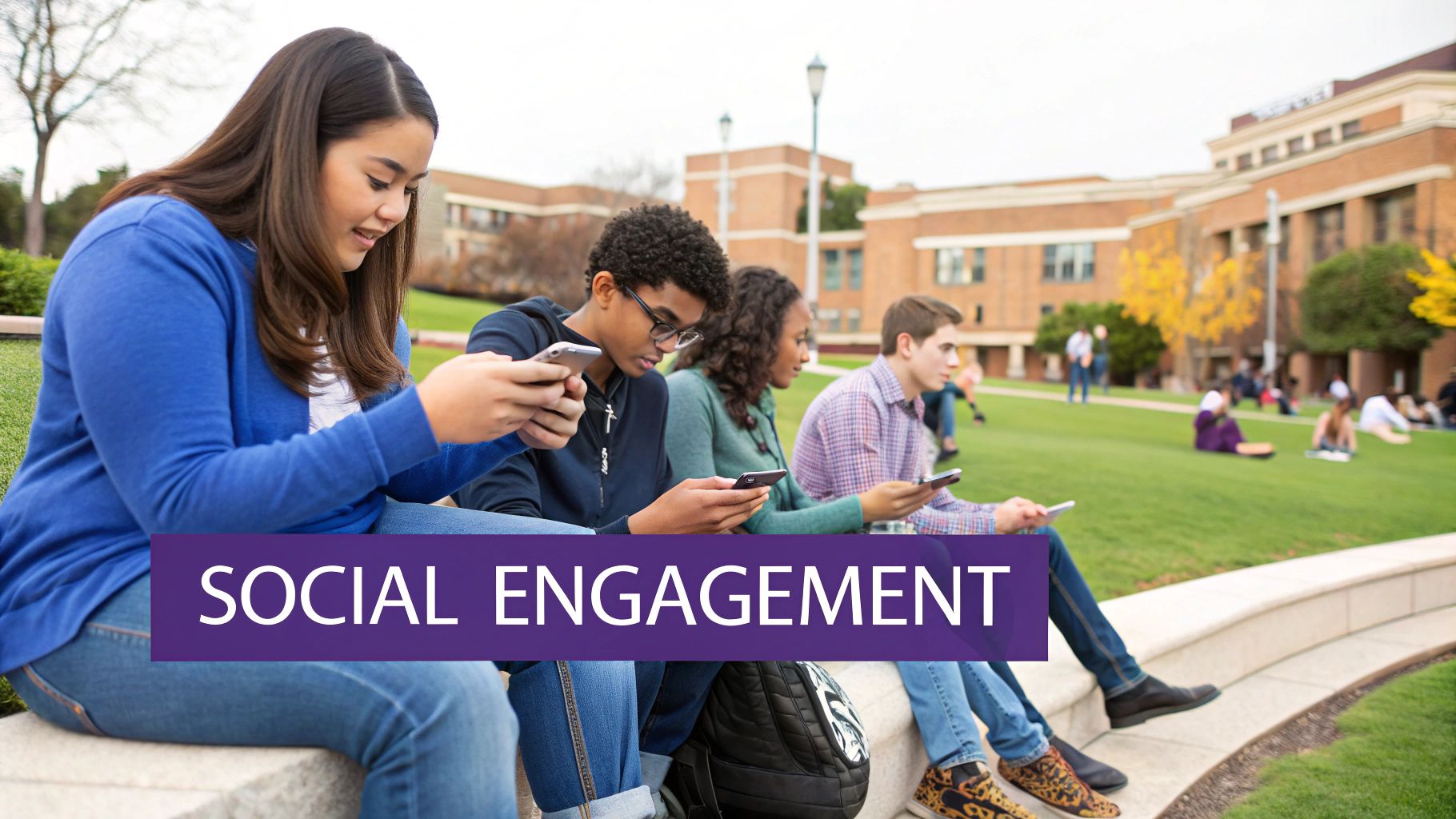
This method goes beyond simply posting campus photos. It involves creating platform-specific content that resonates with each audience segment. For example, you might use LinkedIn ads to target professionals with information about graduate certificates, while simultaneously running a student-led "day in the life" series on Instagram Stories to engage undergraduate prospects. The goal is to create a seamless experience where ads generate initial interest and organic content nurtures it into a qualified lead.
Why It Works for Higher Ed
Social media provides unparalleled access to specific demographics. A university can target ads to high school students in a particular geographic region with an interest in STEM, or to professionals in the healthcare industry looking to upskill. This precision maximizes marketing spend and lead quality. For instance, the University of Florida has seen immense success with TikTok campaigns that showcase authentic campus life, making the university feel accessible and exciting. This builds a strong emotional connection long before a prospective student even visits the official website, creating a warm audience for future lead nurturing efforts.
How to Implement This Strategy
- Embrace Authentic Voices: Utilize student takeovers, alumni testimonials, and faculty spotlights in your organic content. Authentic stories resonate far more than polished promotional material.
- Create Platform-Specific Content: Avoid cross-posting the same message everywhere. Tailor content for each platform: professional insights on LinkedIn, visually driven stories on Instagram, and short-form, engaging videos on TikTok.
- Leverage Retargeting Campaigns: Use the Facebook Pixel or LinkedIn Insight Tag to serve targeted ads to users who have visited your website or specific program pages but did not inquire. This is a highly effective tactic for re-engaging warm leads.
- Implement Social Listening: Actively monitor mentions of your university and relevant keywords. Engage directly with prospective students who are asking questions online to provide immediate value and demonstrate your institution's responsiveness.
3. Search Engine Marketing (SEM) and Pay-Per-Click Advertising
While content marketing builds long-term authority, Search Engine Marketing (SEM) offers immediate visibility, placing your institution directly in front of prospects at the exact moment they are searching for programs. This targeted digital advertising strategy uses paid search ads on platforms like Google and Bing to capture high-intent leads who are actively looking for degrees, certificates, and specific educational solutions. It's a cornerstone of modern higher education lead generation because it connects you with students who have already signaled their interest.

This approach allows you to bid on keywords like "online MBA in marketing" or "bachelor of science in nursing near me," ensuring your ad appears at the top of the search results. Beyond search, SEM also includes display advertising, which can retarget website visitors or reach specific demographics across a vast network of websites and apps, keeping your institution top-of-mind.
Why It Works for Higher Ed
SEM is powerful because it's based on intent. Unlike passive advertising, you're not interrupting a user's activity; you're providing a direct answer to their query. For example, Purdue University Global runs highly targeted search campaigns for working adults, with ad copy that speaks directly to their needs for flexibility and career advancement. This precision ensures that ad spend is directed toward the most qualified and motivated prospects, generating high-quality inquiries. The immediate feedback and data also allow for rapid optimization.
How to Implement This Strategy
- Focus on High-Intent Keywords: Target long-tail keywords that indicate a user is close to making a decision (e.g., "apply for cybersecurity certificate program" vs. "what is cybersecurity").
- Create Dedicated Landing Pages: Never send paid traffic to your homepage. Direct users to a specific landing page designed for that ad campaign, with a clear call-to-action and a simple lead capture form.
- Utilize Negative Keywords: Actively build a list of negative keywords (e.g., "free," "jobs," "salary") to prevent your ads from showing for irrelevant searches, which saves your budget and improves lead quality.
- Implement Conversion Tracking: Go beyond clicks by setting up conversion tracking to measure what truly matters: form submissions, information requests, and application starts. This provides clear ROI on your ad spend. Learn more about how SEM fits into a broader digital marketing strategy.
4. Email Marketing and Nurture Campaigns
Once a prospective student shows interest, the conversation has only just begun. Effective higher education lead generation hinges on what happens next, and email marketing provides a direct, personal channel to build that relationship. This strategy involves creating systematic, automated email sequences, known as nurture campaigns, that guide leads from initial curiosity to application submission by delivering relevant information at the right time.

This isn't about sending generic email blasts. It’s about segmenting your audience and tailoring communication based on their interests, demographics, and where they are in the enrollment funnel. A well-designed nurture campaign makes a prospective student feel seen and understood, transforming a cold lead into an engaged applicant who feels connected to your institution before ever setting foot on campus.
Why It Works for Higher Ed
The path to enrollment is a long-term consideration, not an impulse purchase. Nurture campaigns allow you to maintain a consistent, helpful presence in a prospect's inbox over weeks or months. For instance, Western Governors University (WGU) excels at this by sending personalized email sequences that align with a user’s declared program of interest. These emails deliver program-specific details, student success stories, and reminders about application deadlines, keeping WGU top-of-mind and methodically addressing potential concerns.
How to Implement This Strategy
- Segment Your Lists: Group contacts by program interest (e.g., Nursing vs. Business), enrollment timeline (e.g., starting this year vs. next year), or persona (e.g., recent high school grad vs. working adult).
- Use Behavioral Triggers: Automate emails based on user actions. If someone downloads a financial aid guide, trigger a follow-up email about scholarship opportunities or a link to your net price calculator.
- Include Social Proof: Weave student testimonials, alumni success stories, and faculty spotlights into your campaigns. This authenticates your claims and helps prospects envision themselves at your institution.
- Provide Clear Calls-to-Action (CTAs): Every email should guide the lead to the next logical step, whether it's "Schedule a Call with an Advisor," "Register for Our Virtual Tour," or "Start Your Application."
5. Host Engaging Webinars and Virtual Events
In an era where digital connection is paramount, interactive virtual events have become a cornerstone of modern higher education lead generation. These online gatherings, such as webinars, virtual open houses, and faculty Q&A sessions, allow institutions to engage directly with prospective students on a global scale. By offering valuable, real-time interactions, you can showcase your institution's personality, expertise, and community, moving beyond static brochures to create memorable experiences. This strategy hinges on providing direct access and tangible value. When a prospective student attends a virtual workshop on "Building a Standout College Application Essay" hosted by your admissions team, they receive practical help while your institution captures a highly motivated lead. These events bridge the gap between initial interest and a formal application by fostering a personal connection.
Why It Works for Higher Ed
Prospective students crave authenticity and direct answers. Webinars and virtual tours remove geographical and financial barriers, allowing a wider audience to experience what your institution offers. For example, MIT's virtual information sessions for graduate programs allow candidates from around the world to interact with faculty and current students, a critical factor in their decision-making process. These events transform abstract interest into a tangible connection, making enrollment feel like a natural next step.
How to Implement This Strategy
- Promote Extensively: Announce your virtual events weeks in advance across multiple channels, including email, social media, and your website's homepage, to maximize registration.
- Focus on Value: Design sessions around topics that address specific prospect needs, such as career workshops for a particular major, financial aid explainers, or "day in the life" virtual tours led by current students.
- Encourage Interaction: Use live polls, dedicated Q&A segments, and chat features to keep the audience engaged. The more they participate, the more connected they will feel to your institution.
- Follow-Up Strategically: Segment your follow-up communications. Send the recording and related resources to all registrants, but send a more personalized message with next steps, like scheduling a one-on-one call, to those who attended live. Exploring more advanced strategies for webinars and virtual events can further enhance your outreach.
6. Implement Powerful Referral and Word-of-Mouth Programs
While digital marketing casts a wide net, some of the highest-quality leads come from a source closer to home: your own community. A structured referral program is a key component of a diversified higher education lead generation strategy, transforming your satisfied students, successful alumni, and dedicated faculty into a powerful network of brand ambassadors. These programs formalize word-of-mouth marketing by incentivizing trusted individuals to recommend your institution to their peers, family, and colleagues. This approach leverages social proof at its most authentic. A recommendation from a friend or mentor carries significantly more weight than a traditional advertisement. When a current student shares their positive experience, they are not just promoting a program; they are validating its quality and impact, providing a powerful, trusted testimonial that resonates deeply with prospective students.
Why It Works for Higher Ed
Trust is the cornerstone of the enrollment decision. Prospects are more likely to consider an institution recommended by someone they know and respect. These referred leads are often better informed and more motivated, leading to higher conversion rates and better retention. For instance, Western Governors University (WGU) has a well-established referral program that offers tuition credits to current students who refer new ones. This not only generates leads but also directly supports student affordability, creating a virtuous cycle of growth and community support.
How to Implement This Strategy
- Create a Simple System: Design a straightforward referral process with a dedicated landing page and a simple submission form. The easier it is for someone to refer a friend, the more likely they are to do it.
- Offer Meaningful Incentives: Provide value for both the referrer and the referred prospect. This could be tuition credits, bookstore vouchers, gift cards, or exclusive alumni swag. The incentive should be compelling enough to motivate action.
- Equip Your Ambassadors: Give referrers a toolkit with key talking points, program highlights, and easy-to-share links or social media graphics. This ensures their recommendations are accurate and impactful.
- Track and Celebrate Success: Use tracking links or codes to measure the program's performance. Publicly acknowledge and reward top referrers in newsletters or on social media to build momentum. Understanding what motivates your community can be a powerful tool; you can learn more about how to motivate students on motimatic.com/ to refine your incentive structures.
7. Forge Strategic Partnerships and Affinity Marketing Programs
A highly effective and often underutilized strategy for higher education lead generation is to tap into existing, trusted networks through partnerships. Instead of building an audience from scratch, you align with organizations that already have access to your ideal prospective students, leveraging their credibility and reach to generate highly qualified leads. This involves creating formal relationships with corporations, professional associations, community colleges, and military organizations. This approach creates a direct pipeline of prospects who are often pre-vetted and motivated. For example, a corporate partnership providing tuition benefits for employees gives you access to a dedicated group of working professionals seeking to upskill. These leads come with built-in trust and a clear incentive to enroll, making them more valuable than those from broader, colder marketing efforts.
Why It Works for Higher Ed
These partnerships work because they are built on mutual benefit and established relationships. The partner organization offers a valuable educational benefit to its members or employees, enhancing their value proposition. The university gains access to a targeted, motivated audience at a lower acquisition cost. Arizona State University's renowned partnership with Starbucks, offering full tuition coverage for U.S.-based employees, is a prime example. This initiative not only generates a steady stream of student leads for ASU but also positions Starbucks as a top employer, demonstrating a powerful win-win scenario.
How to Implement This Strategy
- Identify Aligned Partners: Research corporations, non-profits, and associations whose members or employees match your ideal student profile. Look for alignment in industry, career goals, and demographics.
- Develop Co-Branded Campaigns: Create shared marketing materials, dedicated landing pages, and joint informational webinars. Ensure partner traffic is tracked with unique URLs or codes to measure ROI accurately.
- Establish Clear Articulation Agreements: For community college partnerships, create seamless transfer pathways that are clearly communicated. Make the transition process as smooth as possible to encourage enrollment.
- Offer Exclusive Benefits: Provide incentives like tuition discounts, waived application fees, or credit for professional certifications to the partner's audience. This makes your institution's offering more compelling and exclusive.
8. Retargeting and Remarketing Campaigns
Not every prospective student who visits your website is ready to apply on their first visit. An essential strategy for higher education lead generation is to re-engage these interested but unconverted visitors through retargeting and remarketing. This digital advertising method uses tracking pixels to serve personalized ads to users who have previously interacted with your site, keeping your institution top-of-mind as they continue their research across the web. This highly-focused approach allows you to bring warm leads back into the funnel by reminding them of their initial interest. Instead of competing for new, cold traffic, you are nurturing a pre-qualified audience that has already demonstrated a clear intent by visiting specific program pages, your admissions section, or financial aid resources. It’s a cost-effective way to maximize your initial marketing investment and guide prospects toward conversion.
Why It Works for Higher Ed
The path to enrollment is rarely linear; it involves multiple touchpoints and considerable deliberation. Retargeting works because it intercepts prospects during this crucial consideration phase. For instance, a user who viewed your Master of Business Administration page can be shown a Facebook ad featuring an MBA alumni success story or a display ad on a business news site about an upcoming application deadline. This contextual relevance makes the ad feel less like an interruption and more like a helpful reminder, reinforcing the value proposition of your program.
How to Implement This Strategy
- Segment Your Audience: Create distinct retargeting lists based on user behavior. Separate visitors who viewed the main homepage from those who visited a specific degree page or abandoned an application form.
- Customize Ad Creative: Develop tailored ad copy and visuals for each segment. A visitor to the nursing program page should see ads about clinical placements or NCLEX pass rates, not general university branding.
- Use Frequency Capping: To avoid overwhelming prospects and causing ad fatigue, limit the number of times a single user sees your ad within a specific period.
- Exclude Converters: Ensure your system removes users who have already applied or enrolled from your retargeting campaigns to avoid wasting ad spend and creating a poor user experience.
- Test and Optimize: Continuously experiment with different ad formats (e.g., video testimonials vs. static images), platforms (Google vs. LinkedIn), and messaging to identify what drives the most cost-effective conversions.
Higher Education Lead Generation Strategies Comparison
| Strategy | Implementation Complexity 🔄 | Resource Requirements ⚡ | Expected Outcomes 📊 | Ideal Use Cases 💡 | Key Advantages ⭐ |
|---|---|---|---|---|---|
| Content Marketing and Educational Resources | Medium to High 🔄🔄 | Moderate (Content creation team) ⚡⚡ | Long-term lead generation and trust building 📊📊 | Awareness, lead nurturing, SEO growth 💡 | Builds credibility, cost-effective, evergreen content ⭐⭐ |
| Social Media Advertising and Organic Engagement | High 🔄🔄🔄 | High (Ongoing content & management) ⚡⚡⚡ | Fast engagement and brand visibility 📊📊 | Reaching younger demographics, brand building 💡 | Precise targeting, high engagement, real-time interaction ⭐⭐ |
| Search Engine Marketing (SEM) and Pay-Per-Click | High 🔄🔄🔄 | High (Budget-intensive, optimization needed) ⚡⚡⚡ | Immediate traffic and lead acquisition 📊📊 | Capturing high-intent prospects, timely campaigns 💡 | Immediate visibility, real-time ROI tracking, competitive edge ⭐⭐⭐ |
| Email Marketing and Nurture Campaigns | Medium 🔄🔄 | Moderate (Automation tools and CRM) ⚡⚡ | High ROI, long-term relationship building 📊📊 | Lead nurturing, segmented communication 💡 | High ROI, personalized messaging, automation for efficiency ⭐⭐ |
| Webinars and Virtual Events | Medium to High 🔄🔄 | Moderate to High (Planning, tech setup) ⚡⚡ | Quality leads, high engagement 📊 | Deep engagement, thought leadership, dispersed audiences 💡 | Interactive, expert positioning, repurposable content ⭐⭐ |
| Referral and Word-of-Mouth Programs | Medium 🔄 | Low to Moderate (Incentives and management) ⚡ | High-conversion, trust-based leads 📊 | Leveraging existing community trust 💡 | Higher conversion, low cost, social proof ⭐⭐ |
| Partnership and Affinity Marketing | High 🔄🔄🔄 | Moderate to High (Relationship management) ⚡⚡ | Bulk enrollments, consistent qualified leads 📊 | Targeted demographic access, network leverage 💡 | Access to motivated prospects, shared costs, long-term sustainability ⭐⭐ |
| Retargeting and Remarketing Campaigns | Medium 🔄🔄 | Moderate (Ad spend and audience management) ⚡⚡ | Increased conversions from warm prospects 📊 | Re-engagement, personalized follow-up 💡 | Higher conversion, personalized ads, extends marketing reach ⭐⭐ |
Integrating Strategies for Maximum Enrollment Impact
The journey to building a thriving student body is not paved with a single, magical tactic. As we've explored, a truly effective approach to higher education lead generation is a sophisticated, multi-channel ecosystem where each component amplifies the others. From the initial spark of interest generated by compelling content and targeted social media ads to the sustained engagement fostered by personalized email nurturing and dynamic virtual events, every strategy plays a critical role. The key is to move beyond isolated campaigns and embrace a holistic, integrated framework. Think of it as a well-orchestrated symphony. Your content marketing provides the foundational melody, your SEM campaigns capture the audience's immediate attention, and your email sequences provide the harmonious narrative that guides prospects forward. Retargeting acts as the persistent, gentle rhythm that keeps your institution top-of-mind. Neglecting any one of these instruments can leave your enrollment efforts sounding flat and disconnected.
From Strategy to Synergy: The Path Forward
Achieving this synergy requires a strategic mindset. Your team must map the prospective student’s journey not as a linear path, but as a complex web of interactions. Data from your PPC campaigns should inform the topics for your next webinar. Insights from social media engagement should shape the messaging in your email nurture streams. Success lies in creating a seamless feedback loop where every touchpoint is informed by the last and anticipates the next. Consider these actionable next steps to begin integrating your efforts:
- Audit Your Current Funnel: Map out every touchpoint a prospective student has with your institution. Identify gaps where leads drop off and opportunities where channels could better support one another.
- Centralize Your Data: Use a robust CRM or analytics platform to get a unified view of your lead generation activities. This allows you to track a lead's entire journey, from their first click on an ad to their final application submission.
- Implement Cross-Channel Promotions: Actively promote your high-value assets across platforms. Use social media to drive sign-ups for a webinar, then follow up with a targeted email series, and retarget attendees who didn’t apply with a specific program offer.
The Motivational Layer: Beyond Tactics
However, even the most perfectly integrated tactical plan can fall short if it fails to address the human element: student motivation. This is the crucial, often-overlooked layer that transforms a good lead generation system into a great one. Understanding and addressing the underlying behavioral barriers, anxieties, and aspirations of your prospects is paramount. This is where a specialized understanding of motivational science can provide a profound competitive advantage in higher education lead generation.
By infusing your communications with research-backed motivational messaging, you move beyond simply informing prospects to actively inspiring and empowering them to take the next step. This deepens the connection with your institution, building trust and demonstrating a genuine commitment to their success long before they even enroll. By combining the powerful strategies we've discussed with a deep, empathetic understanding of what drives your future students, you will build a resilient, effective, and sustainable enrollment engine that not only meets its targets but builds a community of successful, engaged learners from their very first interaction.
Ready to infuse your lead generation with the power of motivational science? Discover how Motimatic uses research-backed, personalized messaging to help students overcome barriers and progress through your entire enrollment funnel. Visit Motimatic to see how we can help you turn prospects into enrolled students.
See it on your own listOne list, one goal, and a randomized holdout to show the lift. Start a pilot