Getting your online master's program to stand out is tougher than ever. The truth is, effective online master's degree marketing isn't about just generating more leads—it's about building a smart, full-funnel strategy that turns curious prospects into enrolled students, from their first inquiry all the way to their first day of class.
It takes the right channel mix, a creative strategy that actually connects, smart budget investment, and a way to engage people at scale without losing the human touch.
The New Reality of Attracting Graduate Students
Marketing an online master’s degree has completely changed over the last decade. Today’s prospective grad students are sharp consumers. They're often juggling full-time jobs and family life while digging deep into their options.
What they expect is a conversation—personalized, relevant communication that speaks directly to their career goals and the real-world logistics of going back to school.
This guide is designed to cut through the noise and tackle the core challenges universities are up against, from insane competition to the need for a truly modern marketing engine. We’ll walk you through the entire student journey, laying out a practical roadmap to attract and enroll the students you want.
From Inquiry to Enrollment
The journey from a prospect’s first click to their first day of class is a delicate one. Capturing a name and an email is just the starting line. The real work is in nurturing that relationship at every single stage. Success hinges on a strategic blend of tactics designed to build trust and prove your program's unique value. It all comes down to a few key pieces:
- A Multi-Channel Mix: You have to meet prospects where they already are, whether that's on Google, scrolling through social media, or networking on LinkedIn.
- A Compelling Creative Strategy: Your messaging needs to do more than list features. It has to highlight tangible career outcomes and show exactly what makes your program different.
- Strategic Budget Investment: It’s about putting your money where it counts, allocating resources across the funnel to maximize your return and drive down your cost-per-enrollment.
A winning marketing plan doesn't just fill the top of your funnel with leads. It builds a healthy pipeline of qualified, engaged applicants who are far more likely to enroll and thrive. This means shifting from quick, transactional interactions to a more relationship-based approach.
To pull this off, you need tools that let you engage with prospects at scale but still make every interaction feel personal. Platforms like Motimatic are built for this, helping schools automate and personalize their outreach so every potential student feels seen and supported on their path to enrollment. By truly understanding the modern student journey and putting a cohesive strategy in place, you can blow past your enrollment goals, even in this crowded market.
Who Is Your Ideal Graduate Student?

Before you spend a single dollar on an ad campaign for your online master's program, you have to answer one foundational question: who are you actually trying to reach? Real marketing success begins with a deep, almost personal understanding of your ideal student. And I don’t mean just their age and location—you have to go much deeper to craft a message that actually connects.
Think of it like casting the lead in a movie. You wouldn’t just put out a call for "a man in his thirties." You'd have a specific character in mind, with clear motivations, a compelling backstory, and a vision for his future. That's what a student persona is: a detailed, semi-fictional profile that brings your ideal applicant to life, complete with their goals and their challenges.
This means digging into the psychographics—their values, their career frustrations, and their biggest ambitions. What professional hurdles are keeping them up at night? When you know the answers, you can position your program not just as another degree, but as the solution to their specific problems.
Building Your Core Student Segments
Most online master's programs don't just have one type of applicant; they usually attract a few distinct groups. By segmenting your audience into these core personas, you can tailor your messaging, your channel strategy, and your ad creative to hit home with each one. It's a much smarter approach than a generic, one-size-fits-all campaign that resonates with no one. Here are a few of the most common personas we see in graduate enrollment marketing:
- The Ambitious Recent Grad: This person is 22-26 and hungry for a competitive edge right out of the gate. They’re driven by the desire for specialized skills and a higher starting salary. For them, programs with strong networking opportunities and a modern, relevant curriculum are a huge draw.
- The Mid-Career Professional: Typically between 30-45, this individual is looking to pivot into a new field or finally break through that ceiling in their current career. The main thing on their mind is ROI. They need to see a clear, direct line from your degree to a promotion, a major salary bump, or a new job title.
- The International Student: This persona is searching for a world-class education from a university with a solid reputation. They value prestige, global recognition, and flexible learning that works across time zones. For them, the long-term career doors your degree can open—either back home or abroad—are the biggest selling point.
The real power of creating these personas is that it forces you to stop guessing. It ensures every piece of content you create, from a simple ad headline to an entire landing page, speaks directly to the real-world motivations of the people you want in your program.
Where to Find the Right Insights
So, how do you get this information? You don't just make it up. Building accurate personas is a mix of good old-fashioned qualitative and quantitative research. Start with what you already have: your current student data. Look for trends in their professional backgrounds, stated career goals, and where they're coming from.
Building Your Full-Funnel Digital Marketing Mix
Once you’ve figured out who you’re talking to, the next job is building the machine that guides them from that first spark of curiosity all the way to a submitted application. A killer online master's degree marketing plan isn't about just throwing money at different channels and hoping something sticks. It’s about creating a coordinated, full-funnel experience where every touchpoint logically leads to the next. Think of it as a journey. A prospective student won't just decide to enroll the first time they see one of your ads—that's like committing to a cross-country road trip after seeing a single billboard. They need to see the map, check the weather, and feel confident the destination is worth the drive. Your channel mix is their GPS, giving them the right information at exactly the right time.
Top of Funnel: Attracting Awareness
This is the discovery phase. Your only goal here is to get your program on the radar of your ideal student personas. The focus is all about delivering value and being visible, not pushing for a hard sell. You’re simply answering their unspoken question: "Why should I even consider this?"
- Search Engine Optimization (SEO): This is non-negotiable. Your program pages have to be optimized for the keywords potential students are actually searching for, like “best online marketing master's” or “data analytics graduate degree.” It's the most direct way to capture people who are already looking for a solution.
- Content Marketing: This is where you build early trust. Create genuinely helpful blog posts, downloadable guides, or articles that speak directly to the career pain points of your personas. A post titled something like, "Is a Marketing Master's Worth It for a Career Change?" attracts the right audience by giving them value before asking for anything in return.
- Targeted Social Media Ads: Use platforms like LinkedIn and Facebook to run awareness campaigns targeting users by their job title, industry, or professional interests. A sharp, visually compelling ad that highlights a unique program feature can be enough to stop a mid-career professional mid-scroll and make them take notice.
Middle of Funnel: Driving Consideration
Okay, so a prospect knows you exist. Now what? The middle of the funnel is all about building trust and showing them why your program is the best choice out there. This is where you shift from broad awareness to direct engagement, nurturing their initial interest into serious consideration.
This stage is where most universities lose momentum. It's one thing to capture a lead, but keeping them engaged through a long decision-making cycle is the real challenge. The key is to provide consistent, high-value interactions that make your program feel like the obvious frontrunner.
Effective middle-funnel tactics are designed to educate, persuade, and build a connection:
- Lead Nurturing with Email Automation: Once you have their email, put it to work. Use automated sequences to deliver truly valuable content—think faculty interviews, alumni success stories, and deep dives into your curriculum. This keeps your program top of mind in a helpful, non-intrusive way.
- Faculty-Led Webinars: Hosting a webinar with a key faculty member is incredibly powerful. It puts a human face to the program, lets prospects ask specific questions, and creates a personal connection that a brochure never could.
- Strategic Retargeting: Don't let warm leads go cold. Use retargeting ads to re-engage prospects who visited your program page but didn't inquire. Sometimes, showing them a different angle—like a powerful student testimonial—is the nudge they need to take the next step.
Bottom of Funnel: Converting to Application
At the bottom of the funnel, your audience is ready to make a decision. All your marketing efforts should now be laser-focused on one thing: driving applications. The messaging gets more direct, emphasizing deadlines, application requirements, and the final steps to enrollment.
To close the loop, your campaigns need to be action-oriented. Virtual open houses offer a final chance for face-to-face interaction, while application-focused email reminders create a sense of urgency. At this critical point, personalized and scalable communication is everything. You can explore a deeper dive into higher education digital marketing strategies that bridge this gap effectively.
This is also where specialized platforms can make a huge difference. For example, Motimatic focuses on this final, crucial phase. We use behavioral science to deliver personalized nudges that motivate prospects to complete their applications, turning strong interest into official enrollments without burning out your admissions team.
Marketing Channel Mix for Online Master's Programs
To bring this all together, it's helpful to see how these different channels map to the student journey. Each one has a specific job to do, and they all work together to guide prospects from awareness to application.
| Channel | Funnel Stage | Objective | Key Metrics |
|---|---|---|---|
| SEO & Content Marketing | Top | Build awareness, capture organic search intent | Organic Traffic, Keyword Rankings, Time on Page |
| Paid Social (LinkedIn, FB) | Top/Middle | Reach target personas, generate new leads | Impressions, Clicks, Cost Per Lead (CPL) |
| Email Nurturing | Middle | Build relationships, educate prospects, maintain engagement | Open Rate, Click-Through Rate (CTR), Webinar Registrations |
| Retargeting Ads | Middle | Re-engage warm leads who haven't converted | Conversion Rate, Cost Per Action (CPA) |
| Webinars & Virtual Events | Middle/Bottom | Create personal connection, answer detailed questions | Attendance Rate, Engagement Score, Inquiries Generated |
| Application-Focused Emails | Bottom | Drive application completion, create urgency | Application Completion Rate, Clicks on "Apply Now" |
Ultimately, the goal isn't just to be present on these channels, but to orchestrate them into a seamless experience. When a student's journey feels intuitive and supportive, you're not just marketing—you're building the foundation for their success.
Crafting a Creative Strategy That Resonates
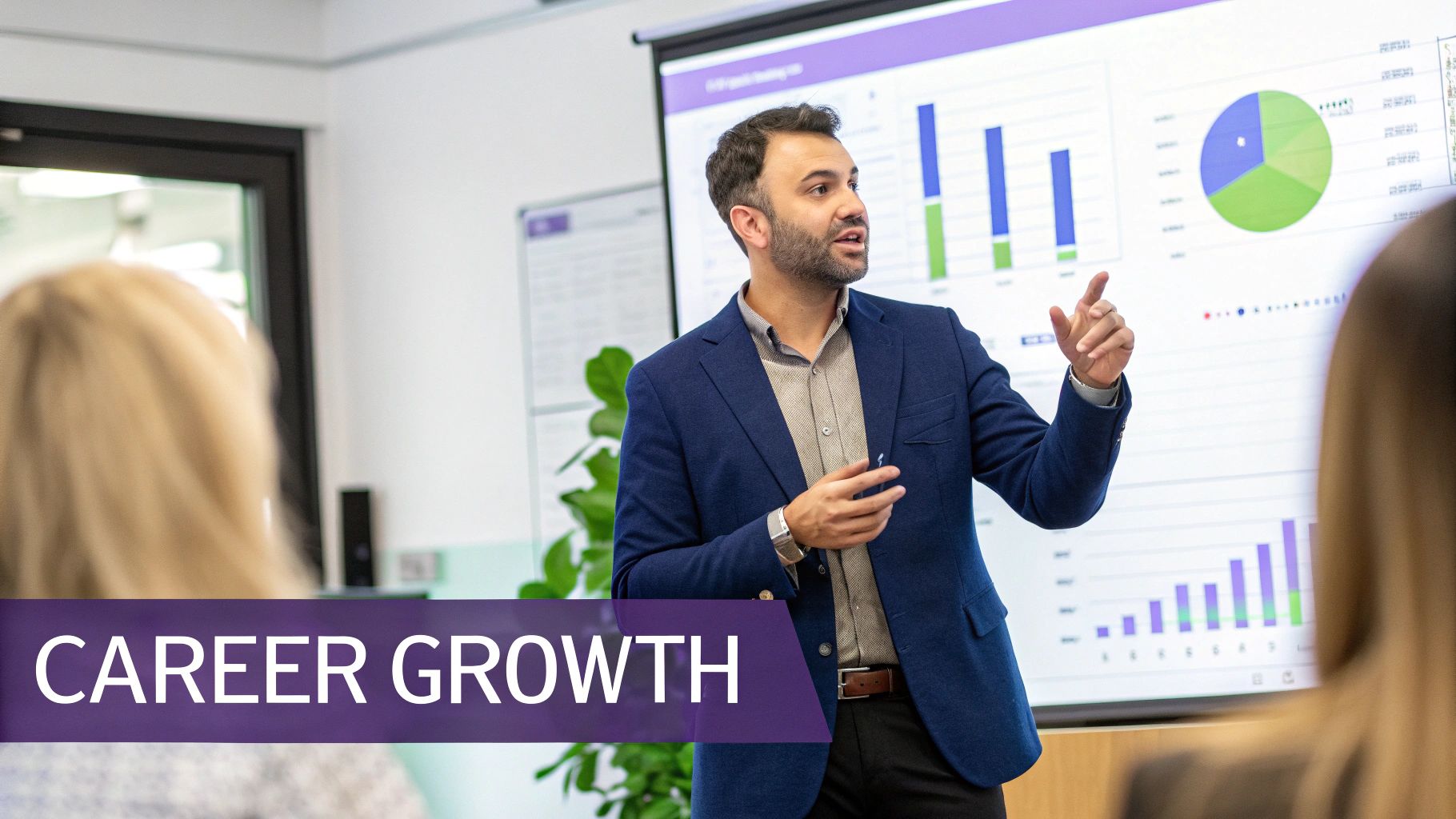
Having the perfect channel mix gets your program in front of the right people, but it’s a powerful creative strategy that actually gets them to act. The best online master's degree marketing does more than just list features like "flexible classes" or "expert faculty." It connects with prospective students on an emotional level by answering their most important question: "How will this degree change my life?"
Think about it. A car ad doesn't just list engine specs and torque ratios. It sells the feeling of freedom, the promise of adventure, or the sense of status. Your program’s messaging needs to do the same thing. It has to translate the attributes of your degree into tangible, student-centric benefits that align with their real-world career goals.
This is all about shifting your focus from what your program is to what your program does for the student. It’s the difference between saying, "Our curriculum includes advanced analytics," and saying, "Master the data skills you need to lead marketing teams and drive measurable business growth." One is a fact; the other is a future.
From Features to Benefits
At the heart of any strong creative strategy is the ability to translate your program’s features into clear, compelling benefits. This simple framework is how you move from institutional-speak to language that speaks directly to a prospect’s motivations.
- Feature: World-renowned faculty with industry experience.
- Benefit: Learn directly from the marketing leaders who are shaping the industry. You’ll gain insider knowledge and a network that can open doors for your career.
- Feature: A fully online, asynchronous curriculum.
- Benefit: Earn your master's without pausing your career or sacrificing family time. You fit the coursework into your life, not the other way around.
- Feature: Specialized concentration in digital strategy.
- Benefit: Become an expert in the most in-demand area of marketing, positioning yourself for senior roles and a significant salary bump after graduation.
That small shift makes your value proposition instantly clear and far more persuasive. You're connecting the dots for prospects, showing them a direct path from enrolling in your program to achieving the future they want.
Highlighting Your Unique Selling Points
In a crowded market, what makes your program the only choice? Your unique selling points (USPs) are the pillars of your messaging strategy. These aren't just small differences; they are the distinct advantages that truly set you apart.
Your USP is your promise to a prospective student. It’s the one thing they can get from your program that they can’t get anywhere else—whether that’s access to a particular research center, a guaranteed internship program, or a curriculum built by Fortune 500 CMOs.
Finding your USPs requires some honest self-assessment. What do you do better than anyone else? Maybe it’s your incredible alumni outcomes, with 95% of graduates landing a promotion or a new job within six months. Or perhaps it’s a hyper-specialized focus that meets a specific, urgent market need. For example, we've seen a huge rise in specialized programs focused on analytics and strategy to meet the demand for data-savvy marketers. As of 2025, the University of Alabama offers a fully online Master of Science in Marketing with concentrations like Marketing Analytics and Digital and Social Media. Highlighting specializations like these is a powerful differentiator. You can learn more about the evolution of online marketing degrees and see how other programs are adapting.
Tailoring Messages to Personas and Funnel Stages
Finally, a truly effective strategy adapts its messaging to who you're talking to and where they are in their decision-making journey. The message that grabs a recent grad's attention is completely different from the one that convinces a mid-career professional to finally hit "apply."
- Top of Funnel (Awareness): Your goal here is to grab attention with broad, benefit-driven messaging that speaks to a core pain point. For a career-pivoter, an ad might read: "Ready for a Career That Values Your Creativity? Discover a Future in Digital Marketing."
- Middle of Funnel (Consideration): Now it's time to build trust and provide proof. Target these prospects with alumni success stories, faculty interviews, and webinars that showcase your program’s specific strengths and community.
- Bottom of Funnel (Decision): Get direct and make it easy to act. Use clear calls-to-action that highlight application deadlines, financial aid opportunities, and how simple the admissions process is.
By tailoring your creative this way, you make sure every ad, email, and landing page feels relevant. You're speaking directly to what matters most to each prospect at that exact moment. This is the kind of personalization that turns passive interest into active enrollment.
Scaling Engagement to Drive Enrollment Conversions
Getting a lead for your online master’s program is a huge win, but it’s really just the starting line. The most critical—and honestly, the toughest—part of online master's degree marketing happens after someone first reaches out. This is where you have to turn that initial spark of interest into an actual application and, ultimately, an enrolled student.
This is where many universities see a major drop-off. A prospective student fills out a form, feeling motivated and ready to go, but then life happens. Without steady, supportive communication, that excitement fizzles out and the lead goes cold. It's a classic case of "lead decay," and it burns through marketing budgets like nothing else.
The answer is to build a system for engagement that can scale. You need a reliable way to keep the momentum going and guide potentially thousands of prospects through a complicated admissions process without completely burying your team.
The Power of Personalized, Automated Nurturing
Think about this post-inquiry phase as an ongoing, supportive conversation. Your job is to guess what questions a prospect will have, deliver information right when they need it, and offer a little encouragement at those key make-or-break moments. Trying to do that one-on-one for every single lead? Impossible.
This is exactly why automated engagement platforms are no longer a nice-to-have; they're essential. They let you build out personalized communication sequences that send the right message at the right time, making every single prospect feel like you're paying attention to them. Instead of blasting out generic emails, you can send content tailored to their specific program interest or how far along they are in the application.
These sequences can cover all the bases:
- Welcome Messages: Instantly confirm you got their inquiry and let them know what's coming next.
- Program Deep Dives: Share links to cool faculty interviews or videos that show off what makes your curriculum special.
- Application Reminders: Gently nudge people as deadlines get closer, maybe even offering help with specific parts of the application.
- Financial Aid Information: Get ahead of the money question by sharing resources on scholarships and funding—a huge hurdle for so many applicants.
This kind of thoughtful approach keeps your program top-of-mind and builds a real connection. It transforms the application journey from a confusing chore into a guided, reassuring experience.
Driving Action with Engagement Platforms
In modern engagement marketing, it's about more than just sending automated emails. Platforms like Motimatic, designed specifically for higher education, use behavioral science to truly motivate me to take that next step. It's not just about dumping information; it's about delivering content that helps me overcome procrastination and anxiety.
Here is a look at Motimatic's approach to student engagement.
The whole idea is to reach students on the channels they already use with supportive, science-backed messages that get them to act.
This points to a major shift in strategy—moving from just passively communicating to actively motivating. For example, instead of a robotic email that says, "Your application is incomplete," a much better message might be, "You're just one step away from finishing your application! Many students find the personal statement section the most rewarding. Here are a few tips to get started."
By personalizing outreach at scale, universities can prevent lead decay and create a supportive environment that significantly boosts enrollment rates. This turns your marketing spend into a more efficient and effective engine for growth.
Platforms like these plug right into your existing marketing channels, reaching prospects on social media and other places they already spend their time. This multi-channel approach makes sure your message is seen without piling more manual work onto your admissions staff. You can get a better sense of how this works by exploring different approaches to marketing for universities and seeing how they fit with what modern students expect.
At the end of the day, scaling engagement is about building relationships efficiently. It ensures no interested prospect falls through the cracks and gives every potential student the guidance and encouragement they need to cross the finish line from inquiry to enrollment.
Measuring Success and Optimizing Your Budget Investment
If you can’t measure it, you can’t manage it. This old saying is especially true for online master's degree marketing. To justify your budget and prove your marketing is actually working, you need a data-driven approach that goes way beyond surface-level stats. Clicks and impressions are nice, but they don't pay the bills. The real goal is to connect every dollar you spend to a tangible outcome: an enrolled student. Think of your marketing budget like an investment portfolio. You wouldn't just scatter your money across random stocks and hope for the best. You’d track performance, cut your losses, and double down on what’s delivering real returns. That’s exactly what we need to do here.
Moving Beyond Vanity Metrics
The first step is to stop obsessing over vanity metrics. Things like social media likes or a spike in website traffic might feel good, but they don’t tell you if your campaigns are actually convincing people to apply. The real story is always in the numbers that track the journey from prospect to student. Here are the core metrics that truly matter for any online master's program:
- Cost Per Inquiry (CPI): This is your top-of-funnel efficiency metric. It tells you exactly how much it costs to generate one new lead from channels like paid search or social media ads.
- Cost Per Application (CPA): Moving down the funnel, CPA shows what you spent to get one person to hit "submit" on their application. It's a critical indicator of how well you're turning initial interest into serious intent.
- Cost Per Enrollment (CPE): This is the bottom line. CPE calculates the total marketing cost to enroll one new student, giving you the clearest possible picture of your return on investment.
Tracking these KPIs for every single channel is how you start making smarter decisions about where your money should go.
Connecting Marketing Spend to Enrollment ROI
Once you have a solid handle on your CPI, CPA, and CPE, you can really start digging into the return on investment (ROI) for each channel. This is how you prove your value and build a bulletproof case for next year's budget. You might find, for example, that LinkedIn ads have a higher initial CPI but a much lower CPA and CPE compared to your Facebook campaigns. What does that tell you? It means LinkedIn is attracting a more qualified audience that’s more likely to follow through and enroll.
The goal is to create a feedback loop. Data from one recruitment cycle should directly inform the strategy for the next. This constant cycle of measuring, analyzing, and optimizing is what separates good marketing from great marketing.
A Practical Framework for Optimization
So, what does this look like in the real world?
Imagine you’re digging into the data from your last recruitment cycle. Your analytics show that the faculty-led webinars you hosted have an incredibly low CPE—they are ridiculously efficient at turning attendees into enrolled students. On the other hand, your generic display ad campaign has a sky-high CPE.
The path forward is crystal clear. You reallocate a chunk of that display ad budget and pour it into promoting your webinars more aggressively. This isn't a gut decision; it's a strategic move based on hard evidence.
This continuous optimization is the secret to scaling your enrollment without just throwing more money at the problem. For more ideas on how to sharpen your recruitment efforts, check out these effective enrollment marketing strategies.
At Motimatic, we help universities turn interest into enrollment with scalable, personalized engagement strategies. See how our platform can help you exceed your goals by visiting https://motimatic.com/.
See it on your own listOne list, one goal, and a randomized holdout to show the lift. Start a pilot