Imagine having a campus tour guide who works 24/7. This guide knows every single prospective student by name and can talk to them about their specific interests—whether that’s a niche science program or a question about financial aid.
That’s the core idea behind marketing automation in higher education. It’s a shift away from the old one-size-fits-all, megaphone style of recruitment and toward thousands of personalized, one-on-one conversations happening at once. For any modern university trying to connect with today's students, it’s no longer a nice-to-have; it's essential.
The Modern Campus Connection
The world of higher education is incredibly competitive. Building a genuine connection with a prospective student can be the single thing that makes them choose your institution over another. The problem is, admissions teams are almost always stretched thin, trying to give a personal touch to thousands of inquiries.
This is where marketing automation truly changes the game. It’s not about replacing people with robots. It’s about supercharging your team by letting technology handle the repetitive, time-consuming tasks.
Think of it as a digital assistant. It sends welcome emails the moment a student fills out a form. It keeps track of which pages they visit on your website and sends reminders about an upcoming application deadline. To forge a modern campus connection, you first have to make sure students can find you, so it's critical to improve website visibility to draw them into your automated funnels.
By automating these touchpoints, your admissions staff is freed up to do what they do best: have meaningful conversations. Instead of manually sending follow-up emails, they can spend their time calling a highly engaged student who has visited the tuition page three times. They can personally answer complex questions from a student who is on the fence about enrolling.
The real power of marketing automation is its ability to help a university speak to a thousand students as if they were speaking to just one. It uses data to create personalized journeys that feel helpful and human.
This completely transforms the recruitment process from a static, broadcast model to one that’s dynamic and responsive to each student's needs.
Manual vs Automated Student Engagement
The difference between the old way and the new way is night and day. The manual approach leans on generic messages and a ton of staff hours. An automated approach, on the other hand, builds a smarter, more efficient system that makes personalization possible at scale. This table really breaks down the contrast.
| Activity | Manual Approach (The Old Way) | Automated Approach (The New Way) |
|---|---|---|
| First Inquiry | Staff manually sends a generic welcome email, often with a delay. | System instantly sends a personalized welcome email based on the student's program interest. |
| Website Visits | Relies on students to self-report their interests or navigate the site alone. | Tracks user behavior to identify high-interest areas (e.g., financial aid, specific majors). |
| Event Invites | Sends mass email invitations for all events to the entire prospect list. | Triggers targeted invitations based on a student's location, academic interest, or engagement level. |
| Follow-Up | Admissions counselors manually review lists to decide who to contact next. | Lead scoring automatically flags the most engaged prospects for immediate, personal outreach. |
Ultimately, automation doesn't just make your team's life easier—it creates a fundamentally better experience for the prospective student, making them feel seen and understood from their very first click.
Why Automation Is a Game-Changer for Recruitment

Let's move beyond the theory and talk about what marketing automation actually does for a university. The real value isn't just in streamlining workflows; it's measured in tangible results that leaders care about most: application volume, lead quality, and, of course, enrollment rates. In a hyper-competitive market, this isn't just about being more efficient. It’s about being more effective. By taking over the repetitive but critical communication tasks, automation frees up your admissions team to focus their energy where it matters most—building real relationships and turning initial interest into committed students.
Turning Data Into Decisive Action
Let’s get practical. Imagine a prospective student, "Maria," visits your university's website four times in a single week. She keeps returning to the mechanical engineering program page and has even spent time on the financial aid calculator. In a world of manual follow-up, this rich behavioral data might sit unnoticed for days, if it’s noticed at all. With automation, this is where the magic happens. Her actions trigger an immediate, personalized response.
- Day 1: An automated email lands in Maria's inbox. The subject? "A Closer Look at Mechanical Engineering at [University Name]." Inside, there's a video featuring a current engineering student and a simple link to schedule a chat with a faculty advisor.
- Day 2: The system knows she clicked the financial aid link. So, it sends a follow-up about an upcoming scholarship deadline specifically for STEM students. No guesswork, just relevant information.
- Day 3: A notification is automatically routed to an admissions counselor, flagging Maria as a high-interest prospect who is clearly ready for a personal phone call.
This entire sequence unfolds without anyone lifting a finger. It ensures that a high-potential lead like Maria never falls through the cracks. Her passive browsing just became an active, guided journey straight toward an application.
Automation transforms the recruitment funnel from a leaky bucket into a powerful engine for growth. It systematically plugs the gaps where prospective students lose interest or disengage, ensuring a smoother path from initial inquiry to enrollment.
Boosting Recruitment and Enrollment Numbers
This isn't just a hypothetical scenario. The data from institutions that have fully embraced automation tells a powerful story of growth.
Look at Florida Polytechnic University. After implementing a dedicated marketing automation platform, they saw a staggering 185% increase in applications over three years. This wasn't just more noise; it came with a 78% growth in admitted students. They achieved this by using automated nurturing and behavioral tracking to engage prospects in a way that truly resonated.
This success story drives home a critical point: in a world where students are more digitally savvy than ever, a data-driven recruitment strategy isn't a luxury—it's a requirement for growth.
A Smarter Way to Nurture Leads
At its core, marketing automation in higher education gives you a framework for smarter lead nurturing. Instead of blasting every inquiry with the same generic message, you can segment, communicate, and connect with students based on their actual interests and engagement level. This targeted approach ensures your messaging is always relevant, helpful, and timely. You're building a genuine relationship with each prospect, making your institution feel uniquely attentive to their needs long before they ever set foot on campus.
The Core Tools of Your Automation Engine
Think of your marketing automation platform as your university's recruitment engine. For it to run powerfully, it needs several core parts working together. Each tool has a specific job, but when they’re combined, they create a system that can engage thousands of prospective students in a truly intelligent way.
When you lift the hood, you’ll see the essential components that make this possible. Understanding what these tools are and what they do is the first step toward building a recruitment machine that’s both efficient and surprisingly personal.
Let's break down the building blocks.
CRM Integration: The Central Hub
At the very heart of any marketing automation in higher education strategy is your Customer Relationship Management (CRM) system. If automation is the engine, the CRM is the central computer and memory bank. It’s where every single piece of information about a prospective student lives. This integration is non-negotiable—it’s what makes true personalization possible. It connects every touchpoint—an opened email, a campus tour request, a submitted form—into one unified student profile. Without it, your automation efforts are flying blind, unable to see the rich history of a student's journey with your university.
Email Marketing: The Personalized Messenger
Email is still a cornerstone of student communication, but automation turns it from a generic broadcast into a dynamic, one-on-one conversation. Instead of blasting the same newsletter to everyone, you can build automated email workflows that trigger based on specific actions or milestones.
- Welcome Series: A new inquiry automatically gets a sequence of emails introducing them to campus life, key programs, and student stories.
- Behavioral Triggers: A prospect downloads a brochure for the nursing program. Moments later, they receive an email with a link to a virtual tour of the simulation labs.
- Deadline Reminders: As application or financial aid deadlines get closer, the system sends personalized nudges only to those who haven’t finished the required steps.
The real magic here is delivering the right message at exactly the right moment. It makes every communication feel relevant and genuinely helpful.
Lead Scoring: The Priority System
How does your admissions team decide which of the thousands of inquiries to focus on today? That's the problem lead scoring solves. Think of it as a simple point system that helps you spot the most engaged and promising prospects in your pipeline. It’s a bit like a video game. Each prospective student "levels up" by earning points for their interactions with your university.
Lead Scoring in Action:
- Opening an email: +5 points
- Clicking a link to a program page: +10 points
- Filling out a "Request for Information" form: +25 points
- Visiting the tuition page multiple times: +50 points
Once a prospect hits a certain score—say, 100 points—the system can automatically flag them as a "marketing-qualified lead" and alert an admissions counselor for immediate, personal follow-up. This data-driven approach ensures your team invests its time where it will have the biggest impact: on students who are most likely to enroll.
Landing Pages and Forms: The Data Capture Tools
Your website is a critical asset, but specialized landing pages and forms are your primary tools for gathering valuable student information. These aren't just any old pages on your site; they are built with a single, clear purpose, like downloading a viewbook, registering for a webinar, or signing up for a campus visit.
Every time a student fills out a form, that data flows straight into your CRM. This enriches their profile and often kicks off the next step in an automated workflow. This seamless data capture is the fuel for your entire marketing automation engine. As a key part of your overall strategy, these tools support modern higher education digital marketing by creating clear, frictionless paths for students to take action.
The dashboard below shows how these different tools can connect to create automated workflows, simplifying the process for your team.
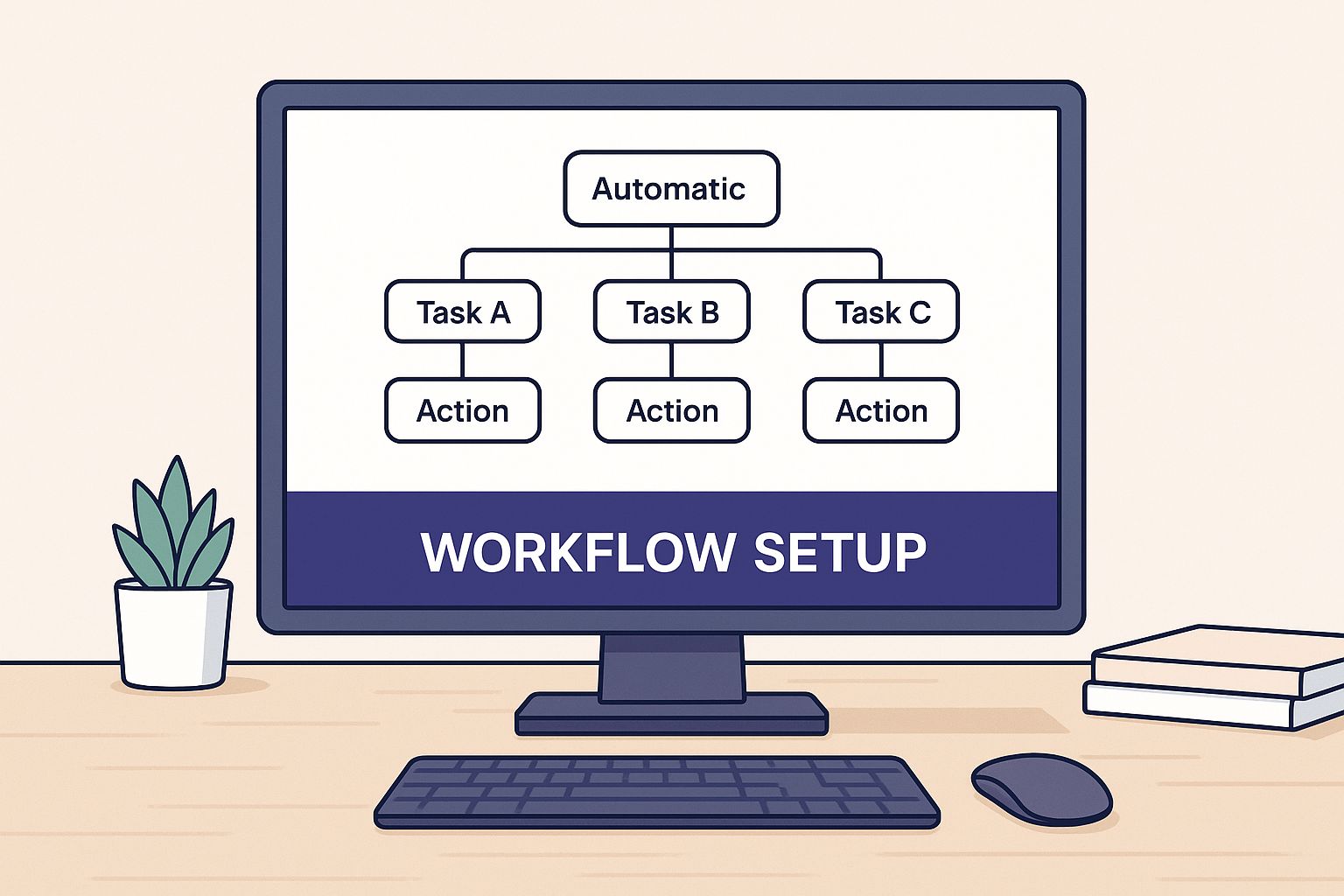
This visual makes it clear: a well-organized workflow is what ties all your automation tools into a single, cohesive student journey.
Analytics and Reporting: Proving What Works
Finally, every engine needs a dashboard. Analytics and reporting tools give you the hard data you need to measure performance and prove your return on investment. They answer the questions that matter most: Which email campaigns are driving the most applications? How long does it take for an inquiry to become an enrolled student? What is our cost per enrollment? This data lets you stop guessing. You can A/B test email subject lines, analyze workflows to find bottlenecks, and generate clear reports for university leadership. These insights are essential for fine-tuning your strategy and showing everyone the undeniable value of your automation efforts.
Crafting a Hyper-Personalized Student Journey
This is where marketing automation truly earns its keep. We're moving beyond simple efficiency and into the realm of creating deeply meaningful interactions with prospective students. Hyper-personalization isn't about just dropping a [First Name] into a mass email. It’s about crafting a journey that feels so attentive and relevant that it shows a student you genuinely understand their unique needs and goals.
Imagine a journey so tailored that your university's website actually changes based on a student's interests. A prospect who keeps browsing engineering program pages might suddenly see homepage banners featuring the engineering labs, success stories from the College of Engineering, and invitations to a STEM-specific webinar. That's the power of dynamic content in action.
This level of personalization proves your institution is listening, adapting, and responding to a student’s unspoken questions. It transforms your digital presence from a static brochure into a living, breathing guide that anticipates and serves their needs before they even ask.
From Interest to Action with Behavioral Triggers
At its heart, this kind of personalization is powered by behavioral triggers—automated responses to specific actions a student takes. These triggers are your secret weapon for delivering the perfect piece of content at the exact moment it’s most helpful, nurturing the relationship one step at a time. Think of it as a series of helpful nudges guiding students along their path.
- Action: A student downloads the chemistry program brochure.
- Triggered Response: An automated email arrives the next day with a link to a virtual tour of your state-of-the-art science labs.
- Action: A prospective international student visits the visa information page.
- Triggered Response: The system sends them a guide on "5 Steps for International Students to Prepare for Enrollment" and an invitation to a Q&A with an international admissions advisor.
- Action: A user starts an application but doesn't complete it within 48 hours.
- Triggered Response: A gentle reminder email is sent, offering help and highlighting the benefits of completing the application soon.
These automated sequences make your university feel incredibly responsive and supportive. You're building trust and momentum throughout the entire recruitment cycle without lifting a finger for each interaction.
Mapping the Modern Learner's Journey
Of course, to make any of this work, you have to know who you're talking to. The core of a hyper-personalized student journey is a well-defined audience segmentation strategy. By grouping prospects based on their interests, location, or how they've engaged with you, you can create journeys that speak directly to their specific context. Let's walk through what this looks like for a prospective student we'll call Alex:
- Initial Inquiry: Alex first engages by requesting information about the business school. This single action segments Alex into the "Prospective Business Student" audience.
- Nurturing Content: Over the next few weeks, Alex receives a curated email series. Instead of generic campus news, the content is all business-focused: a profile on a successful alumni entrepreneur, an interview with the dean of the business school, and an invite to a webinar on "Careers in Finance."
- Behavioral Signal: The system sees that Alex clicked the webinar link but didn't register. This triggers a follow-up email a day later with the webinar recording and a direct link to book a 15-minute call with a current business student.
- Personal Outreach: Alex books the call—a clear signal of high interest. This action automatically raises Alex's lead score and notifies an admissions counselor to make a personal phone call, fully equipped with the history of Alex's interactions.
This entire journey feels personal and guided. It makes Alex feel valued and understood long before a formal application is even submitted. It's this data-driven, empathetic approach that has become absolutely essential.
According to a recent benchmarks report, personalization is now critical for engaging today's "Modern Learners," who are both selective and digitally sharp. The report highlights that universities succeeding are those using advanced marketing automation to deliver tailored experiences, such as showcasing clear career outcomes or adapting messages based on a student’s specific digital interactions. Discover more insights on how these data-informed strategies are shaping the future of enrollment in the 2025 Higher Education Marketing Trends.
Ultimately, when you use marketing automation this way, you’re not just sending messages. You’re building relationships at scale, making every single prospective student feel like your top priority.
Your Practical Roadmap to Implementing Automation
Jumping into marketing automation can feel like a massive undertaking, but it doesn't have to be. The secret isn't trying to automate everything at once. It's about breaking the process down into manageable phases, starting small, and proving the value of your efforts step by step. This roadmap is designed to cut through the noise and give you a clear path forward. You’ll build momentum with early wins and create a solid foundation for a much smarter, data-driven recruitment strategy. Getting a feel for the basics is a great first step; understanding how to automate repetitive tasks in a general sense provides a helpful mental model before you dive into a higher-ed-specific platform.
Phase 1: Define Your Goals and KPIs
Before you look at a single piece of software, you have to know what you're trying to achieve. What specific problem are you trying to solve? A vague goal like "improve engagement" won't cut it. You need concrete, measurable objectives.
Start by zeroing in on your biggest pain points. Is your admissions team drowning in manual follow-ups? Are you losing fantastic leads right after their first inquiry?
Tie your goals directly to Key Performance Indicators (KPIs) that will get leadership's attention.
- Goal: Drive more qualified applications from out-of-state students.
- KPI: A 15% increase in applications from target regions within one academic year.
- Goal: Shrink the follow-up time for new inquiries.
- KPI: Cut the average response time from 48 hours to under 1 hour.
- Goal: Boost enrollment yield from your admitted students.
- KPI: Increase the application-to-enrollment conversion rate by 5%.
These clear metrics don't just guide your strategy—they help you build a compelling case for budget and get other departments on board by showing a clear path to ROI.
Phase 2: Choose the Right Platform
Now that you have your goals, you can start looking at platforms. The market is crowded, but a generic business tool often falls short of the unique demands of marketing automation in higher education. You need features like pre-built student journey workflows, easy integration with your Student Information System (SIS), and robust analytics that track the entire enrollment funnel.
One of the most common mistakes is choosing a platform based on price alone. The best system is the one that fits your specific goals, plays nicely with your existing tech, and offers the support you need to actually succeed. Always prioritize long-term value over short-term savings.
Make a shortlist and get on some demos. Ask the vendors to show you exactly how their platform would solve one of the specific pain points you identified in Phase 1. This makes the evaluation process far more practical and much less abstract.
Phase 3: Integrate Your Student Data Systems
This is often the trickiest part from a technical standpoint, but it's the absolute foundation of everything else. Your automation platform must connect to your CRM and SIS to create a single, unified view of every student. Without this link, your automation will run on incomplete data, leading to clumsy, disconnected messages that miss the mark. Start with the essentials. Focus first on integrating data from new web inquiries. This gives you a clean, manageable dataset to work with as you build out your first campaigns. You can tackle more complex integrations later on, but getting that initial sync right is a critical early win.
Phase 4: Build Your First High-Impact Campaigns
Don't try to boil the ocean by automating the entire student journey from day one. Instead, pick one or two high-impact campaigns that directly address a key goal. A Welcome Series for new inquiries is a perfect place to start. This kind of workflow is relatively simple to build but delivers immediate value. It ensures every single prospect gets a timely, personalized, and engaging set of communications. Once that’s running smoothly, you can build another campaign for application completion reminders or event invitations. For more ideas on keeping prospects hooked, exploring proven student engagement strategies can give you some fantastic inspiration for your first automated workflows.
Phase 5: Train Your Team for Success
At the end of the day, technology is only as good as the people using it. Real adoption and long-term success depend on great training. Your admissions, marketing, and IT teams all need to understand their roles within this new automated world. Focus training not just on the "how" (which buttons to click), but on the "why." Help your team see how automation frees them from tedious tasks, letting them focus on what they do best: building real, meaningful relationships with students. This creates a sense of ownership and excitement, turning your team into your biggest automation advocates.
Measuring What Matters and Proving Your ROI

Getting your automation platform up and running is a huge accomplishment, but it’s really just the starting line. The true power gets unlocked when you start using its data to measure what actually moves the needle, prove the value of your work, and constantly refine your approach. It’s time to look past surface-level stats like email opens and focus on the numbers that show real, undeniable impact. At its core, marketing automation in higher education finally gives you the hard data to justify your budget. No more guesswork. You can now track the entire student journey with precision, connecting every automated touchpoint to a concrete outcome. This lets you walk into meetings with leadership and answer the tough questions with total confidence.
Beyond Vanity Metrics to Real Impact
If you want to prove your ROI, you need to track the metrics that tie directly to enrollment and revenue. These are the numbers that paint a clear, honest picture of your recruitment engine’s health and efficiency. Here are a few of the most critical KPIs to watch:
- Cost Per Enrolled Student: This is the ultimate bottom-line figure. It tells you exactly how much you invested to bring each new student through the door.
- Application-to-Enrollment Rate: A powerful metric that reveals the quality of your applicants and how well your post-application nurturing is working.
- Funnel Velocity: This shows you how fast a prospect moves from that first inquiry to becoming an enrolled student, shining a light on any bottlenecks in your process.
Optimizing Your Strategy with Data
Think of the data from your automation platform as a detailed roadmap for improvement. It tells you exactly where your recruitment funnel is strong and, more importantly, where it’s leaking.
The greatest advantage of automation is turning ambiguity into action. It replaces “I think this is working” with “I know this is working, and here’s the data to prove it.”
For example, you can lean on A/B testing to sharpen your messaging. Pit different email subject lines, calls-to-action, or even send times against each other to see what truly connects with specific student segments. If a particular workflow shows a major drop-off at one stage, you can zoom in on the content at that specific touchpoint to figure out what's causing friction and smooth it out. This is a fundamental part of modern enrollment marketing strategies, making sure every step is fine-tuned for conversion.
Still Have Questions About Automation? Let's Clear Things Up.
It's completely normal to have a few questions—and maybe even some healthy skepticism—when you're thinking about bringing a new approach to your campus. So, let's tackle some of the most common concerns we hear from university leaders and marketers about marketing automation in higher education. The goal here is to give you straight answers to help you move forward with confidence.
Is Marketing Automation Too Impersonal for Higher Education?
This is probably the biggest myth out there, but the truth is actually the complete opposite. When you do it right, automation is the very thing that makes deeper personalization possible. It’s how you graduate from sending generic, one-size-fits-all emails to communicating with prospective students based on their specific program interests, where they live, or how they're interacting with your website.
True automation isn’t about replacing the human touch; it’s about making it more impactful. It frees up your admissions team from the repetitive, administrative grind so they can spend their time having meaningful, one-on-one conversations with the students who are most engaged and ready to connect.
How Much Does Marketing Automation Cost for a University?
There’s no simple answer here, because there's no single price tag. Your costs will really depend on the platform you go with, the size of your contact database (all your prospective students), and the specific tools and features you need. An entry-level system might start in the low hundreds of dollars a month, but a more powerful platform for a large university could easily run into the thousands. But focusing only on the price tag is missing the point. The real question is about Return on Investment (ROI). A good automation system should pay for itself, and then some, by delivering:
- Increased Staff Efficiency: Giving your team back countless hours of manual work.
- Higher Application Quality: Attracting candidates who are a better fit and more serious about applying.
- Improved Enrollment Conversion: Helping you turn more admitted students into fully enrolled ones.
Our Student Data Is a Mess. Can We Still Use Automation?
Yes, absolutely. In fact, you're in good company—this is a super common starting point for many schools. Lots of institutions actually use the process of implementing an automation platform as the perfect catalyst to finally get their student data cleaned up, organized, and all in one place. A messy database can feel like a huge hurdle, but you don't have to fix everything overnight.
The trick is to start small. Pick one, manageable data source to begin with, like new inquiries coming in from your website forms. This lets you build a clean foundation from the get-go and see some immediate wins. Most modern platforms come with powerful tools and great support to help you tackle data integration and hygiene, so you can get organized as you grow.
Ready to guide students from their first click all the way to graduation? Motimatic uses behavioral science and intelligent automation to boost enrollment, improve retention, and ensure student success. See how our purpose-built platform can help you build meaningful connections at scale. Learn more at Motimatic.
See it on your own listOne list, one goal, and a randomized holdout to show the lift. Start a pilot