In higher education, the traditional lecture model is no longer sufficient to captivate and retain students. The challenge isn't just about delivering information; it's about creating an environment where students are active participants in their own learning journey. This requires a shift towards dynamic, interactive, and personalized educational experiences. Effective student engagement strategies are the cornerstone of this modern approach, directly impacting student satisfaction, retention rates, and overall academic success. When students are engaged, they invest more effort, think more critically, and build a stronger connection to their institution.
This article moves beyond theory to provide a comprehensive collection of actionable strategies designed for today's higher education landscape. We will explore nine powerful methods, from gamification and project-based learning to the flipped classroom model and culturally responsive teaching. Each section offers practical implementation details and real-world examples to help you transform passive listening into active learning. These tactics are crucial for building a vibrant learning environment, but it's also important to consider the bigger picture. For broader initiatives in education, exploring effective strategies for academic community engagement can provide valuable insights into fostering a deeper connection between students and the institution. Let’s dive into the specific strategies you can implement to boost student success.
1. Active Learning Strategies
Active learning transforms students from passive recipients of information into engaged participants in their own education. This pedagogical approach requires students to think critically, discuss complex ideas, investigate problems, and create new knowledge. By moving beyond traditional lectures, active learning strategies foster a deeper understanding and significantly improve long-term retention of material.
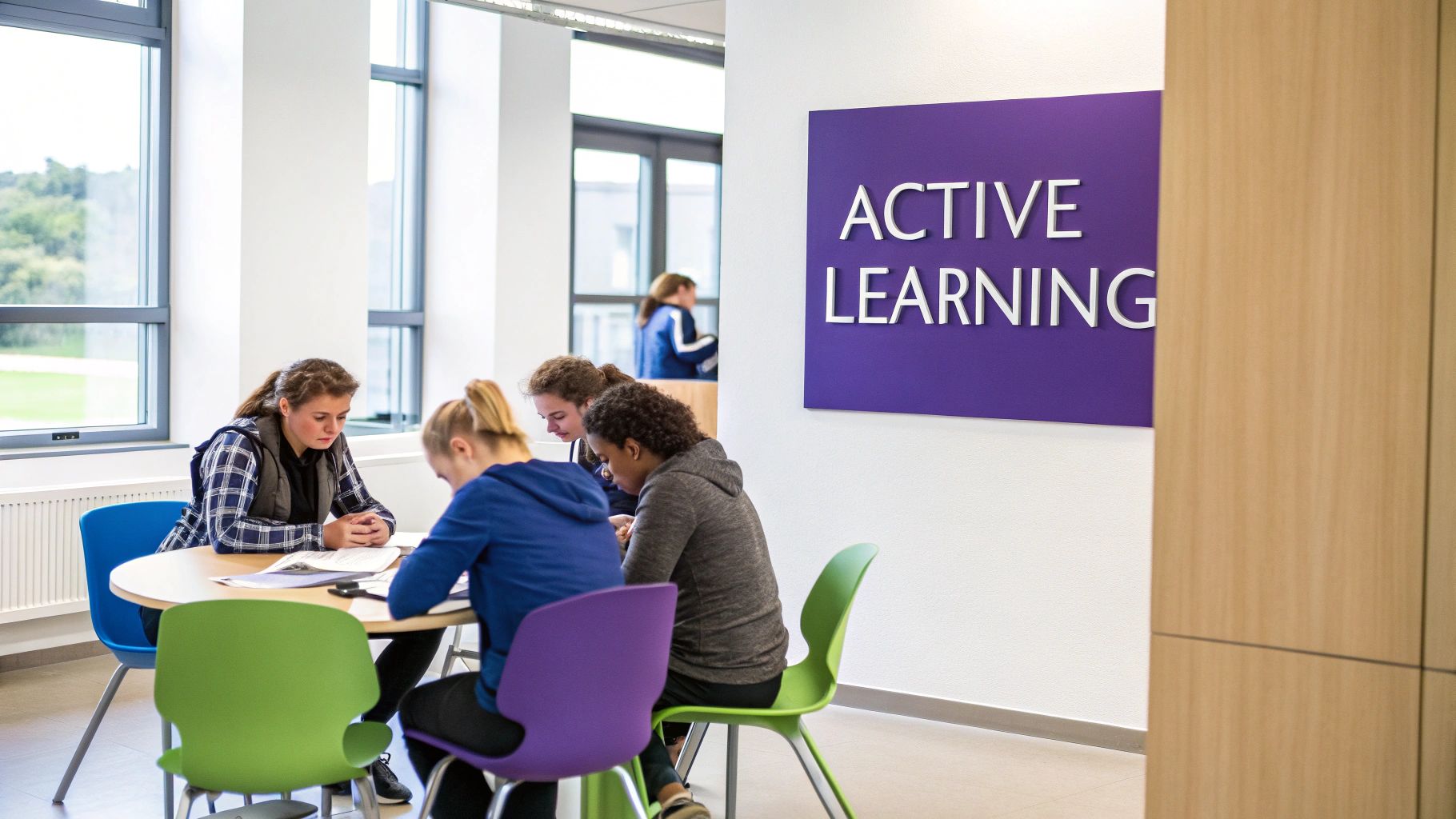
Institutions like MIT have successfully used peer instruction in physics courses, where students grapple with concepts and teach one another, reinforcing their own learning. This method is one of many effective student engagement strategies that prioritize doing over listening.
How to Implement Active Learning
To effectively integrate this approach, consider these actionable steps:
- Start Small: Begin with low-stakes activities like a "think-pair-share," where students consider a question individually, discuss it with a partner, and then share with the larger group. This builds comfort and participation.
- Explain the "Why": Clearly communicate the purpose and benefits of an activity. When students understand how it connects to learning objectives, their buy-in and motivation increase. For more insights, explore these tips on how to motivate students.
- Use Technology: Leverage real-time engagement tools like Poll Everywhere or Kahoot for quick comprehension checks, formative assessments, or to simply energize the classroom.
- Incorporate Movement: Whenever possible, get students moving. Gallery walks, where students rotate through stations to respond to prompts, can break up long sessions and stimulate different ways of thinking.
https://www.youtube.com/embed/xxVxgQJwV7w
2. Gamification of Learning
Gamification applies game design elements like points, badges, and leaderboards to educational contexts to boost student motivation and participation. This strategy leverages the natural human enjoyment of play, competition, and achievement to make learning more compelling. It transforms academic tasks into engaging challenges, fostering perseverance and a positive attitude toward complex subjects.
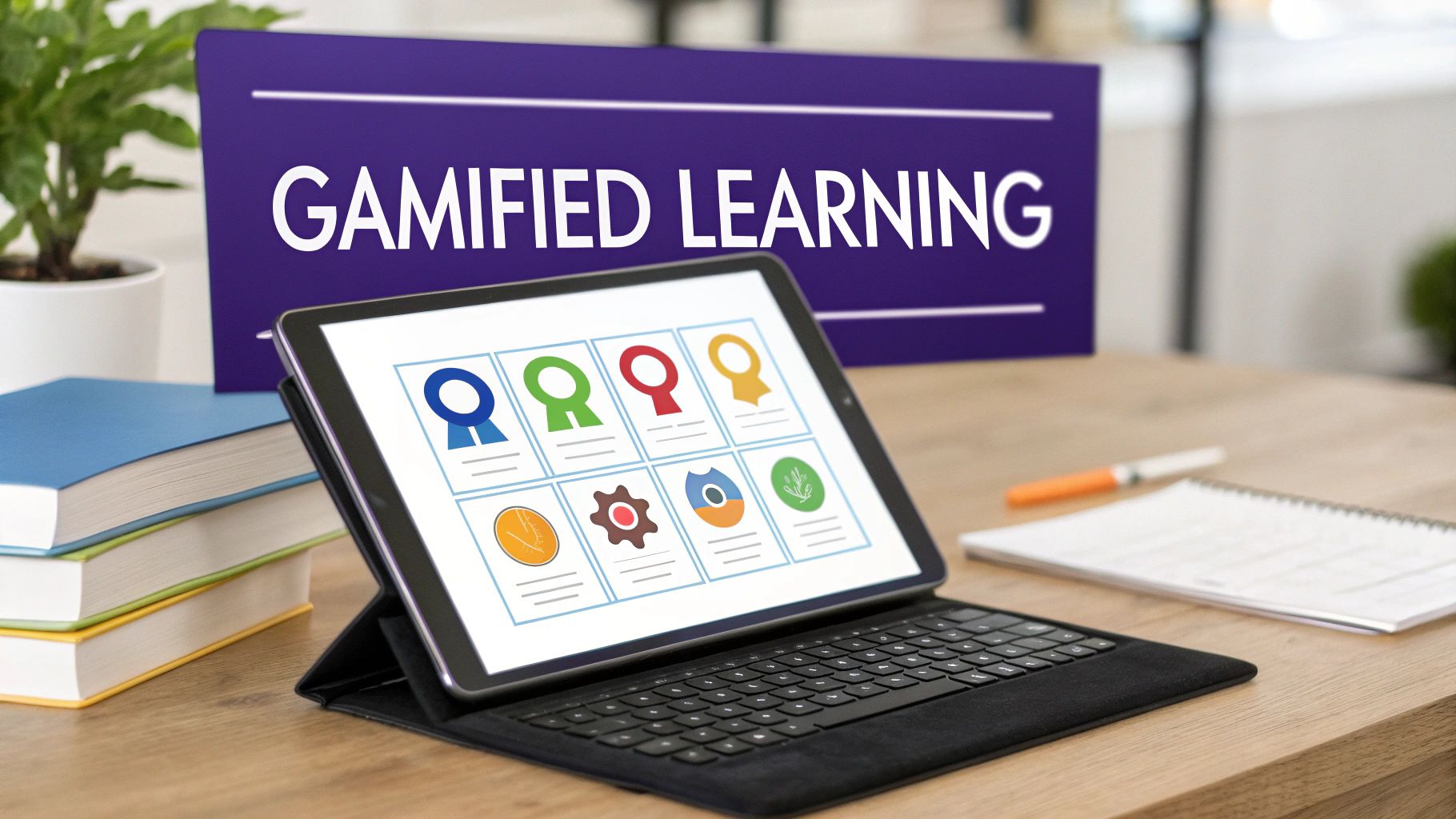
Popular platforms like Duolingo have perfected this model for language learning, using streaks and experience points (XP) to encourage daily practice. Similarly, Khan Academy's mastery-based system awards badges for skill proficiency, providing tangible rewards for progress. These student engagement strategies show that well-designed game mechanics can significantly enhance learning outcomes.
How to Implement Gamification
To effectively gamify your course or program, consider these practical steps:
- Align with Objectives: Ensure every game element, from quests to leaderboards, directly supports a specific learning objective. The game should enhance the educational experience, not distract from it.
- Balance Competition and Collaboration: While leaderboards can motivate some, they may discourage others. Incorporate team-based challenges and collaborative quests where students must work together to succeed.
- Visualize Progress: Use progress bars, level-up systems, or skill trees to give students a clear visual representation of their advancement. Seeing how far they have come is a powerful motivator to continue.
- Provide Meaningful Feedback: Use game mechanics to deliver instant, constructive feedback. For instance, when a student answers incorrectly, a "quest" could pop up guiding them to the relevant learning material for review.
3. Flipped Classroom Model
The flipped classroom model revolutionizes the traditional educational structure by shifting direct instruction from the group learning space to the individual learning space. Core content is delivered to students outside of class, typically through pre-recorded videos or assigned readings, freeing up valuable class time for more dynamic, collaborative, and application-based activities. This approach transforms the instructor's role from a "sage on the stage" to a "guide on the side," fostering deeper student engagement strategies. Pioneered by educators like Jonathan Bergmann and Aaron Sams, this model gained significant traction with the rise of resources like Khan Academy. It has been successfully implemented in diverse settings, from Clintondale High School's school-wide adoption to advanced physics courses at the University of Colorado Boulder, demonstrating its versatility and impact on student outcomes.
How to Implement a Flipped Classroom
To successfully flip your course, focus on making both the pre-class and in-class components meaningful:
- Keep Pre-Class Content Concise: Create or curate short, focused instructional videos, ideally between 8 and 12 minutes. This respects students' attention spans and makes the content more digestible.
- Establish Accountability: Use low-stakes "entrance tickets" or brief online quizzes to ensure students complete the pre-class work. This preparation is essential for the in-class activities to succeed.
- Design Active In-Class Experiences: Plan activities that require students to apply, analyze, or evaluate the concepts they learned independently. This could include problem-solving sessions, group projects, debates, or lab work.
- Provide Clear Instructions: Explicitly state what students are expected to do before class and how that preparation will be used during class. This clarity helps manage expectations and improves student buy-in.
4. Collaborative Learning
Collaborative learning moves beyond individual effort by structuring activities where students work together to achieve shared goals. This method emphasizes peer interaction, mutual responsibility, and the co-creation of knowledge. By engaging in teamwork to solve problems or complete complex tasks, students develop crucial communication, negotiation, and leadership skills alongside academic content.
Pioneered by researchers like David and Roger Johnson, this approach has proven its value across disciplines. For example, the Jigsaw method, developed by Elliot Aronson, is highly effective in social studies for ensuring every student becomes an expert on one piece of a topic and teaches it to their peers. These dynamic student engagement strategies promote deeper learning and foster a sense of community, which can significantly impact student success. Explore how these strategies contribute to improving student retention through engagement.
How to Implement Collaborative Learning
To build a successful collaborative environment, follow these structured steps:
- Establish Clear Group Norms: Before starting a task, co-create guidelines with students for respectful communication, equitable participation, and conflict resolution. This sets a foundation for productive teamwork.
- Assign and Rotate Roles: Define specific roles within each group, such as a facilitator, a note-taker, a timekeeper, or a reporter. Regularly rotating these roles ensures every student develops a range of skills.
- Use Individual and Group Accountability: Design tasks where each member is responsible for a specific component (individual accountability) that contributes to the final group product (group accountability). This prevents social loafing.
- Teach Collaboration Skills Explicitly: Do not assume students already know how to work together effectively. Dedicate time to teaching skills like active listening, giving constructive feedback, and reaching a consensus.
5. Personalized Learning
Personalized learning revolutionizes the traditional one-size-fits-all classroom by tailoring educational experiences to individual student needs, interests, and learning preferences. This student-centered approach leverages data and technology to customize the pace, content, and instructional methods for each learner. By shifting focus from a standardized curriculum to an individual's journey, personalized learning fosters deeper engagement and a stronger sense of ownership over one's education. Pioneering models like the Khan Academy's mastery-based system have shown how this strategy empowers students to learn at their own speed, ensuring they grasp foundational concepts before moving forward. This approach is one of the most powerful student engagement strategies because it makes learning directly relevant and responsive to each student.
How to Implement Personalized Learning
To effectively integrate this dynamic approach, consider these actionable steps:
- Start with Clear Objectives: Establish clear, non-negotiable learning standards for the course. Personalization is about the path to mastery, not changing the destination.
- Use Formative Data: Regularly use low-stakes quizzes, exit tickets, and in-class observations to gather data on student progress. This information is crucial for adjusting individual learning paths in real time.
- Provide Multiple Pathways: Offer students various ways to learn content and demonstrate their understanding. This could include video lectures, readings, collaborative projects, or hands-on labs.
- Balance Tech and Human Interaction: While adaptive learning platforms like DreamBox are powerful, they should supplement, not replace, instructor guidance. Use technology for practice and data-gathering, freeing up class time for high-impact, one-on-one and small-group support.
6. Project-Based Learning (PBL)
Project-Based Learning (PBL) shifts education from short-term memorization to long-term engagement by immersing students in complex, authentic challenges. This powerful pedagogical model requires students to investigate real-world problems over an extended period, applying knowledge, collaborating with peers, and producing a tangible public product or presentation. PBL drives deep learning by making academic content relevant to students' lives and future careers. The success of institutions like the New Tech Network demonstrates the effectiveness of this approach. Their entire curriculum is built around projects that require students to master both academic content and essential skills like critical thinking and collaboration. This model is one of the most comprehensive student engagement strategies because it integrates multiple skills into a single, meaningful experience.
How to Implement Project-Based Learning
To successfully integrate PBL into your curriculum, follow these structured steps:
- Begin with the End in Mind: Start by defining the key learning objectives and skills you want students to master. Design an authentic problem or challenge that requires them to apply this knowledge and create clear success criteria from the outset.
- Establish Structured Checkpoints: Break down large, complex projects into smaller, manageable milestones. Regular check-ins, peer feedback sessions, and draft reviews ensure students stay on track and allow for timely instructor intervention.
- Teach Project Management Skills: Don't assume students know how to manage a long-term project. Explicitly teach skills like time management, task delegation, and effective collaboration. Provide tools and templates to help them organize their work.
- Connect with the Community: Whenever possible, involve community partners or industry experts. This adds a layer of authenticity and gives students a real-world audience for their work, significantly boosting motivation and engagement.
https://www.youtube.com/embed/LMCZvGesRz8
7. Inquiry-Based Learning
Inquiry-based learning places students in the role of investigators, empowering them to ask questions, explore problems, and construct their own knowledge. This student-centered approach shifts the focus from receiving answers to discovering them, fostering natural curiosity and critical thinking. Instead of presenting established facts, educators pose authentic problems or phenomena, guiding students through a process of investigation and discovery. This method champions the idea of "learning by doing," a philosophy advocated by educators like John Dewey. For instance, in a history course, rather than memorizing dates from a textbook, students might analyze primary source documents to build their own interpretations of a historical event. This active process is a powerful student engagement strategy because it makes learning relevant and personally meaningful, boosting both motivation and comprehension.
How to Implement Inquiry-Based Learning
To effectively integrate this approach, consider these actionable steps:
- Start with a Hook: Begin with a compelling question, a puzzling observation, or an engaging real-world problem. This "engage" phase, the first step in the popular 5E Model (Engage, Explore, Explain, Elaborate, Evaluate), is crucial for capturing student interest.
- Provide Scaffolding: Equip students with the necessary tools for investigation. This might involve teaching research skills, demonstrating how to use lab equipment, or providing graphic organizers to help structure their thinking and evidence-gathering.
- Encourage Diverse Perspectives: Structure activities, like Socratic seminars, that require students to consider multiple viewpoints and defend their own conclusions with evidence. This teaches them that complex questions rarely have a single, simple answer.
- Balance Guidance and Freedom: Gradually move from guided inquiry, where the instructor provides significant structure, to more open or independent inquiry as students build confidence and skills. This ensures they feel supported but not constrained.
8. Technology-Enhanced Learning
Technology-Enhanced Learning (TEL) integrates digital tools, platforms, and resources to support and enrich educational experiences. This approach moves beyond simply using technology as a substitute for traditional methods, instead leveraging it to create more interactive, accessible, and personalized learning environments that can significantly boost student engagement strategies. Educators utilize TEL to design dynamic activities that cater to diverse learning styles. For instance, using tools like Flipgrid for video discussions allows students to articulate their thoughts more deeply than in a text-based forum, while platforms like Padlet facilitate real-time, anonymous brainstorming, encouraging participation from even the most reserved students.
How to Implement Technology-Enhanced Learning
To effectively integrate TEL and make it a cornerstone of your teaching, consider these actionable steps:
- Align with Objectives: Always choose technology that directly supports your learning goals. A tool should enhance the pedagogical approach, not just add a layer of complexity. The SAMR model by Ruben Puentedura is an excellent framework for this.
- Prioritize Accessibility: Ensure that all students have equitable access to the required technology and provide necessary support. This includes considering bandwidth limitations, device availability, and digital literacy levels.
- Start Simple, Build Complexity: Begin with straightforward, user-friendly tools like Google Classroom for assignments or Kahoot for quizzes. As you and your students become more comfortable, you can introduce more advanced platforms like Minecraft Education Edition for immersive problem-solving.
- Provide Clear Guidelines: Establish and communicate clear expectations for digital citizenship and online behavior. This creates a safe and productive virtual learning space. To better understand this shift, you can learn more about the digital transformation in higher education.
9. Culturally Responsive Teaching
Culturally Responsive Teaching is a pedagogical approach that recognizes, respects, and leverages students' diverse cultural backgrounds, experiences, and perspectives within the learning environment. This strategy validates students' identities by connecting curriculum and instruction to their lives, which builds bridges between what they learn in school and who they are. By acknowledging and integrating students' cultural capital, educators create a more inclusive and equitable classroom where all students feel seen, valued, and empowered to succeed. This approach is one of the most powerful student engagement strategies for fostering a true sense of belonging. Pioneers like Gloria Ladson-Billings and Geneva Gay have shown that when education is culturally affirming, students become more invested participants. For example, successful ethnic studies programs in California schools have demonstrated increased academic engagement and graduation rates by centering curricula on the histories and contributions of diverse cultural groups.
How to Implement Culturally Responsive Teaching
To effectively integrate this approach, consider these actionable steps:
- Learn About Your Students: Go beyond surface-level information. Take the time to understand your students' cultural backgrounds, traditions, communication styles, and lived experiences through informal conversations, surveys, or introductory activities.
- Diversify Your Curriculum: Actively review and revise your course materials. Incorporate texts, research, and media from authors and creators who represent a wide range of cultures, ethnicities, and viewpoints, not just as a special topic but integrated throughout the course.
- Use Culturally Relevant Examples: Connect abstract concepts to students' lives. Use analogies, case studies, and real-world problems that resonate with their cultural and community contexts to make learning more meaningful and accessible.
- Foster Inclusive Classroom Dialogue: Establish classroom norms that encourage students to share their unique experiences and perspectives respectfully. Position students as experts on their own lives and create opportunities for them to teach and learn from one another.
Student Engagement Strategies Comparison Matrix
| Learning Approach | Implementation Complexity 🔄 | Resource Requirements ⚡ | Expected Outcomes 📊 | Ideal Use Cases 💡 | Key Advantages ⭐ |
|---|---|---|---|---|---|
| Active Learning Strategies | Moderate to High (preparation + training) | Moderate (technology tools, materials) | Improved retention (+10-15%), critical thinking, motivation | Small to medium classes, discussion-heavy environments | Enhances engagement, accommodates diverse styles, immediate feedback |
| Gamification of Learning | High (design, integration of game mechanics) | High (platforms, design resources) | Increased motivation and engagement, fun learning | Digital native audiences, motivation challenges | Boosts intrinsic motivation, offers instant feedback and recognition |
| Flipped Classroom Model | Moderate to High (content creation upfront) | Moderate (video tools, LMS) | Self-paced learning, more interaction time, accountability | Blended learning, flipped/hybrid classrooms | Maximizes face-to-face interaction, personalized learning experiences |
| Collaborative Learning | Moderate (group setup and management) | Low to Moderate (group materials) | Interpersonal skills, peer learning, engagement | Group projects, teamwork skills development | Builds communication, exposes diverse perspectives, teamwork skills |
| Personalized Learning | High (technology, data systems) | High (adaptive tech, training) | Tailored pacing, improved outcomes, learner ownership | Diverse learner needs, technology-rich environments | Addresses individual differences, supports custom learning paths |
| Project-Based Learning (PBL) | High (planning, scaffolding, assessment) | Moderate to High (time, materials) | 21st-century skills, motivation, deep learning | Real-world problem solving, interdisciplinary themes | Promotes relevance, deep understanding, project management skills |
| Inquiry-Based Learning | Moderate to High (facilitation skill needed) | Low to Moderate (resources vary) | Critical thinking, curiosity, self-directed learning | Science, research-focused, higher-order thinking areas | Develops research skills, encourages curiosity, mirrors real-world problems |
| Technology-Enhanced Learning | High (infrastructure, support required) | High (devices, platforms, maintenance) | Accessibility, engagement, personalized learning | Digital classrooms, remote/hybrid learning | Enhances accessibility, immediate feedback, prepares digital natives |
| Culturally Responsive Teaching | Moderate to High (knowledge, PD) | Low to Moderate (curriculum redesign) | Engagement, positive identity, improved achievement | Diverse classrooms, equity-focused environments | Builds cultural competence, inclusivity, supports marginalized students |
Putting It All Together: Scaling Engagement for Lasting Impact
We've explored a comprehensive toolkit of student engagement strategies, moving far beyond traditional lecture formats. From the dynamic, hands-on nature of Active Learning and Project-Based Learning to the intellectual curiosity sparked by Inquiry-Based Learning, the path to a more engaging educational experience is varied and rich with opportunity. We've seen how flipping the classroom can maximize in-person time for meaningful interaction and how gamification can tap into students' intrinsic motivation. The core principle connecting these diverse approaches is a fundamental shift in perspective. True engagement isn’t a gimmick or an add-on; it’s about designing learning environments that are inherently participatory, relevant, and responsive to student needs. It involves recognizing students not as passive recipients of information but as active co-creators of knowledge.
Key Takeaways for Your Institution
As you consider implementing these strategies, keep these foundational pillars in mind:
- Intentional Design is Crucial: Effective engagement doesn't happen by accident. Whether adopting a fully Flipped Classroom model or integrating technology-enhanced tools, success depends on careful planning and clear learning objectives.
- Flexibility is a Strength: No single strategy fits all courses, subjects, or student populations. The most effective educators build a versatile repertoire, blending approaches like collaborative learning with personalized feedback to meet the dynamic needs of their classrooms.
- Authenticity Drives Connection: Culturally Responsive Teaching underscores the need for genuine connection. When students see their experiences and backgrounds reflected and valued in the curriculum, their motivation to engage deepens significantly.
Actionable Next Steps
Transforming theory into practice requires a measured, strategic approach. Don't feel pressured to implement everything at once. Instead, start small and build momentum.
- Select One or Two Strategies: Choose the approaches that best align with your course objectives and institutional resources. Perhaps begin by introducing a single Project-Based Learning module or experimenting with a gamified review session.
- Gather Feedback Continuously: How are students responding? Use simple polls, brief surveys, or informal check-ins to gauge the effectiveness of new initiatives. Just as researchers refine their methods, exploring general strategies to boost engagement can offer transferable insights for improving feedback mechanisms in the classroom.
- Collaborate and Share: Connect with colleagues who are also experimenting with new student engagement strategies. Sharing successes, challenges, and resources can accelerate learning and foster a campus-wide culture of pedagogical innovation.
Ultimately, mastering these student engagement strategies is about more than just improving attention in a single course. It’s about cultivating lifelong learners, critical thinkers, and future leaders. By building an educational ecosystem that prioritizes active participation, personalization, and collaboration, you create an environment where students don't just learn, they thrive. This commitment is the cornerstone of boosting retention, improving academic outcomes, and fulfilling the core mission of higher education.
Ready to scale your student engagement efforts beyond the classroom? Motimatic uses AI-powered messaging to deliver personalized, timely nudges that motivate students at critical points in their journey, from enrollment to graduation. Discover how you can boost persistence and success by visiting Motimatic today.
See it on your own listOne list, one goal, and a randomized holdout to show the lift. Start a pilot